
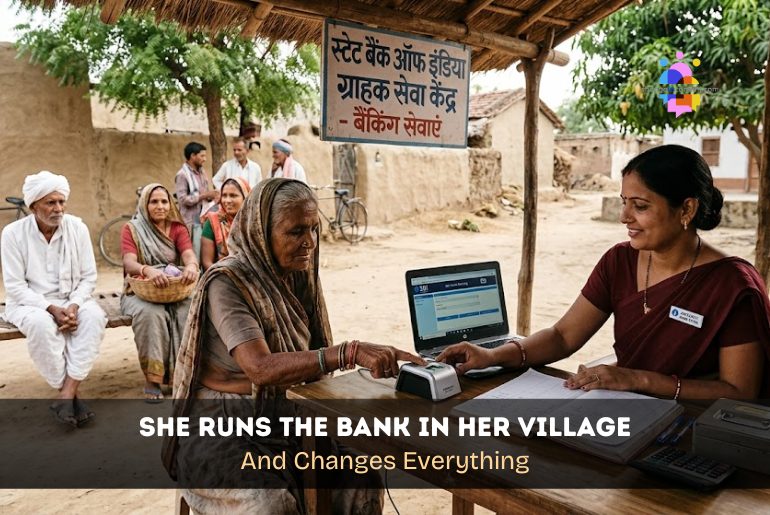
Women-led banking points are emerging as one of the most quietly powerful shifts in India’s financial inclusion story. Across villages where bank branches remain distant and digital literacy is uneven, these small, localised service centres (often run by women) are becoming the bridge between formal finance and everyday life. They are not just facilitating transactions. They are reshaping behaviour, trust, and access at the grassroots level.
But it is not merely a rural banking story. It is a deeper lesson in leadership, inclusion, and systems design. When women get access, authority, and opportunity, they do not just participate. They transform outcomes. What we are witnessing through these banking points is not a trend, but a proof of concept.
Understanding women-led banking points: What they are and why they matter
Women-led banking points operate under India’s Banking Correspondent (BC) model. The model aims to extend banking services to underserved regions where traditional branches cannot reach. These Customer Service Points (CSPs) function as last-mile outlets. They offer services such as account opening, cash withdrawal and deposit, fund transfers, bill payments, and access to government schemes.
In practical terms, it means a villager no longer needs to travel miles to a bank branch or depend on informal moneylenders. Instead, there is a familiar, accessible face within the community who can explain, assist, and execute financial transactions.
According to reports and sector data, India has over 13 lakh Banking Correspondents, forming one of the largest last-mile financial networks in the world. However, despite this scale, women still account for a relatively small share, estimated at around 18%-22% across several private networks.
That gap is precisely why the rise of women-led banking points matter.
From financial exclusion to financial confidence
The shift from informal money systems to formal banking is not just an economic one. It is deeply social.
In many rural regions, access to money has historically been controlled by informal lenders who operate without transparency. These informal leaders often impose exploitative conditions. The presence of local banking points disrupts that system. It introduces accountability, structure, and awareness.
Women-led banking points amplify that shift further. They do not just enable access, but enable understanding.
Consider the story of Sangeeta Jain from Gwalior, a polio-affected entrepreneur who runs a banking kiosk serving nearby rural areas. ‘Transaction’ alone does not define her work. Translation defines it. She explains what interest means, why savings matter, and how financial decisions impact families.
“I did not start this to run a business. I started because I saw how easily people were misled about money,” she says. “When you understand money, you stop being afraid of it.”
That is the real transformation. It is not about opening accounts, but about removing fear.
Why women-led banking points build more trust
Data and field observations consistently highlight a pattern: women agents tend to build greater trust, especially among female customers.
There are several reasons for this.
- First, familiarity. Women in rural communities often feel more comfortable approaching another woman, especially for discussions around savings, loans, or household finances.
- Second, communication style. Women agents tend to spend more time explaining services, which improves understanding and adoption.
- Third, social proximity. Unlike distant institutions, these agents are part of the same ecosystem. Their credibility is not built through branding. It is built through relationships.
This trust translates into measurable outcomes. Higher account usage. Better repayment behaviour. Increased adoption of insurance and savings products.
In other words, inclusion improves performance.
The economics behind women-led banking points
The financial model of these banking points is evolving.
Earlier, many CSPs relied heavily on government-linked transactions such as pensions and subsidies. Today, revenue streams are diversifying. Agents now earn through:
- Remittances
- Micro-insurance services
- Loan facilitation
- Digital payments
- Utility services
Income levels vary significantly based on location and activity. Reports suggest women CSP operators earn ₹8,000 to ₹15,000 per month in rural areas. That goes up to ₹15,000 to ₹30,000 or more in semi-urban markets.
While these numbers may not seem large in urban contexts, they are significant in rural economies. More importantly, they represent independent, self-earned income, which has ripple effects on household decision-making, education, and long-term financial stability.
The challenges that still exist
The story is not without friction.
According to Reserve Bank of India data, the number of banking correspondent outlets declined by over 2 lakh in a single year. That raises concerns about sustainability and attrition.
The reasons are structural:
- Low transaction volumes in some regions.
- High dependency on ecosystem support.
- Operational challenges and limited financial literacy among customers.
- Family responsibilities that pull women out of work.
- Attrition rates are estimated at around 10% annually, particularly in early stages before the business stabilises.
There are also concerns around fraud and oversight, given that CSPs handle cash and sensitive financial data. To mitigate this, systems now include biometric authentication, KYC checks, transaction monitoring, audits, and regulatory oversight.
These challenges are real. But they are not unique to women-led models. Instead, these are systemic issues within last-mile financial delivery.
Women-led banking points as a leadership lesson
That is where the story moves beyond banking.
Women-led banking points are not just solving a financial access problem. They are offering a blueprint for leadership and system design.
They demonstrate that:
- Access is not enough. Support must follow.
- Representation is not symbolic. It changes outcomes.
- You cannot build trust through systems alone. You have to build it through people.
For organisations, this becomes a powerful metaphor.
If a rural banking system can improve performance by enabling women to lead at the last mile, what does that say about boardrooms, leadership teams, and operational structures?
The resistance to women in leadership roles often hides behind arguments of capability, scale, or risk. The reality is simpler. When given responsibility, women deliver. Often with greater resilience and community impact.
Connecting financial inclusion to structural inequality
The importance of formal banking access also ties directly to broader issues of financial vulnerability and exploitation. We have previously explored how the lack of financial awareness and access exposes women to exploitative lending systems in India.
Women-led banking points act as a preventive layer against such exploitation. They bring transparency, documentation, and informed decision-making into spaces where informal systems once dominated.
This is not just financial inclusion. It is financial protection.
The Changeincontent perspective
At Changeincontent, we see women-led banking points as more than a policy success or a rural innovation. We see them as evidence. Evidence that inclusion is not a social obligation alone. It is a strategic advantage.
For governments, the lesson is clear. Programmes like BC Sakhi are not welfare schemes. They are infrastructure investments in trust and accessibility.
For organisations, the takeaway is sharper. Inclusion cannot remain a narrative. It must be embedded in how systems are designed, who is empowered, and how decisions are made.
For society, the message is uncomfortable but necessary. The question is no longer whether women can lead. The question is why systems still hesitate to let them.
Conclusion: Women-led banking points are not the future. They are the proof.
The story of women-led banking points is not about technology, policy, or even finance alone.
- It is about proximity, trust, and leadership.
- It is about a woman sitting at a small desk in a village, helping someone understand money for the first time.
- It is about replacing fear with clarity. Dependence with agency. Silence with participation.
And in doing so, it answers a much larger question. What happens when women are given the space to lead?
The answer is already visible. We just need to pay attention.
Disclaimer: The views expressed in this article are based on the writer’s insights, supported by data and resources available both online and offline, as applicable. Changeincontent.com is committed to promoting inclusivity across all forms of content. We broadly define inclusivity in terms of media, policies, law, and history. It encompasses all elements that influence the lives of women and marginalised individuals. Our goal is to promote understanding and advocate for comprehensive inclusivity.
