
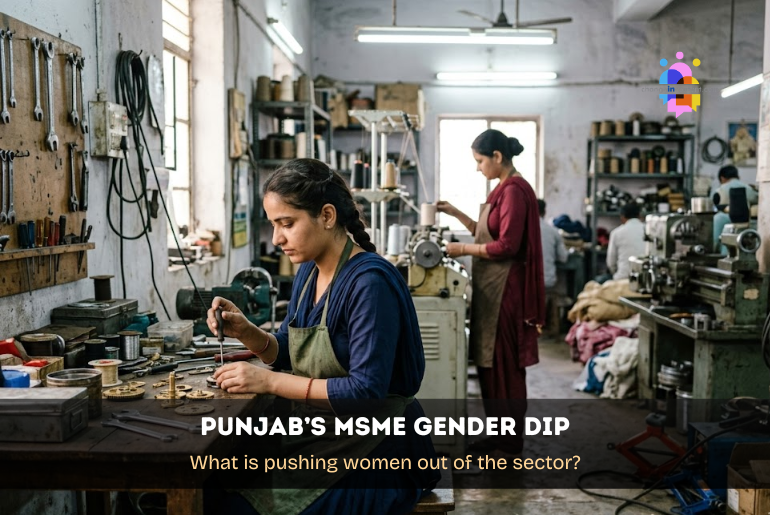
Female employment in the MSME sector has become a major concern in Punjab after the latest figures showed a steep decline in women’s participation in the sector. According to data cited in a recent parliamentary reply and reported by The Economic Times, female employment in Punjab’s MSMEs, as recorded on the Udyam Registration portal, stood at 3.53 lakh by February-end in FY 2025–26, down from 8.40 lakh in FY 2024–25. That points to a decline of more than 50%. It even allows for the fact that the March data was still not reflected at the time of reporting.
We do not see this as a story about singling out Punjab for blame. It is a story about recognising what the numbers may be telling us. When a state that had seen a steady rise in women’s MSME participation between 2020–21 and 2024–25 suddenly records such a sharp drop, the right response is not outrage alone. It is careful questioning. What changed? What barriers are surfacing more sharply? And what will it take for the state, for MSMEs, and for women themselves, to ensure that this gap does not deepen into a structural retreat?
What do the latest numbers on female employment in the MSME sector show?
The most immediate headline is the decline in women’s jobs within Punjab’s MSME ecosystem.
The female employment in Punjab’s micro, small and medium enterprises fell from 8.40 lakh in 2024–25 to 3.53 lakh by February 28, 2026. Over the same period, Punjab also recorded a fall in women-owned MSMEs.
In 2024–25, the state had 5.76 lakh MSMEs in total, of which 2.18 lakh, or roughly 37%, were women-owned. By the end of February in the current fiscal, total registrations had come down to 4.13 lakh. Women-owned enterprises fell to 1.36 lakh, or around 33%.
What about the nearby states?
The contrast with nearby states makes the picture sharper.
- Haryana saw female MSME employment rise from 4.16 lakh to 4.92 lakh, an increase of 18.27%.
- Jammu and Kashmir moved up slightly from 1.44 lakh to 1.51 lakh over the same period.
Himachal Pradesh and Chandigarh also saw declines, but the Punjab drop remains the most striking among the states cited in the report.
The national picture of female employment in the MSME sector
Nationally, the broad direction was different.
According to the same parliamentary response, female employment in MSMEs across India rose from 2.04 crore in 2024–25 to 2.13 crore as of February 28, 2026. At the same time, the country’s total number of women-owned enterprises registered on the Udyam Registration Portal and Udyam Assist Platform stood at more than 3.07 crore by February 28, 2026.
Why we must not read the drop in female employment in MSME casually
It would be easy to read the Punjab numbers as a one-year fluctuation. But that would miss the significance of what came before.
The same parliamentary reply notes that Punjab had recorded a continuous increase in female MSME employment from 1.43 lakh in 2020–21 to 8.4 lakh in 2024–25. Women-owned MSMEs in the state had also grown sharply over those years, from 13,671 in 2020–21 to 2.18 lakh by 2024–25.
That longer trajectory matters because it means the current fall is not happening in a vacuum. It follows a period of rapid expansion. In other words, the issue is not that Punjab never saw women entering the MSME sector. It did. The harder question is why that momentum now appears fragile.
The response from the CII Punjab State Council
One explanation raised in the reporting is that 2024–25 may have reflected an exceptional post-COVID labour market phase. Ashpreet Sahni of the CII Punjab State Council suggested that labour shortages after the pandemic may have pushed more women into previously male-dominated roles, and that the subsequent dip may partly reflect normalisation.
Even if that is true, the argument does not fully answer the core problem. If women enter the MSME ecosystem only when labour shortages force the issue, then the system was never inclusive to begin with.
The structural issues the numbers are pointing to
The most useful value lies not in the numbers alone, but in the explanations offered by people close to industry.
The safety concerns
Safety and logistics were among the first concerns raised. Sahni reportedly pointed out that the new industry in Punjab is increasingly moving to the outskirts. That is because the existing industrial focal points become congested. At the same time, people perceive the standalone or peripheral industrial locations as unsafe for women. Concerns around crime and mobility, including risks such as snatching and insecure commuting conditions, were cited as deterrents.
That is not a small point. Women’s economic participation is often discussed as if it begins with jobs. In reality, it often begins with safe access to those jobs. If industrial growth shifts outward but transport, lighting, last-mile safety, and women-friendly work infrastructure do not keep pace, then participation becomes selective. The opportunity exists on paper, but not equally in practice.
The credit barrier
Credit was another likely barrier. The same reporting notes concerns that banks remain hesitant to lend to women without collateral. Unfortunately, the government has not acted aggressively enough to close that financing gap. It matters because female employment in MSMEs and women-owned MSMEs are connected.
When fewer women can start or sustain their own enterprises, the ecosystem also loses some of its strongest channels for women’s hiring, mentoring, and ownership-led participation.
The support gap
Industry voices also pointed to a lack of support infrastructure. CICU president Upkar Singh Ahuja reportedly argued for more women’s hostels near industrial hubs and dedicated bus services from villages. That suggestion deserves attention because it recognises the problem as systemic rather than individual.
Women do not stay out of work simply because they “lack confidence.” They stay out when the ecosystem around work is not built for them.
Could the data itself be incomplete?
There is also a procedural angle that one cannot ignore.
A senior Punjab government official suggested that the numbers may have been affected by technical issues with the Udyam Registration portal. He says that the the portal was reportedly down for around a month and a half.
Since certain state incentives are linked to portal data, the official suggested that some enterprises may not yet have uploaded their latest figures. Another district-level official, however, noted that registrations are based on self-declaration and are not strictly department-endorsed.
It does not invalidate the trend, but it does add caution. The drop may be real, but the degree of the drop may still need verification once the full fiscal-year numbers are available. That is an important distinction.
Good journalism should not flatten uncertainty where uncertainty exists. The more useful question, then, is not whether the current data is perfect. It is whether Punjab’s MSME system is resilient enough to withstand exactly these kinds of shocks, reporting gaps, and underlying structural pressures.
What Punjab’s numbers say about the broader women-in-business challenge
Punjab’s situation lies within a broader national contradiction.
India has seen large gains in formalisation through Udyam registration, and women-led enterprises now number in the crores. Yet women remain unevenly distributed across access to credit, safety, infrastructure, leadership, and enterprise scale.
The Economic Survey 2024–25 noted that while women account for over 50% of India’s artisans, only around 22% of MSMEs are women-owned.
That mismatch should sound familiar. Women are present in work, but not always in ownership. They are present in labour, but not always in capital. Similarly, they are visible in participation, but not always in the systems that define business survival.
We have examined this larger terrain earlier in our article on women-owned MSMEs in India. That remains relevant to Punjab’s current story because it asks the same foundational question: what does it take to move from presence to sustained participation?
What the state, organisations, and women themselves can take from this
If Punjab wants to prevent this drop from becoming a pattern, three sets of responses will matter.
What the state can do
The first response lies with the state. Policy cannot stop at the promotion of women’s entrepreneurship in abstract terms. If industrial areas are moving outward, then mobility and safety infrastructure must move outward too. Hostels, safe transport, functional lighting, and localised women-support systems are not side issues. They are labour participation architecture.
MSMEs and Industry Bodies
The second lies with MSMEs and industry bodies. Small and medium enterprises often claim that inclusion is hard because margins are tight. That may be true. But some inclusion barriers are not budget-heavy. Safer shifts, cluster transport, women’s grievance systems, and local hiring networks with women’s groups can dramatically change participation patterns when done seriously.
What women’s networks can do
The third lies with women’s networks, collectives, and enterprise support systems themselves. Where women-owned MSMEs weaken, the answer is not to place the burden solely on individual women to “be more ambitious.” It is to build ecosystems of mentorship, financing guidance, market access, and enterprise continuity that reduce the friction of staying in business.
The Changeincontent perspective
At Changeincontent, we do not read Punjab’s decline in female employment in MSMEs as a simple statistical dip. We read it as a warning that women’s economic participation remains fragile when systems are not designed for continuity.
Too often, women’s employment rises when markets need labour and falls when old structural habits return. That is not empowerment. It is dependency disguised as progress.
The more useful lesson here is that equal participation in business does not come from intent alone. It comes from an organised effort. It requires safety, financing, infrastructure, policy follow-through, and a willingness to see women not as supplementary labour, but as central economic actors.
Let us not use the numbers in Punjab to shame the state. We must use them to sharpen the state’s response.
Conclusion: Female employment in MSMEs cannot remain this fragile
Female employment in MSMEs should not rise only when labour shortages demand it and fall when systems return to old defaults. If Punjab’s current trend remains the same in the final data, the issue is larger than just one year’s performance. It is a reminder that women’s participation in enterprise is still too dependent on conditions that can shift quickly.
The question now is not whether Punjab can reverse the dip. The question is whether the state, the MSME ecosystem, and women’s enterprise networks are willing to build the conditions that make women’s participation stable, safe, and worth sustaining.
Disclaimer: The views expressed in this article are based on the writer’s insights, supported by data and resources available both online and offline, as applicable. Changeincontent.com is committed to promoting inclusivity across all forms of content. We broadly define inclusivity in terms of media, policies, law, and history. It encompasses all elements that influence the lives of women and marginalised individuals. Our goal is to promote understanding and advocate for comprehensive inclusivity.
