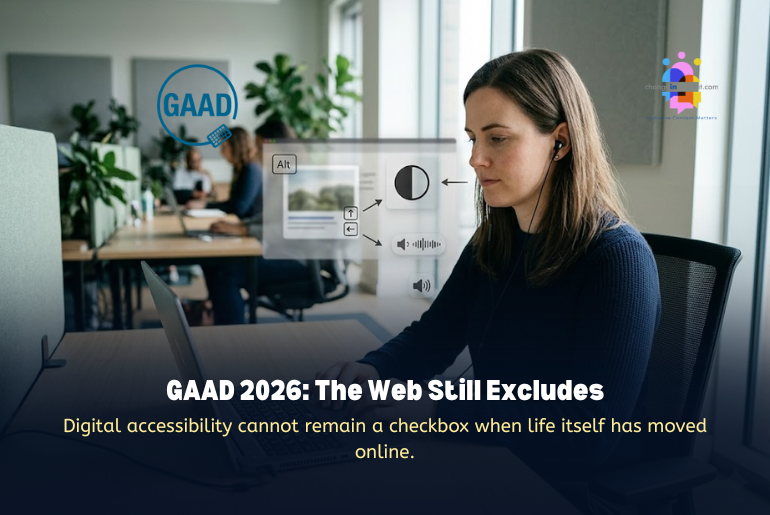
The Global Accessibility Awareness Day (GAAD) is commemorated every year on the third Thursday of May. The 15th Global Accessibility Awareness Day (GAAD) took place on Thursday, May 21, 2026. The day focuses on raising awareness about the experiences of more than one billion people worldwide who live with disabilities or impairments, especially when using digital platforms and technology.
The story behind GAAD
GAAD began as a simple idea in November 2011, when Los Angeles-based web developer Joe Devon wrote a blog post expressing concern about the lack of attention to digital accessibility in the tech industry. He suggested creating a dedicated day to encourage developers and companies to build products that everyone, including people with disabilities, could use.
The idea soon gained support from Jennison Asuncion, an accessibility professional from Toronto, who came across the blog post and connected with Devon through Twitter. Together, they organised the first Global Accessibility Awareness Day on May 9, 2012.
What started as a grassroots effort has now grown into a global movement observed in countries around the world every year. GAAD continues to play an important role in helping people understand why accessible websites, apps, and digital services matter, especially for those who are new to the topic of accessibility and inclusion.
Building a more inclusive digital world starts with awareness
Accessibility is still not seen as essential. Many people assume disability affects only a small group, but globally, more than one billion people live with disabilities. In India alone, Census 2011 recorded 26.8 million persons with disabilities, making up 2.21% of the country’s population.
The report also noted that 2.41% of India’s male population and 2.01% of its female population reported having a disability. These are not small groups. As many as 14.9 million males and 11.9 million females with disabilities in India.
Considering how much India’s population has grown and changed since then, the actual numbers today are likely much higher.
When society, organisations, and even ordinary people think about disability, many still carry a limited understanding, personal bias, and a strong sense of distance from the realities disabled people deal with every day.
For many, accessibility is something they think about only when directly affected by it. There is still a large gap in awareness, along with attitudes influenced by privilege, pride, and lack of exposure to the everyday barriers disabled people face online and offline.
Akhsay Ujawane on GAAD and the need for it
In a candid conversation with ChangeInContent, Akshay Ujawane, Accessibility Consultant at Level Access, spoke about how many spaces still misunderstand accessibility and disability despite their importance.
Akshay says,
It begins with understanding disability. It could be a visual, cognitive, permanent or temporary physical disability, and a motor disability. Accessibility is not just a tick mark. It has to be thought through from the perspective of the person with the condition. Also, there is sometimes the social absence of people with disabilities that makes them invisible. It begins with an audit and inclusive thinking.
With years of experience supporting accessibility testing, compliance, and inclusive digital practices across platforms, Akshay also added that “Change depends on awareness as much as technology. Accessibility improves only when companies, developers, and even everyday users begin to see inclusion as a shared responsibility rather than a niche issue.”
The state of accessibility
The main aim of Global Accessibility Awareness Day is to make accessibility a basic part of technology and digital product development. At the end of the day, technology should work for everyone. Accessibility should be a basic part of how we build websites, apps, and digital platforms from the beginning. Digital accessibility means people with disabilities should be able to use online services, read content, shop, study, work, and communicate independently without running into barriers.
However, accessibility remains a major issue in India’s digital space. Many Indian websites, including e-commerce platforms and even several government websites, are difficult or sometimes impossible for persons with disabilities to use. According to a report by the Centre for Internet and Society, out of 7,800 Government of India websites studied, 5,815 had accessibility barriers, while 1,985 websites failed to open altogether.
There are already global standards for accessibility. The Web Content Accessibility Guidelines (WCAG), created by the World Wide Web Consortium, lay out how websites and digital platforms can work better for everyone, including people with disabilities.
Global websites are failing too.
But the 2025 WebAIM Million Report found that only 5.2% of the world’s top 1 million websites meet basic accessibility standards, while 94.8% still fail to fully comply with current WCAG guidelines. The 2026 report states that 95.9% of home pages had WCAG 2 failures detected. This number increased from 94.8% in 2025.
That says a lot about the state of accessibility online right now. Many websites continue to struggle with common accessibility failures, from missing image descriptions and poor keyboard navigation to unreadable layouts and inaccessible forms.
Also Read: The Power of Allyship: Advancing Disability Inclusion in the Workplace
In many cases, the problem is not refusal but confusion. Many companies and brands still feel overwhelmed by where to begin, how much accessibility might cost, or how to fit it into existing systems. Accessibility illiteracy also remains a major issue, with teams often lacking a basic understanding of inclusive design.
There is clearly a lot more work, awareness, and honest discussion needed around accessibility, and that is exactly why conversations like these continue to matter at ChangeInContent.
The closing thoughts
The internet has become part of almost everything we do today. People study online, book appointments, apply for jobs, order food, use banking apps, and connect with others through digital spaces every single day. But for millions of people with disabilities, many of these experiences still come with barriers that most users never even notice.
GAAD exists because accessibility is still often overlooked. Perhaps that is the biggest takeaway from all of this. People should not have to fight to access spaces that were meant for everyone in the first place. Equal access to digital spaces should be the norm by now.
The good thing, though, is that more people are finally starting to talk about it, question it, and learn from it. That is also where change usually begins.
Editorial note and disclaimer
This article is part of Changeincontent’s Knowledge Hub section, where we examine inclusion, accessibility, disability rights, workplace systems, and digital equity through an evidence-led editorial lens.
The article draws on publicly available information about Global Accessibility Awareness Day, Census 2011 disability data, the Rights of Persons with Disabilities Act, accessibility research from WebAIM, findings from the Centre for Internet and Society, and an interview conducted by Changeincontent with Akshay Ujawane, Accessibility Consultant at Level Access.
The article is intended for public awareness and editorial discussion, not as legal, technical, or compliance advice. Organisations should consult qualified accessibility professionals for audits, remediation, and WCAG compliance work.