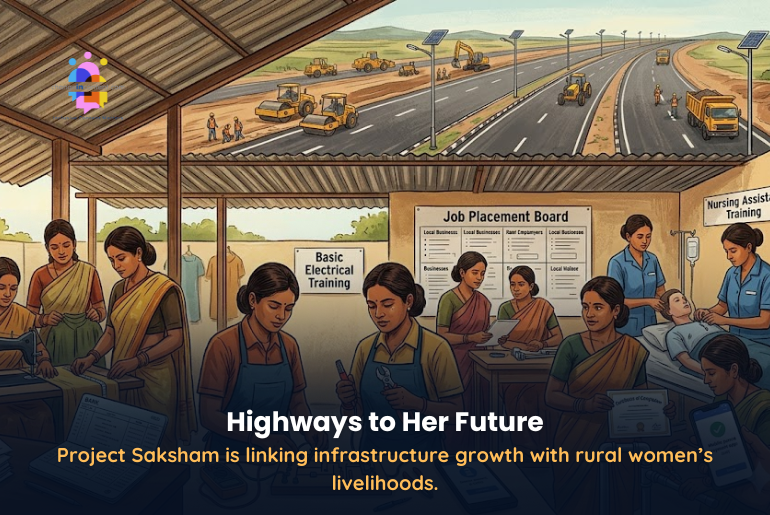
Project Saksham by NHAI is not only a skill development initiative. It is a quiet attempt to answer a bigger policy question: when highways bring economic growth to a region, do the women living around those highways get to participate in that growth?
The National Highways Authority of India, in partnership with the Vertis Foundation, is using Project Saksham to provide structured skill development, employment support and pathways to financial independence for rural women and underserved youth.
According to the Ministry of Road Transport and Highways, the initiative currently operates through 12 training centres across the country and has trained more than 6,000 youth, with over 4,000 beneficiaries placed across sectors. Women make up more than 80% of the programme’s beneficiaries.
For a country where women’s employment remains a serious concern, this is not a small policy signal. The latest PLFS analysis by Changeincontent showed that female labour force participation remains low, and young women face sharper employment challenges.
Also Read: PLFS Data for Q1 2026: Women and Youth Unemployment.
What is Project Saksham by NHAI?
Project Saksham by NHAI is a women-focused skill development and employment initiative aimed at rural communities connected to India’s national highway network. It seeks to ensure that infrastructure expansion does not remain limited to roads, logistics and transport, but also creates livelihood opportunities for people living near those corridors.
The Ministry has described the initiative as part of NHAI’s broader vision of inclusive infrastructure development. The idea is simple but important: communities residing along national highways, especially rural women, should directly benefit from the economic opportunities created by infrastructure growth.
It matters because highways often change the economic geography of a region. They bring movement, construction, services, warehouses, transport networks, roadside businesses and local demand. But women in nearby communities may remain excluded because of limited skills, low mobility, family restrictions, lack of formal exposure, and weak access to employers.
Project Saksham tries to bridge this gap by taking training and employment pathways closer to underserved communities.
What skills do women and youth receive training in?
The training under Project Saksham focuses on practical, market-linked skills. Participants receive training in areas such as electrical work, plumbing, appliance repair, tailoring, general duty assistant nursing and multi-skilled technician programmes.
That is important because rural women’s skilling is often limited to narrow, gendered categories. Project Saksham includes tailoring, but it does not stop there. By including electrical work, plumbing, appliance repair and technical training, the initiative can help widen the imagination of what women can get the training for.
That is where the policy value lies.
A woman trained only for “acceptable” work remains boxed in. A woman trained for market-linked work gets a chance to enter the formal economy.
What impact has the programme reported so far?
According to the official PIB release, Project Saksham has trained over 6,000 youth and placed more than 4,000 beneficiaries across different sectors. Those placed through the programme earn average monthly incomes between ₹13,000 and ₹16,000, which the Ministry says often exceed entry-level wage benchmarks in several states.
The gender composition is central to the story. More than 80% of beneficiaries are women, showing that the programme is not simply skilling rural youth in general, but actively focusing on women-led empowerment.
For many rural women, an income of ₹13,000 to ₹16,000 a month can change more than household earnings. It can change decision-making power, mobility, family perceptions, confidence, access to banking, and future aspirations.
Employment is not only about a salary. For many women, it is the first formal proof that their labour has economic value outside the home.
Why does the community model matter?
One of the most important parts of Project Saksham is its on-ground engagement model. According to the Ministry, field teams work closely within rural communities, engaging with families to build trust, address socio-cultural barriers and encourage women to participate in skill development and employment opportunities, often for the first time.
That is crucial.
Many women do not stay out of work because they lack interest. They stay out because things like permission, safety concerns, social norms, lack of confidence, lack of exposure, and family hesitation block the route to work.
A skill centre alone cannot solve that.
If we wish to encourage a rural woman to attend training and take up employment, the family often needs to be engaged as well. Transport, timing, safety, dignity, income reliability and workplace conditions all matter.
Project Saksham’s community engagement model recognises this reality. It understands that women’s employment is not only an individual decision. It is often a household negotiation.
Why is this more than a skilling story?
Project Saksham sits at the intersection of infrastructure, gender, employment and rural development.
India has spent years building highways as engines of economic growth. The next policy question is whether these highways can also become engines of local inclusion.
- A national highway can connect cities.
- A training centre can connect a woman to income.
- A placement can connect a family to financial security.
- A first salary can connect a girl to a different future.
That is why this initiative matters.
If infrastructure projects only move goods faster, they remain economic assets. If they also create work for women living around them, they become social assets.
The larger challenge: Women still need work they can access and sustain
While Project Saksham offers encouraging results, we must also see it against the backdrop of India’s broader women’s employment challenge. Women need more than training certificates. They need safe work, credible employers, transport, fair wages, continued mentoring, grievance redressal, and growth pathways.
The programme’s reported placement numbers are promising. But the deeper test will come over time.
- Do women stay in these jobs?
- Do their incomes rise?
- Do they move into better roles?
- Do they retain control over their earnings?
- Do families continue supporting their work?
- Do employers provide safe and respectful workplaces?
- Do training centres track long-term outcomes?
These questions matter because we cannot measure women’s empowerment only at the point of placement. Its measurement should also consider retention, dignity, mobility and financial control.
What policymakers can learn from Project Saksham by NHAI
Project Saksham offers a useful model for policy design.
- First, infrastructure projects should include livelihood planning for nearby communities. Roads, ports, railways, industrial corridors and logistics hubs can all be linked with skill centres and local employment pathways.
- Second, women’s employment programmes must address social barriers, not only skill gaps. Family engagement, local trust-building and community outreach are essential.
- Third, training must be market-linked. Women need skills that connect to real jobs, not generic certificates.
- Fourth, we must build placement support into skilling initiatives. Training without employment support often leaves women with certificates but no income.
- Fifth, outcome tracking must go beyond numbers trained. The real policy metrics should include placements, income, retention, safety, career growth and women’s control over earnings.
Changeincontent Perspective: Roads should not only connect places. They should connect women to opportunity.
Project Saksham by NHAI shows how infrastructure policy can become more human when it looks beyond concrete, traffic and connectivity.
At Changeincontent, we believe inclusive growth must be built into the design of development, not added later as a token gesture. If a highway passes through a rural community, the people living around it should not remain spectators to growth. Women, especially, must be able to access the economic movement created around them.
Project Saksham’s early numbers are encouraging. More than 6,000 youth trained, over 4,000 placed, more than 80% women beneficiaries, and average monthly incomes between ₹13,000 and ₹16,000 point to a model worth watching.
But the next step is equally important.
India needs to ensure that these women not only enter work. They must stay, earn, grow, feel safe, and build confidence that travels beyond one job.
Because the real success of infrastructure is not only measured in kilometres. It is also measured in the lives it moves forward.
Methodology and Editorial Note
This article is based on the official Press Information Bureau release issued by the Ministry of Road Transport and Highways on 15 May 2026, along with additional reporting on Project Saksham. The article focuses on the gender and employment implications of the initiative from Changeincontent’s Policy Pulse lens.