
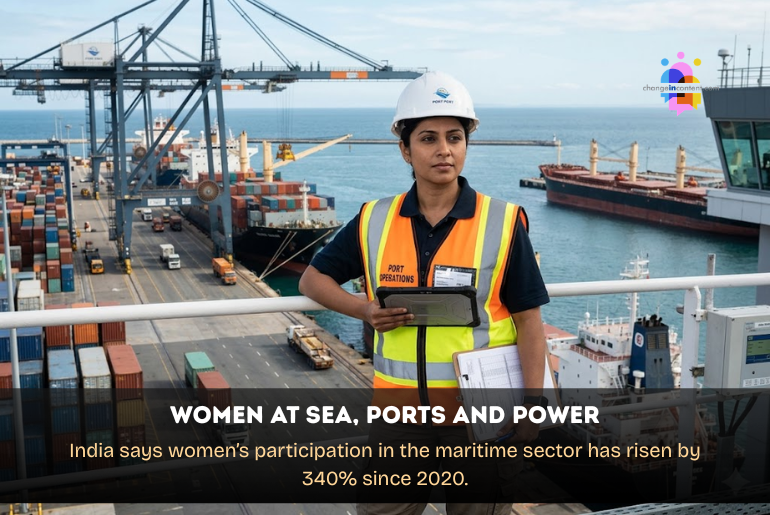
Women’s participation in India’s Maritime sector has risen by 340% since 2020, Union Minister of Ports, Shipping and Waterways Sarbananda Sonowal said while addressing the 10th Indian Ocean Dialogue in New Delhi. For a sector long associated with ships, ports, cargo, engineering, logistics, and field operations dominated by men, the figure signals a shift that deserves closer attention.
Sonowal said the rise results from India’s push for a more inclusive, resilient, and future-ready maritime workforce. He also highlighted initiatives such as Sagar Mein Samman. The initiative aims to advance dignity, inclusion, and leadership opportunities for women across the maritime sector.
Key message
India’s maritime growth is no longer only about port expansion, trade routes, shipping capacity, or blue economy ambitions. It is also about who gets access to this growth. If women are entering maritime careers in larger numbers, the next question is whether they are moving into technical, operational, leadership, policy, logistics, and decision-making roles with safety, dignity, and long-term career progression.
Women’s participation in India’s Maritime sector rises 340%
For decades, India’s maritime industry remained heavily male-dominated, with women often missing from technical, operational, and leadership roles. That story now seems to be shifting. Union Minister Sarbananda Sonowal said that women’s participation in India’s maritime sector has risen by 340% since 2020, calling it a major step towards building a more inclusive maritime workforce.
Addressing the 10th Indian Ocean Dialogue in New Delhi, Sonowal said India’s maritime growth is no longer only about ships, cargo, port expansion, or trade routes. It is also about the people who build, operate, manage, and lead the sector. He described Nari Shakti as a central pillar of India’s maritime growth story.
Initiatives such as Sagar Mein Samman focus on dignity, inclusion, and leadership opportunities for women in the maritime sector. The programme’s significance lies in its attempt to move gender inclusion from symbolic representation to workforce participation in ports, shipping, logistics, and maritime administration.
That is important because the society traditionally sees the maritime careers as tough, technical, mobile, physically demanding, and unsuitable for women. That perception has limited access for generations. A 340% rise does not erase those barriers, but it does show that the sector is beginning to open up.
Why the Indian Ocean Dialogue matters for inclusive Maritime growth
The 10th Indian Ocean Dialogue was held in New Delhi as India assumed the chairmanship of the Indian Ocean Rim Association for 2025 to 2027. The dialogue focused on maritime security, blue economy cooperation, sustainability, regional connectivity, and inclusive development across the Indian Ocean Region.
The forum brought together ministers, policymakers, diplomats, academics, industry leaders, and regional stakeholders. Sonowal said India remains committed to working with partners to advance a safe, secure, and stable Indian Ocean Region. He also placed the surge in women’s participation within India’s wider maritime vision. That is where economic growth and social empowerment must move together.
This framing matters. The Indian Ocean is a critical space for global trade, energy movement, supply chains, coastal livelihoods, climate security, and regional diplomacy. If the workforce shaping this region remains narrow, the benefits of maritime growth will also remain narrow.
India’s maritime policy direction now increasingly combines infrastructure, logistics, port-led development, sustainability, and human capital. That is where women’s participation becomes more than a social goal. It becomes a strategic workforce issue.
How the Blue Economy can create new Maritime careers for women
As India expands its blue economy, women’s participation is becoming an important part of the growth story. The blue economy includes activities linked to oceans, coasts, and marine resources. It includes shipping, fisheries, offshore energy, coastal tourism, shipbuilding, port operations, maritime logistics, marine research, and sustainability-led industries.
These sectors are changing. Modern maritime work is not limited to life at sea. It includes digital systems, port automation, climate monitoring, marine science, supply chain management, engineering, finance, sustainability reporting, trade documentation, safety compliance, coastal planning, and technology-led logistics.
That wider scope creates new entry points for women across different skill levels and professional backgrounds. Women can enter as seafarers, engineers, marine scientists, port managers, logistics specialists, safety officers, policy researchers, sustainability experts, entrepreneurs, and supply chain leaders.
Greater participation can also reshape how the sector thinks. A more diverse workforce can strengthen leadership pipelines, improve workplace culture, broaden access to talent, and bring new perspectives to safety, sustainability, and long-term planning. For a sector tied to trade, energy movement, climate resilience, and coastal economies, inclusion is not an accessory. It is part of future readiness.
What Other Sectors Can Learn From Maritime Inclusion
The rise in women’s participation in India’s maritime sector offers lessons beyond shipping and ports. Many industries still treat inclusion as a recruitment exercise. They count women who enter, but rarely track where they go, how long they stay, and whether they reach decision-making roles.
The maritime sector’s current push shows that inclusion needs a full pathway. It begins with awareness, but it must move into training, safety, workplace infrastructure, leadership access, and measurable career outcomes.
Other sectors can learn from this in four ways.
- First, link inclusion to sector growth. If an industry is expanding, women must be a part of the workforce plan from the start.
- Second, skilling must be specific. We cannot invite women into sectors without access to technical training, field exposure, mentorship, and career guidance.
- Third, safety and dignity must be non-negotiable. Design workplaces, vessels, ports, field sites, and logistics hubs to ensure that women can work without being treated as exceptions.
- Fourth, leadership must be intentional. Women’s participation should not remain concentrated in support functions while men dominate technical and strategic roles.
That is also why Changeincontent has consistently argued that women’s participation in public systems and government-linked sectors must be measured beyond presence. In our earlier article on women in the central government workforce, we explored how representation in institutions shapes who gets to influence policy, administration, and national development.
Changeincontent perspective on the rising women’s participation in India’s Maritime sector
India’s maritime sector is entering a very different phase from what it looked like even a few years ago. Ports are expanding. Shipping networks are becoming more strategic. The blue economy is gaining policy attention. The Indian Ocean Region is becoming central to global trade, climate, security, and diplomacy.
In that context, women’s participation cannot remain a side note.
A 340% rise is promising. It shows that a sector once seen as almost closed to women is beginning to change. But the number should also push us to ask sharper questions.
- Which roles are women entering?
- Are they moving into technical and operational positions?
- Are they being trained for leadership?
- Are maritime workplaces safe and inclusive?
- Are women from coastal communities, smaller towns, and non-elite backgrounds getting access to?
That is where the next phase matters.
Celebrating entry is not enough. India must now build retention, progression, dignity, safety, and leadership for women in maritime careers. If the sector can do that, it will not only change the face of shipping and ports but also change the face of the world. It can become a model for other male-dominated industries that often claim women are unavailable, uninterested, or unprepared.
The truth is simpler. Women enter sectors when systems open. They stay when systems respect them. They lead when systems stop treating them as exceptions.
India’s maritime future will be stronger if women are not just welcomed into it, but trusted to shape it.
Editorial Note
This article is part of Changeincontent’s coverage of gender, workforce inclusion, policy, and economic participation. It draws inspiration from the publicly available statements by Union Minister Sarbananda Sonowal at the 10th Indian Ocean Dialogue in New Delhi, official communications from the Press Information Bureau, and supporting public reports on India’s maritime inclusion push.
Changeincontent uses these inputs for editorial analysis and public-interest discussion. The article does not independently verify the underlying workforce datasets behind the reported 340% rise, and the figure has been attributed to the Union Minister’s statement.
Sources used
Press Information Bureau: Reported Sarbananda Sonowal’s statement that women’s participation in India’s maritime sector has increased by 340% since 2020, and highlighted Sagar Mein Samman.
All India Radio News/NewsOnAIR: Reported Sonowal’s comments linking women’s participation with India’s broader maritime vision and inclusive growth.
Indian Transport and Logistics News: Reported the quote on Sagar Mein Samman and the link between maritime growth, social inclusion, SAGAR, and MAHASAGAR.
