
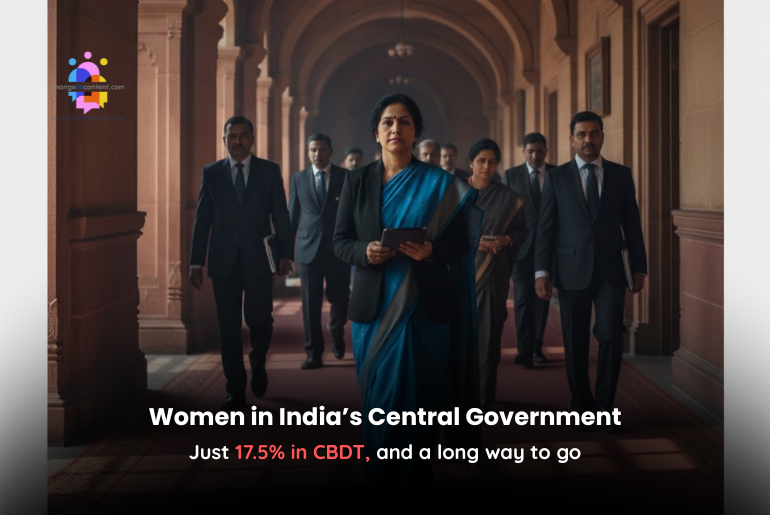
The Central Board of Direct Taxes (CBDT) has recently released its report on gender composition. The numbers tell a familiar story: women in the central government remain vastly underrepresented. Out of more than 51,000 employees, women account for only 17.5% of the total workforce. It means that women make up fewer than one in five employees in the CBDT.
Despite policy commitments and periodic messages of support, the machinery of governance remains dominated by men. The absence of women in decision-making roles across ministries and departments is not just a question of employment; it is a question of perspective. Moreover, it is a question of whose voices shape India’s laws, taxation, and policies.
The report was released while the central government has yet to restart its employee census, which was last conducted in 2011. The CBDT, which operates under the Department of Revenue in the Ministry of Finance, plays a crucial role in India’s direct tax policies and manages tax administration through the Income Tax Department.
Only 17.5% of the CBDT workforce are women
As of September, the Central Board of Direct Taxes (CBDT) had a total workforce of 51,421 employees. Of this, 11,693 hold executive roles, while 39,728 work in non-executive positions.
Among the executives, 2,648 women comprise the workforce, accounting for 22.6%. In the non-executive group, only 6,372 women are employed, forming 16% of that segment. In total, 9,020 women work in the CBDT, which is just 17.5% of its entire staff strength. These data indicate that women continue to represent a small share of the organisation’s workforce.
Earlier this year, on International Women’s Day, CBDT Chairman Ravi Agrawal shared a message celebrating the contributions of women in the Income Tax Department. He spoke about the board’s commitment to creating an inclusive and supportive workplace. He also assured women officers that future policies would continue to take their needs into account, especially regarding job postings and tenure decisions.
However, the recently published gender profile data shows that despite policy commitments and diversity mandates, women’s representation across ministries and departments continues to show little to no progress.
Women are still in the minority: SEBI & PSUs begin sharing gender data
There is no rule that requires the central government, regulators, or autonomous bodies to reserve positions for women or to release gender-based employment data. Nevertheless, a few institutions have begun sharing this information independently.
The Securities and Exchange Board of India (SEBI) mentioned in its annual report that as of March 31, 2025, it had 1,105 employees, including 787 men and 318 women. Similarly, the latest Annual Public Enterprises Survey reported that women formed 9.5% of the workforce in central public sector enterprises during 2023–24, with 77,625 women employed across various roles. These voluntary disclosures are a positive step toward transparency, yet they also highlight the serious underrepresentation of women in many key sectors, despite gradual increases in their workforce participation.
Women in the central government: A positive shift in some sectors
On a more positive note, according to the most recent Group 1 examination results, approximately 66% of the officers posted to the Commercial Taxes Department are women. Going beyond the 30% reservation quota, these women are now preparing to take charge as Commercial Tax Officers, where they will oversee the implementation of GST after completing their training.
Women make up only 10.9% of central government staff
Discussions about improving women’s presence in the government workforce have been ongoing for years, yet the gap remains significant. On December 8, 2023, Parliament raised the question of whether the government would consider reserving 30% of positions for women across all departments, offices, and public sector undertakings.
Former Women and Child Development Minister Smriti Irani responded by pointing out that Article 16(4) of the Constitution already provides reservation for Scheduled Castes (15%), Scheduled Tribes (7.5%), and Other Backward Classes (27%).
She added that, in line with the Supreme Court’s ruling in the Indira Sawhney case, total reservations cannot exceed 50%, making it unlikely to establish a separate quota for women. However, the government has implemented a 33% horizontal reservation for women in direct recruitment to non-gazetted posts, from constables to sub-inspectors, in the police forces of all Union Territories and the Central Armed Police Forces.
The challenge of data and representation
Even with policies aimed at increasing women’s participation, we still lack a comprehensive understanding of the number of women working in the government. The government has been conducting a Census of central government employees since 1960 to track employment patterns. However, the last census was conducted in 2011. The census showed that only 3.37 lakh women worked in the central government. It means the representation accounted for just 10.9% of the total workforce.
This situation highlights two primary issues. First, women remain underrepresented in most government departments and jobs, particularly in senior and executive positions. Second, because we lack up-to-date and detailed workforce data, it is challenging to assess the progress being made. Moreover, it also presents challenges in understanding the obstacles women face and planning new steps to improve representation.
Without regular data and monitoring, even policies meant to help women may not be as effective as intended.
Women in the central government: The closing thoughts
Gender parity is fundamental in institutions such as the Central Board of Direct Taxes (CBDT) and other central government departments. These offices make decisions that affect millions of people, from taxation to public policy. When women are fairly represented, policies and programs are more likely to consider their needs and perspectives.
Making central government workplaces fair and equal for women is still a work in progress. Gender parity is not measured solely by policies or quotas. Instead, the real measure is the the culture, support systems, and opportunities that allow women to enter at every level. True inclusion requires consistent attention, deliberate planning, and mechanisms to track progress over time.
Also Read: She works, but where? Revealing the gender gap in Indian workplaces.
Disclaimer: The views expressed in this article are based on the writer’s insights, supported by data and resources available both online and offline, as applicable. Changeincontent.com is committed to promoting inclusivity across all forms of content. We broadly define inclusivity as media, policies, law, and history. It encompasses all elements that influence the lives of women and marginalised individuals. Our goal is to promote understanding and advocate for comprehensive inclusivity.
