
We often discuss India’s labour market in terms of big national numbers. Labour force participation. Worker population ratio. Unemployment rate. Percentages move slightly up or down, and the headline quickly becomes about stability. But the PLFS Data for Q1 2026 tells a sharper story when we see it through the lives of women and girls.
The Periodic Labour Force Survey, conducted by the National Statistics Office under MoSPI, is India’s primary source of labour force data. The latest quarterly bulletin covers January to March 2026. It presents estimates under Current Weekly Status. That means the assessment of a person’s work or unemployment status seven days before the survey.
The revamped PLFS design now provides quarterly estimates for both rural and urban India, rather than only for urban areas as in earlier quarterly bulletins.
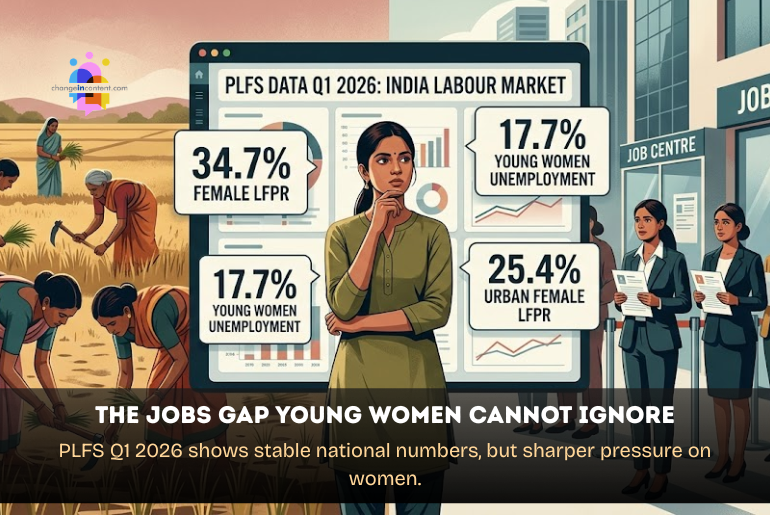
At first glance, the report looks calm. The overall labour force participation rate for people aged 15 and above stood at 55.5% in January to March 2026, compared with 55.8% in the previous quarter. Female labour force participation remained broadly unchanged at 34.7%, compared with 34.9% in October to December 2025.
But “broadly unchanged” is not always good news. When women’s participation is already low, stability can also mean stagnation.
What does the PLFS Data for Q1 2026 reveal about women?
The PLFS data shows that women are still far less likely than men to be in the labour force. Among people aged 15 and above, male labour force participation was 77.3% in January to March 2026, while female participation stood at 34.7%.
The rural-urban gap is equally important. Rural female LFPR was 39.2%, while urban female LFPR was only 25.4%. In comparison, rural male LFPR stood at 78.6% and urban male LFPR at 75.0%.
It tells us something important. The women’s employment challenge in India is not the same everywhere. Rural women are more likely to be a part of the labour force, but much of that work is in agriculture and self-employment. Urban women (despite living closer to formal workplaces) continue to show much lower participation.
That should worry policymakers.
Urban India is home to many modern jobs, services, offices, industries, startups, global capability centres, retail networks, and education hubs. Yet, only one in four urban women aged 15 and above was in the labour force during the quarter.
That is not a small gap. It is a structural warning.
The worker data shows the same imbalance.
The Worker Population Ratio, or WPR, measures the percentage of the population that is employed. For people aged 15 and above, India’s WPR was 52.8% in January to March 2026. That is slightly down from 53.1% in the previous quarter. The official press note records that urban WPR was broadly stable at 46.9%.
For women, the gap remains large.
Female WPR for people aged 15 and above was 32.8% overall. Rural female WPR was 37.6%, while urban female WPR was only 23.1%. Male WPR, by contrast, was 73.6% overall, with 75.2% in rural areas and 70.6% in urban areas.
In simple words, fewer women are entering the labour force, and fewer women are actually working.
That is why we cannot judge female employment only by unemployment rates. If many women are outside the labour force altogether, unemployment rates capture only the women who are actively seeking or available for work.
A low or stable unemployment rate does not mean women are doing well if we are not even counting many as job-seekers.
Young women are facing the hardest job market
The youth numbers are the most worrying part of the PLFS Data for Q1 2026.
Among people aged 15 to 29, the overall unemployment rate was 15.0% in January to March 2026. For young men, it was 14.0%. For young women, it was 17.7%.
That gap matters because it shows that young women who are already participating in the labour force are finding it harder to secure work.
Youth unemployment rose during the first three months of 2026, moving from 14.7% in January to 14.8% in February and 15.2% in March. Furthermore, the unemployment among young women remained significantly worse than among young men. It rose from 16.3% in December 2025 to 17.8% in January, 17.6% in February, and 17.7% in March.
That is where the gender story becomes sharper.
Young women participate at much lower rates than young men. Still, those who do enter the labour market face higher unemployment rates. Data also points out that young women’s LFPR remained between 20% and 23% during the year, while male LFPR stayed above 60%.
That means the problem is double-layered. Fewer young women enter the labour market. Among those who do, more struggle to find work.
Why young women’s unemployment should concern India
Youth unemployment is not only a labour statistic. It affects confidence, family decisions, marriage choices, mobility, financial independence, skills, migration, and long-term career formation.
For young women, the consequences are often deeper.
- A young man who remains unemployed may continue looking for work for longer.
- A young woman who remains unemployed may be pushed out of the labour market altogether.
- Families may stop supporting her job search.
- Families may start treating marriage as the alternative.
- Mobility may be restricted.
- Skill investments may stop.
- Her education may not translate into income.
That is why the female youth unemployment is not just an economic concern. It is a gender equality concern.
If India educates girls but cannot create safe, suitable, fairly paid and accessible work for young women, the country loses twice. It loses labour force potential today and leadership potential tomorrow.
The rural women’s story is mostly about self-employment and agriculture
The PLFS Data for Q1 2026 shows that rural women’s labour force participation is higher than that of urban women. But we must read this carefully.
Among rural women workers aged 15 and above, 72.7% were self-employed during January to March 2026. Only 11.2% were regular wage or salaried employees, and 16.1% were casual labourers.
It indicates that rural women’s work depends heavily on self-employment. That is often about agriculture, family-based work, small enterprises, livestock, home-based production, unpaid or low-paid work, and informal economic activity.
The report also shows that in rural areas, 73.5% of female workers aged 15 and above were engaged in agriculture. That is a massive concentration.
It matters because not all work brings equal income, security, social protection or bargaining power. We may count a woman as working, but her work may not provide her with independent income, formal wages, predictable earnings, Social Security, or decision-making power.
So when rural female participation appears stronger, we must still ask: what kind of work are we counting, and what does it give women in return?
Urban women are more likely to be in salaried work, but fewer are in the labour force.
Urban women show the opposite pattern.
Among urban women workers aged 15 and above, 54.2% were regular wage or salaried employees in January to March 2026. It suggests that women who work in urban areas are more likely to be salaried employees than those in rural areas.
But the problem is that too few urban women are in the labour force to begin with.
- Urban female LFPR was only 25.4%.
- Urban female WPR was only 23.1%.
- Urban female unemployment for women aged 15 and above was 9.1%, compared with 5.8% for urban men.
In simple terms, urban women face a narrow gate.
Those who pass through may have a better chance of securing salaried work. But many women never enter, and those who do enter face higher unemployment than men.
Why does this happen?
The answer is not one thing. It includes unsafe transport, care work, marriage and motherhood penalties, lack of flexible jobs, workplace bias, family restrictions, lower access to networks, hiring discrimination, and jobs that do not match women’s education or mobility realities.
Urban female unemployment remains stubbornly high.
The overall unemployment rate for people aged 15 and above was 5.0% in January to March 2026. Rural unemployment was 4.3%, while urban unemployment was 6.6%. The official press note states that urban unemployment among people aged 15 and above declined from 6.7% in the previous quarter to 6.6%.
But for urban women, unemployment remained much higher.
Urban female unemployment was 9.1% in January to March 2026. Urban male unemployment was 5.8%.
So while the overall urban unemployment number looks stable or slightly improved, women continue to face a much tougher job search in cities.
That should challenge the idea that urban labour markets are automatically more inclusive. Cities offer more jobs, but they do not automatically offer equal access to women.
Why the numbers are not just about women “choosing” not to work
Whenever policies discuss women’s labour force participation, the explanation often becomes personal.
- Women choose family.
- Women prefer home.
- Women leave after marriage.
- Women do not want demanding jobs.
- Women lack ambition.
These explanations are too easy.
Systems shape women’s work decisions.
- If a young woman does not find safe transport, she may not take a job.
- If salaries are too low after travel and childcare costs, work may not seem viable.
- If workplaces penalise maternity, she may exit.
- If families fear harassment, they may restrict mobility.
- If jobs require relocation, night shifts or long hours without support, many women are filtered out before they even apply.
So we must not read the PLFS Data for Q1 2026 as a story of women’s reluctance. Let’s read it as a story of labour market design.
Does India offer enough work that women can access safely, sustain realistically, and grow over time? Right now, the answer is still not strong enough.
What the report means for girls entering the workforce
The focus on young women is especially important because girls are moving through education with higher aspirations than before. Many are graduating, learning digital skills, preparing for competitive exams, applying for jobs and entering professional spaces.
But if the labour market cannot absorb them, education loses some of its promise.
The transition from education to employment is one of the weakest points for young women. A girl may complete school or college, but still face barriers such as a lack of local jobs, unsafe commuting, family pressure, poor placement support, limited internships, digital exclusion, or employers asking for experience she has not been allowed to build.
That is where India must intervene early.
- Career guidance for girls cannot begin after graduation.
- Skill-building cannot be limited to certificates.
- Colleges must connect young women to internships, apprenticeships, digital work, local industry, entrepreneurship pathways and safe mobility support.
If young women are unemployed at 22, the consequences can follow them into their thirties.
How does the PLFS Data for Q1 2026 compare with the previous quarter?
Changeincontent had earlier analysed the PLFS data for October to December 2025, in which the female LFPR reached 34.9%. You can read that earlier analysis here: Female LFPR in 2025: PLFS Oct-Dec.
In the latest quarter:
- The female LFPR fell slightly to 34.7%
- Female WPR also moved from 33.1% to 32.8%
- Female unemployment rose from 4.9% to 5.3%.
These changes may look small. But they matter because women’s participation is already low. We cannot dismiss a small decline in a weak base.
The latest data does not show a collapse. But it also does not show meaningful improvement. That is the real story.
What policymakers should take from this
The PLFS Data for Q1 2026 makes one thing clear. India needs more than just more jobs. It needs more women-accessible jobs. That means jobs with safe mobility, predictable hours, fair wages, childcare support, anti-harassment systems, maternity protection, flexible structures and growth pathways.
First, urban women’s employment needs targeted attention
With urban female LFPR at only 25.4%, cities must become safer and more work-enabling for women. Cities must treat transport, childcare, workplace safety and flexible work design as economic infrastructure.
Second, young women need transition support.
We must build apprenticeships, internships, placement-linked training, career counselling, digital skills and employer partnerships around young women’s realities, not generic youth skilling.
Third, rural women’s work needs better value.
If most rural women workers are self-employed and heavily concentrated in agriculture, policy must improve income, market access, mechanisation, credit, land rights, producer collectives and non-farm opportunities.
Fourth, treat unpaid care as a labour market issue
Women cannot enter or stay in paid work if care remains entirely private, unpaid and female.
Fifth, discuss employment data with gender depth.
Overall numbers can hide women’s realities. Every labour market update should ask what is happening to rural women, urban women, young women, salaried women, self-employed women and women outside the labour force.
What organisations should take from this
For employers, the message is equally clear.
- If women are not applying, ask why.
- If women are not joining, review role design.
- If women are leaving, examine the culture.
- If young women are not getting employment, check entry-level filters.
- If women are not rising, look at promotion and sponsorship.
- If women are not returning, build returnship pathways.
Organisations cannot wait for the labour market to produce job-ready women magically. They must help create women-ready workplaces.
That means inclusive job descriptions, safer workplaces, flexible arrangements, transparent hiring, early-career mentoring, manager training, anti-harassment systems, maternity return support and real growth opportunities.
Hiring women is only the first step. Keeping them and helping them grow is the harder test.
What young women can take from the PLFS data for Q1 2026
The burden should not fall on women alone. But young women can use this data as a signal to prepare strategically.
- Build skills that connect to real jobs, not only certificates.
- Look for internships and apprenticeships early.
- Create a basic digital professional profile.
- Learn communication, digital tools and workplace writing.
- Track sectors that hire women actively.
- Do not rely only on government exams if private opportunities exist.
- Build networks with women already working in your field.
- Ask colleges for placement support.
- Consider local entrepreneurship if formal jobs are not accessible.
- Learn how to identify safe and credible employers.
Most importantly, do not internalise labour market failure as personal failure.
If finding work is hard, it does not mean you are not capable. It means the system is still not built well enough for women’s talent.
Changeincontent Perspective: Women’s work cannot remain a footnote in labour data
The PLFS Data for Q1 2026 is not a story of dramatic collapse. It is more uncomfortable than that. It is a story of stubborn gaps.
At Changeincontent, we believe India must stop treating women’s employment as a secondary reading of national labour data. Women’s participation is not a side indicator. It is central to growth, household security, gender equality and India’s demographic future.
The latest numbers show that:
- Women are still entering the labour force at much lower rates than men.
- Urban women remain especially underrepresented.
- Young women face higher unemployment than young men.
- Rural women work heavily in agriculture and self-employment, where income and security can remain fragile.
If India wants to grow seriously, it cannot afford to keep women’s work fragile, invisible or inaccessible. The question is not whether women want to work. The question is whether India is building enough work that women can actually take, keep and grow through.
Methodology and editorial note
This article is based on the MoSPI Periodic Labour Force Survey Quarterly Bulletin for January to March 2026, released on 11 May 2026, the official MoSPI press note, reports based on PLFS monthly data, and Changeincontent’s previous analysis of female LFPR for October to December 2025.
The PLFS quarterly bulletin uses Current Weekly Status, which assesses whether a person was employed, unemployed, or outside the labour force during the seven days preceding the survey. The article focuses specifically on women and girls, with emphasis on female LFPR, WPR, unemployment, youth unemployment, rural and urban differences, and the type of work women are concentrated in.
Research sources
- MoSPI Press Note on PLFS Quarterly Bulletin, January to March 2026.
- MoSPI PLFS Quarterly Bulletin, January to March 2026.
