
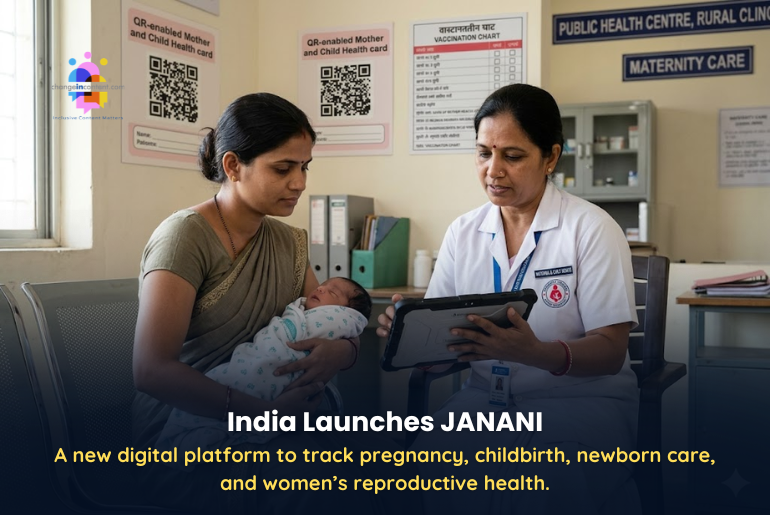
The Union Ministry of Health and Family Welfare has launched JANANI, India’s new digital maternal and child health platform. The platform will track care across pregnancy, childbirth, newborn health, immunisation, reproductive health, and family planning. Short for Journey of Antenatal, Natal and Neonatal Integrated Care, the platform is an upgraded version of the existing Reproductive and Child Health portal.
The government launched the platform during the National Summit on Innovation and Inclusivity. It aims to create a continuous digital health record for women and children. The platform includes QR-enabled Mother and Child Health cards, automated high-risk pregnancy alerts, due-list generation, real-time dashboards, and integration with national systems such as U-WIN and POSHAN.
What does the story of JANANI mean?
JANANI is not just another government portal. It is an attempt to bring maternal and child healthcare into a more connected digital system. That is where it can track parameters such as missed check-ups, high-risk pregnancies, immunisation schedules, postnatal care, and newborn services more closely.
The impact of this platform will depend on how well it serves the women who most need public healthcare, especially those facing poor connectivity, limited smartphone access, low digital literacy, and reliance on overburdened frontline workers.
JANANI creates a digital health record across pregnancy, birth and newborn care
As India modernises public healthcare, the Centre has introduced JANANI, a nationwide digital platform to track maternal and child health services in a single system. As an upgrade to the Reproductive and Child Health portal, JANANI creates a longitudinal health record. It captures service delivery events across pregnancy, childbirth, newborn care, home-based care, immunisation, and family planning.
JANANI covers the full continuum of care. It includes antenatal check-ups, delivery preparedness, institutional delivery, postnatal care, newborn care, home-based newborn and young child care, and contraceptive services. With continuous tracking, the platform can help health workers identify missed services, follow up on due care, and support timely medical interventions.
That matters because maternal and child healthcare does not occur in a single moment. A woman’s care journey begins before delivery and continues through pregnancy, childbirth, newborn care, immunisation, nutrition, and reproductive health decisions. A system that follows this journey more closely can help reduce gaps in service delivery.
QR cards, high-risk alerts, and dashboards: What JANANI offers
One of JANANI’s key features is the QR-enabled digital Mother and Child Health card. The government has designed the card to improve portability, allowing women to access their health records across healthcare facilities. It can be especially useful for women who move across districts or states, including migrant families and those who access different public health facilities at different stages of care.
The platform also includes automated alerts for high-risk pregnancies, generation of due lists for pending services, and real-time dashboards for supervisory review. These tools intend to help frontline workers and supervisors track beneficiaries more closely, identify risks early, and support targeted interventions.
JANANI also connects with national health and nutrition platforms such as U-WIN and POSHAN. That allows better data flow across programmes. This integration is important because maternal health, immunisation, newborn care, nutrition, and family planning are deeply connected. When systems operate in isolation, women and children can fall through the gaps.
JANANI registrations cross 1.34 crore as platform scales nationwide
JANANI supports beneficiary registration through ABHA, Aadhaar authentication, and mobile numbers. Its pan-India search feature aims to help prevent duplicate records and support continuity of care, especially for families who move across regions.
Women can also self-register through web and mobile platforms, access digital MCH cards, receive reminders for antenatal visits and immunisation schedules, locate nearby health facilities, and access health and nutrition guidance.
The platform has already recorded 1.34 crore beneficiary registrations, including more than 30 lakh registrations of pregnant women. It has also generated more than 30 lakh digital Mother and Child Health cards and recorded over 1 lakh biometric verifications.
These numbers show the scale of the digital intervention. But registrations alone cannot define success. The larger question is whether the platform helps women receive timely care, whether high-risk pregnancies are identified earlier, whether newborns are followed up properly, and whether frontline workers can use the system without being overwhelmed.
The ground-level challenges JANANI must solve
While JANANI brings scale and digital efficiency to maternal and child healthcare, its success will depend on how well the system works on the ground. One major concern is India’s digital divide. Many pregnant women, especially in rural, tribal, low-income, and migrant communities, still face limited smartphone access, patchy internet connectivity, or low digital literacy.
Even if the platform offers self-registration and digital tracking, many beneficiaries may still depend almost entirely on ASHA workers, ANMs, nurses, and local health centres to access services. That makes frontline readiness critical. A digital platform cannot succeed if the people expected to use it do not get enough training, time, devices, connectivity, and support.
The data privacy question
JANANI also raises important questions around data privacy and consent. The platform uses sensitive identifiers and health information, including ABHA, Aadhaar authentication, mobile numbers, and biometric verification. When maternal and child health data is centralised at scale, safeguards around consent, data storage, access control, and accountability become essential.
Women should not have to trade privacy for care. A strong public-health technology platform must clearly explain what data is collected, who can access it, how it is protected, and how beneficiaries can exercise control over their own health records.
Will frontline workers get more support or more work?
There is also the risk of adding to the workload of ASHA workers, ANMs, and other frontline staff. If digital data entry becomes time-consuming or technical glitches slow down service delivery, health workers may spend more time updating records than engaging directly with mothers and newborns.
That is where the story connects to a wider workplace issue. Public health platforms depend heavily on frontline women workers, many of whom already carry intense emotional, administrative, and physical workloads.
Changeincontent has previously explored women’s workplace engagement and the hidden burden of showing up despite systems that do not always support them. You can read that here.
For a platform of this scale, infrastructure, training, usability, accountability, and field-level support will matter just as much as the technology itself.
The Changeincontent perspective
JANANI signals a larger shift in how India approaches maternal and child healthcare. It moves the system from episodic service delivery towards continuous, data-backed care that follows women and children across every stage of need.
That is important in a country where access to healthcare still varies sharply by income, geography, mobility, caste, disability, digital access, and local health infrastructure. A pregnant woman in a city hospital and a pregnant woman in a remote village may both be counted in the same national health system, but their actual access to timely care can look very different.
Technology can help close that gap. But it can also hide it if we start treating registrations as outcomes. The real measure of JANANI will not be the number of digital cards generated. It will be:
- Whether high-risk pregnancies are detected earlier.
- Whether women receive antenatal care on time.
- Whether newborns are followed up properly.
- Whether migrant mothers remain visible in the system.
- Whether ASHA workers and ANMs feel supported, not burdened.
- Whether women understand and control their own health data.
Maternal health is not only a medical issue. It is a dignity issue. A governance issue. A gender issue. A public-health equity issue.
JANANI has the potential to become more than a digital platform. But only if it strengthens the human system behind healthcare. Because no app, dashboard, QR card, or biometric verification can replace the trust between a woman and the health worker who reaches her, when the system must not fail.
Editorial note and disclaimer
This article is part of Changeincontent’s Policy Pulse section, where we examine public policy, governance, health systems, and inclusion through a gender-sensitive and equity-focused lens. The article is based on official information from the Union Ministry of Health and Family Welfare, Press Information Bureau updates, and credible public reporting on JANANI’s launch, features, registrations, and intended use. Changeincontent has used these details for editorial analysis and public-interest discussion.
This article is not medical advice and does not evaluate the platform’s technical performance, data-protection framework, or field-level implementation, which will require further evidence as JANANI scales across India.
Sources used
Press Information Bureau: Official release on the launch of JANANI, its features, QR-enabled MCH cards, high-risk alerts, due lists, dashboards, and integration with national platforms.
RCH Portal, Ministry of Health and Family Welfare: Background on the Reproductive and Child Health portal and its purpose in capturing family planning, maternal health, child health, and immunisation services.
