
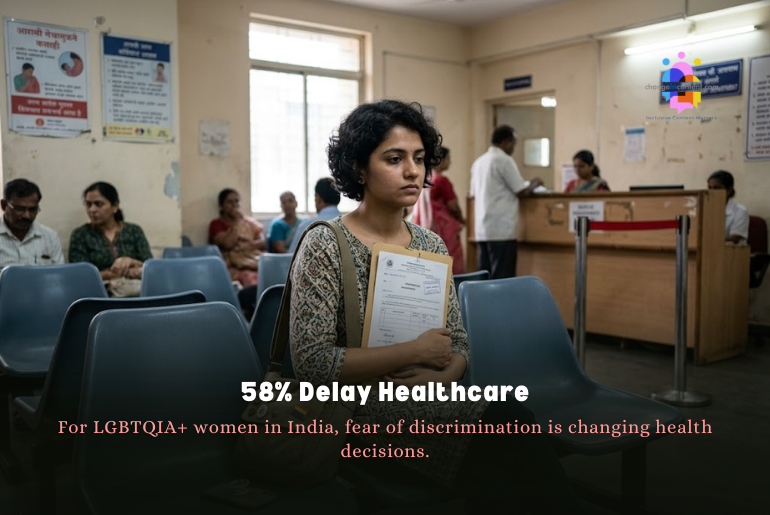
A new study has found that 58% LGBTQIA+ women in India delay healthcare because they fear discrimination or poor treatment. Conducted by Kantar in collaboration with DIVA Charitable Trust and The Curve Foundation, the research surveyed more than 3,200 LGBTQIA+ women and non-binary people across five countries and found that respondents in India reported the highest level of healthcare avoidance among the markets studied.
For many women in India, accessing medical care can already involve financial stress, family judgment, stigma, and discomfort around discussing reproductive or sexual health. For LGBTQIA+ women and non-binary people, those barriers can become even sharper. The fear is not abstract. It can show up even before booking an appointment. Moreover, it can show inside the consultation room, during a medical history discussion, or in the silence that follows when a patient decides not to disclose something important.
Key learnings
Healthcare avoidance is not a small behavioural choice. It is a sign of broken trust. When people delay care because they expect bias, they are not being careless about their health. They are trying to protect themselves from systems that have made them feel unsafe. That is why the findings matter beyond the LGBTQIA+ community alone. They ask whether India’s healthcare spaces are truly prepared to treat every person with dignity.
58% LGBTQIA+ women in India delay healthcare over fear of discrimination
The research by Kantar, DIVA Charitable Trust and The Curve Foundation surveyed more than 3,200 LGBTQIA+ women and non-binary people across five countries. Around 58% of respondents in India said they had delayed or avoided seeking healthcare because they feared discrimination or poor treatment.
That number points to a much larger issue than one missed appointment. It raises the question of whether people feel respected, understood, and safe when they enter healthcare spaces. When someone expects judgement before a consultation even begins, seeking help can become emotionally exhausting.
In many cases, people wait until symptoms worsen instead of seeking early treatment. When medical spaces feel unsafe, they can delay preventive check-ups, mental health support, sexual health consultations, hormone-related care, reproductive health services, and routine screenings.
Lady Phyll, Executive Director of DIVA Charitable Trust, said the findings show what happens when visibility remains conditional. She noted that when more than one in three people are delaying healthcare because they fear discrimination, the issue is no longer symbolic inclusion. Still, people are changing life decisions to stay safe.
When the clinic becomes a place of fear
In India, 60% of respondents said they had experienced discrimination while seeking healthcare. Many reported feeling dismissed, misunderstood, or not taken seriously by healthcare providers because of their identity.
These experiences may appear small to outsiders.
- A careless question.
- A dismissive tone.
- An assumption about sexuality.
- A refusal to understand gender identity.
- A provider who makes the patient explain too much.
- A staff member who makes the patient feel watched.
But repeated moments of disrespect can change how people use healthcare systems over time. Patients may avoid follow-up visits, hide important health information, hesitate to ask questions, or delay routine care. That can affect diagnosis, treatment, mental health, sexual health, reproductive care, and long-term wellbeing.
The problem is not only whether healthcare exists. The problem is whether people can access it without having to prepare for humiliation.
The fear does not stop at the hospital door.
The study also found that discrimination does not stop at clinics or hospitals. Respondents reported verbal abuse, harassment, and intimidation in everyday spaces such as social media platforms, public transport, and social venues. Kantar’s public summary noted that social media abuse, public transport, and public spaces such as cafés, bars, and restaurants remain areas where safety concerns persist.
That matters because healthcare decision-making does not happen in isolation. A person who already feels unsafe in public life may also feel unsafe walking into a clinic, answering personal questions, or trusting a provider with sensitive information.
For LGBTQIA+ women and non-binary people, safety can become a calculation.
- Which doctor will not judge?
- Which clinic will not stare?
- Which form will allow the right identity?
- Which space will not turn a health concern into a moral interrogation?
That daily calculation affects more than healthcare. It can influence where people travel, how openly they express themselves, whether they access public services, and whether they feel safe enough to seek help when they need it.
Why invisibility in data becomes invisibility in policy
Many institutional systems continue to overlook LGBTQIA+ women and non-binary people. These include healthcare, workplaces, public services, and research. When such institutions do not measure communities properly, the needs of those communities often do not shape policy decisions, service design, medical training, or institutional priorities.
James Brooks, Chief Research Officer at Kantar, said LGBTQIA+ women and non-binary people remain underrepresented and overlooked. Conditional safety, uneven access to care, and systems not designed with them in mind shape their experiences. He also noted that when people are invisible in data, they become invisible in decision-making.
That line explains the larger crisis. If healthcare systems do not collect, understand, or respond to LGBTQIA+ experiences, discrimination becomes harder to challenge. Silence becomes policy by default.
What institutions and businesses must understand
The study also found that expectations from businesses are changing. In India, 78% of respondents said companies should actively support diversity and inclusion.
That matters because inclusion cannot remain limited to Pride Month campaigns or symbolic representation. People increasingly expect brands, employers, hospitals, insurers, public bodies, and service providers to build systems that are safe in practice, not just inclusive in language.
- Healthcare providers need sensitisation, inclusive intake forms, privacy protections, non-judgemental staff training, mental health awareness, and clear anti-discrimination protocols.
- Workplaces need insurance policies, leave systems, gender-neutral benefits, and health support that recognise LGBTQIA+ employees.
- Brands need to understand that visibility without accountability can quickly become tokenism.
That is where healthcare, business, and public culture meet. Changeincontent has previously examined how LGBTQIA+ entrepreneurship and business visibility are changing India’s inclusion landscape. You can read that here.
LGBTQIA+ women in India delaying healthcare: The Changeincontent perspective
When 58% of LGBTQIA+ women in India say they delay or avoid healthcare because they fear discrimination, we should stop calling this a communication gap. It is a trust crisis.
Healthcare is supposed to be the place where a person becomes more protected, not more exposed. But for too many LGBTQIA+ women and non-binary people, the clinic is not just a clinic. It is a room where someone may judge them, misunderstand them, misgender them, dismiss them, question them, or force them to explain their identity before even taking their symptoms seriously.
That is not care. That is a barrier dressed as a system.
The solutions
We cannot reduce the solution to awareness alone. Hospitals, clinics, medical colleges, insurers, workplaces, and public health institutions need to build inclusion into everyday healthcare delivery.
- Doctors must be trained to ask better questions
- Forms must stop erasing identities. Staff must be sensitised
- Confidentiality must be respected
- Mental health must be taken seriously
- Sexual and reproductive healthcare must become safer for people who do not fit heteronormative assumptions.
Businesses also have a role to play. If companies want to speak about diversity, they must look at healthcare access, employee benefits, insurance design, workplace safety, and whether LGBTQIA+ employees can seek care without fear or shame.
The most painful part of the study is not the number. It is what the number represents.
- People are choosing delay over possible humiliation.
- Silence over possible judgement.
- Risk over unsafe care.
That should unsettle us because no one should have to decide whether a doctor’s room is safe enough before deciding whether their health deserves attention.
Editorial Note and Disclaimer
This article is part of Changeincontent’s Mosaic section, where we examine social realities linked to gender, sexuality, public systems, safety, inclusion, and dignity. The article is based on publicly available reporting and statements from the Kantar, DIVA Charitable Trust and The Curve Foundation study on LGBTQIA+ women and non-binary people across five countries, with a specific focus on India’s healthcare findings.
Changeincontent has used these findings for editorial analysis and public-interest discussion. This article is not medical, legal, or mental health advice. Readers seeking healthcare support should consult qualified, affirming healthcare professionals or trusted community organisations.
Sources
Kantar public communication on the study: Reported India-specific findings, including 58% delaying healthcare, 60% facing discrimination in healthcare settings, and 78% expecting companies to support diversity and inclusion.
Kantar North America press release: Explained the cross-market survey of more than 3,200 LGBTQIA+ women and non-binary people across five countries, and included quotes from Kantar and DIVA Charitable Trust.
DIVA Magazine: Reported the 2026 Kantar-DIVA-Curve Survey and its findings on healthcare avoidance, visibility, safety, and wellbeing.
