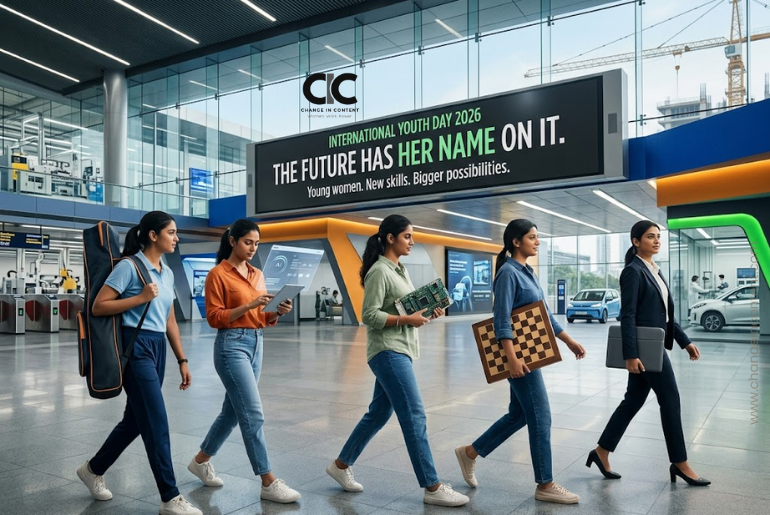
The Quick Read
- International Youth Day 2026 is observed on 12 August under the theme “Different Contexts, Common Aspirations.” The United Nations says young people across very different realities still share aspirations around dignity, participation and opportunity.
- UN Women’s 2026 statement puts a sharper gender lens on that idea. For young women and girls, those aspirations include equal rights, opportunity, safety and the ability to shape the decisions affecting their futures.
- India’s young women are already proving their capacity across sport, technology, entrepreneurship, education and new-economy skills. Divya Deshmukh became the youngest Women’s World Cup chess winner at 19, while 19-year-old Sheetal Devi continues to reset standards in international para archery.
- India’s skilling ecosystem is also showing encouraging female participation. More than 34,000 young people have been trained through the Skill Impact Bond, and 74% were women; independently verified outcomes showed 76% placement and 62% retention up to Cohort 6.
- Yet the transition into work remains uneven. Change in Content’s analysis of PLFS Q1 2026 found young women particularly exposed to unemployment and weak education-to-work transitions.
- India cannot become a developed economy by asking young women merely to participate. It needs them building companies, writing code, designing policy, leading laboratories, creating jobs and owning more of the economic value they help create.
International Youth Day 2026
Someone who is 19 years old today will be 40 when India reaches 2047. That is worth remembering every time we talk about Viksit Bharat, India becoming an economic superpower, or the jobs and technologies that will define the next two decades.
The young women sitting in universities today, preparing for competitive examinations, learning artificial intelligence, opening small businesses, playing sport professionally or entering their first jobs are not a supporting cast in that story.
They are the generation that will live it. That gives International Youth Day 2026 a particularly useful meaning for India.
The United Nations has chosen “Different Contexts, Common Aspirations” as this year’s theme. It argues that young people may live in profoundly different economic, political and social circumstances, but their expectations around dignity, participation, opportunity and a viable future overlap.
For young women, that idea lands differently. Because aspiration has rarely been their problem. The more interesting question is what happens when aspiration meets opportunity.
UN Women has made the gender question explicit
UN Women’s statement for International Youth Day this year focuses directly on the aspirations of young women and girls. It places equality alongside dignity, peace, sustainability, and meaningful participation, while recognising that young women face barriers that can prevent those aspirations from becoming lived reality.
That matters because “youth” can become a strangely gender-neutral word.
We speak about youth employment. Youth skilling; Youth innovation; Youth leadership. But young men and young women do not necessarily enter those systems from the same starting point.
A young woman may have the same degree and a very different mobility radius.
- The same ambition and more pressure to prioritise marriage.
- The same technical skills and less confidence from employers.
- The same job and a different calculation around working late.
- The same salary and a larger expectation of unpaid care at home.
So celebrating youth without looking at gender can hide a great deal. Fortunately, there is another side of the story.
Young Indian women are already showing us what becomes possible when talent gets room.
Divya Deshmukh is 20. She has already changed Indian chess history
Take a chess board. 64 squares. No room for excuses.
In July 2025, Divya Deshmukh, then 19, defeated Koneru Humpy to win the FIDE Women’s World Cup. She became the youngest winner in the tournament’s history and the first Indian woman to claim the title. The victory also earned her the Grandmaster title.
That is impressive enough. But perhaps the more interesting part is what Divya said afterwards. She saw it as a beginning.
For a generation of young women growing up watching Indian chess, that changes the scale of what appears normal.
A woman winning internationally is no longer an exotic exception from another era. She could be 19. She could be Indian. And she could be sitting opposite one of the country’s most accomplished players and still expect to win. Representation works quietly like that.
First something looks extraordinary. Then somebody younger sees it. Eventually it becomes a career possibility.
Sheetal Devi keeps making the impossible look badly researched
Then there is Sheetal Devi. At 19, she is already a world para-archery champion and one of the most recognisable young athletes India has produced.
In June 2026, Sheetal improved her own Asian record in compound qualifying at the Hyundai World Archery Para Series in the Czech Republic, shooting 697 and finishing 13 points ahead of the field.
Earlier this year, World Archery noted that she had become the first woman without arms to win a para-archery world title. There is a temptation with stories like Sheetal’s to reduce them to “inspiration”. That almost undersells her.
She is not competing symbolically. She is competing professionally. Winning. Breaking records. Changing technique. Changing expectations. And changing what a young girl with a disability might imagine when somebody tells her what she cannot do.
That belongs in an economic conversation too. A developed country is not merely one with higher GDP. It is one that wastes less human capability.
And many young women are building without becoming famous
Most young women shaping India will never appear on a podium. That does not make their contribution smaller. Thousands are entering technical programmes, apprenticeships, vocational careers, startups and digital work.
India’s current skilling numbers provide one encouraging example.
Under the Skill Impact Bond, more than 34,000 young people across 21 states had been trained by April 2026. Women represented 74% of trainees. Independent verification through Cohort 6 showed 92% certification, 76% job placement and 62% retention.
Those are valuable numbers because they move beyond a familiar problem in skilling programmes.
Training somebody is not the same as creating an economic outcome. A certificate does not pay rent. A retained job might. That is why placement and retention matter. And India’s skill policy is beginning to acknowledge the gendered part of the pathway more explicitly.
In July 2026, the Ministry of Skill Development and Entrepreneurship announced a Committee on Gender Mainstreaming intended to address barriers across outreach, mobility, training, apprenticeships, placement, retention and career progression. The Ministry also announced plans to document successful models for women’s skilling, employment and entrepreneurship.
That is the right direction.
Because young women need more than training seats. They need exits from training that lead somewhere.
AI may become one of the biggest opportunities of their working lives
The labour market these women enter will change repeatedly.
Artificial intelligence. Automation. Climate technologies. Advanced manufacturing. Digital commerce. Healthcare. Financial technology. The creator economy.
These are not distant trends anymore.
Government material published around World Youth Skills Day 2026 notes that AI, digitalisation, automation, climate action and demographic change are already reshaping labour markets. The India Skills Report 2026, cited by the government, puts overall employability at 56.4%, up from 46% in 2020.
For young women, this disruption creates both risk and possibility. That is why Change in Content has argued that digital literacy for women in 2026 now has to mean much more than knowing how to use a smartphone. AI literacy, digital safety, financial awareness and the ability to use technology for work and income increasingly belong in the same conversation.
Our deeper look at women and the future of digital work in India reached a similar conclusion: digital work can widen access to jobs, enterprise and markets, particularly when geography or mobility would otherwise narrow the options available to women.
The message to young women is not “learn AI because AI is fashionable”. Learn enough technology so that somebody else does not automatically control the next layer of opportunity.
Entrepreneurship is another door getting wider
A young woman coming out of college does not have to choose only between: government job or a corporate job. She can build.
India already has a much broader startup culture than it did a decade ago. Official government data released in June 2026 noted that more than 45% of recognised startups had at least one woman director or partner by December 2025. That metric does not mean 45% of startups are women-led, but it does show a substantial female presence in the formal startup ecosystem.
Programmes such as Swavalambini are specifically trying to introduce entrepreneurship to women while they are still in higher education. The programme has targeted female students with entrepreneurship awareness, training and access to support systems.
And entrepreneurship no longer belongs only to metropolitan founders raising venture capital. Women are building in beauty, biotechnology, finance, education, health, rural livelihoods and consumer markets, as we explored in our story on women entrepreneurs driving India’s economic growth.
For young women, that should change the question from: “Which jobs are available to me?” to include: “What value can I create?” That is a more powerful economic question.
But we should not inspire young women past the inconvenient data
Positive stories should not require us to pretend every indicator is positive.
Change in Content’s analysis of PLFS data for the first quarter of 2026 found that young women remain especially vulnerable during the transition from education into employment. The article documented barriers including weak local job availability, unsafe commuting, limited internships, poor placement support and experience requirements that young candidates struggle to meet.
That transition deserves much more attention.
India is producing ambitious girls. Many are succeeding in education. The danger lies in what happens between the classroom and the first few years of economic independence.
- A missed first job can become a longer career delay.
- A mobility restriction can shrink an entire job market.
- A two-year break can become a permanent exit.
That is why our earlier story on what young women in India are doing remains relevant. Young women’s education, employment and training pathways still diverge substantially from those of young men.
The response should not be gloom. It should be infrastructure. Better apprenticeships. More internships. Safe transport. Industry-linked education. Digital access. Career counselling. Women-friendly manufacturing. Entrepreneurial credit. Flexible pathways back after interruption. And employers willing to give somebody their first experience instead of advertising an “entry-level” role asking for three years of it.
India needs young women in more places than we currently imagine
When people discuss women’s progress, the same sectors often appear. Education. Healthcare. HR. Banking. Useful sectors.
But India’s growth ambitions require women much more widely. Electronics manufacturing. Semiconductors. AI. Defence technology. Logistics. Renewable energy. Cybersecurity. Agritech. Data science. Advanced manufacturing. Public administration. Space. Research. Entrepreneurship.
The country cannot build world-class capacity while informally deciding that half its young population belongs in only selected corners of the economy. That is particularly relevant to India’s 2047 ambitions.
In our analysis of women in industry leadership and India’s 2047 power gap, we looked at the relationship between women’s participation and the country’s long-term economic ambitions.
The next generation can change those numbers. But only if entry turns into retention.
Retention into progression. Progression into leadership. And leadership into ownership and decision-making.
A small note to the young woman reading this
Perhaps you are 18. Or 22. Or 27. Maybe you have everything planned. More likely, you have approximately 3 things planned and 17 tabs open. That is allowed.
The economy you will spend your career inside does not fully exist yet.
- Some jobs you will do have not been invented.
- Some companies you may work for have not been founded.
- Some skills that will matter enormously in 2036 are still relatively obscure in 2026.
So the advantage may not belong to the person who has the most perfect plan. It may belong to the person who keeps learning.
- Learn technology.
- Learn money.
- Learn how business works.
- Learn to communicate.
- Learn to negotiate.
- Learn how your industry makes revenue.
- Learn what AI changes in your field.
- Build friendships with women who want different things from life.
- Find men who treat your ambition as normal.
- Ask for opportunities before you feel perfectly ready.
- And do not assume one early rejection has revealed anything profound about your ability.
Divya Deshmukh was 19 when she became a world champion. Sheetal Devi is 19 and rewriting the mechanics of her sport.
Their stories are extraordinary. Yours does not have to look like theirs to matter.
The Change in Content Perspective: The Future Does Not Need Women to Catch Up
International Youth Day 2026 is built around different contexts and common aspirations.
India’s young women embody both.
- Some grow up in metros. Others in villages.
- Some attend elite universities. And some become the first graduate in their family.
- A few of them have strong financial support. Others begin by figuring out how to afford the bus fare to training.
- One may become a chess Grandmaster. Another may run a rural enterprise. Another will write software. Teach. Farm. Build a factory. Design a chip. Treat patients. Enter politics. Run a company. Create art. Or invent work that does not yet have a familiar job title.
There should be space for all of them. We often speak about women as though they have to catch up with the future. Perhaps that framing is already outdated. Young women are already inside it.
The better question is whether India’s schools, employers, families, markets and institutions can keep pace with them. Because if India becomes the developed, confident economic power it wants to be by 2047, young women will not have been beneficiaries of that transformation.
They will have built a significant part of it. And they should know that now.
Editorial Note and Disclaimer
This DEI Insights article marks International Youth Day 2026, observed by the United Nations on 12 August. It combines current official data, institutional research and illustrative stories of young Indian women achievers with the editorial perspective of Change in Content. Statistics from different programmes use different definitions, samples and age groups and should not be treated as directly comparable. This article is intended for editorial and informational purposes.
Sources
- United Nations: International Youth Day 2026: Different Contexts, Common Aspirations
- UN Women: Statement for International Youth Day 2026
- Ministry of Skill Development and Entrepreneurship: World Youth Skills Day 2026
- Skill Impact Bond/MSDE: Youth training and placement outcomes
- FIDE: Divya Deshmukh, Women’s World Cup Champion
- World Archery: Sheetal Devi, 2026 performance and record