The Quick Read
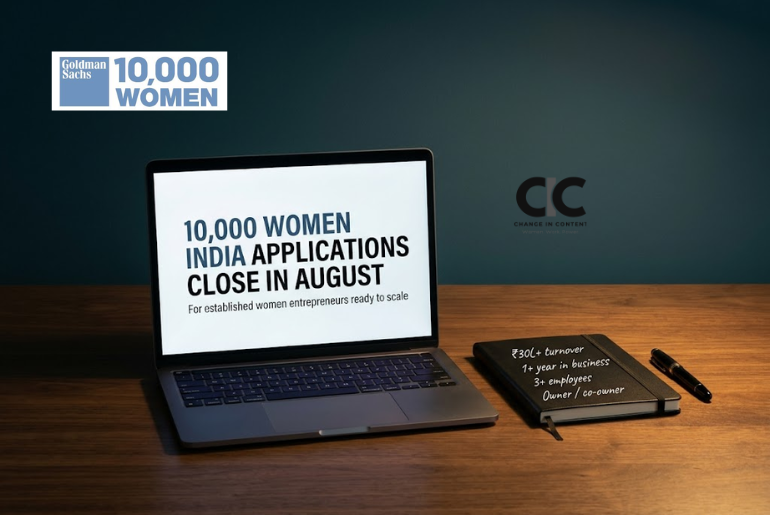
- Goldman Sachs 10,000 Women applications are currently open in India, with the official programme timeline saying applications close in August 2026. Interviews and final decisions are also scheduled for August, followed by the cohort starting in September.
- The programme is intended for established women entrepreneurs who are the primary decision-makers in their businesses. Applicants must be owners or co-owners, have operated for at least one year, employ at least three people and report annual turnover above ₹30 lakh. Previous 10,000 Women graduates are not eligible to reapply.
- In India, the in-person programme is delivered through IIM Ahmedabad, IIM Bangalore and IIM Lucknow, and Goldman Sachs fully funds tuition. Participants are responsible for travel, lodging and related costs.
- The curriculum includes more than 100 hours of learning, delivered through three residential modules covering areas such as financial management, marketing, negotiation, leadership, innovation and operational growth.
- Goldman Sachs says the programme has supported more than 4,100 women-led businesses in India since 2008. Its current programme page reports that participants have, on average, quadrupled revenue within 18 months of graduation.
- Applications begin with a short online Expression of Interest form.
Goldman Sachs 10,000 Women: Applications for Indian women entrepreneurs are open
There are opportunities you bookmark. And there are opportunities where the calendar should probably decide for you.
For established women entrepreneurs in India, this may be one of the latter.
The Goldman Sachs 10,000 Women applications are open for the next India cohort, but the official programme schedule states that the application window closes in August 2026. Interviews and final decisions are also planned for this month, with the programme beginning in September.
As Change in Content publishes this on 24 August, that makes the message fairly straightforward:
If the programme fits your business, look at it now. Not because every entrepreneur needs another course. But because this one has been built specifically for women who have moved beyond the “I have a business idea” stage and are facing the more complicated question: How do I actually scale what I have already built?
What is Goldman Sachs 10,000 Women?
Goldman Sachs launched 10,000 Women globally in 2008 as an initiative that provides women entrepreneurs with business and management education, mentoring, professional networks, and access to capital-related resources.
Its global footprint has since expanded to more than 320,000 women across more than 150 countries. In India, Goldman Sachs says more than 4,100 women-led businesses have received in-person education through the initiative.
The India programme currently works with three academic partners:
- Indian Institute of Management Ahmedabad
- Indian Institute of Management Bangalore
- Indian Institute of Management Lucknow, including its Delhi and Lucknow campuses.
The programme itself is tuition-funded by Goldman Sachs. There is, however, an important practical detail: travel, accommodation and other related participant expenses are not included.
That belongs in a founder’s decision before she applies, particularly because the curriculum includes residential learning.
Who can apply?
This is where some potential applicants will discover immediately whether the programme is relevant to them. Goldman Sachs says applicants should be established women entrepreneurs ready for the next stage of growth.
The current eligibility requirements are:
- You must be the primary decision-maker in the business.
- You must be an owner or co-owner.
- The business must have been operating for at least one year.
- Annual turnover must be above ₹30 lakh.
- The business must employ at least three people.
- Previous Goldman Sachs 10,000 Women graduates are not eligible to apply again.
The programme is open across industries. So whether the business is in manufacturing, technology, professional services, food, healthcare, retail, consumer products, education or another sector is not in itself the deciding factor.
That makes the programme particularly relevant to a part of India’s women entrepreneurship ecosystem that sometimes receives less attention than startups at one end and micro-enterprises at the other: the established founder who has proved there is a business but now needs to build a bigger one.
What will selected entrepreneurs actually study?
This is not structured as a motivational founder event. Goldman Sachs describes it as more than 100 hours of learning, including three in-person residential modules.
The curriculum develops capabilities around areas including:
- financial management,
- marketing,
- negotiation,
- leadership,
- strategy,
- innovation,
- and operational excellence.
The objective is practical: help the entrepreneur analyse growth opportunities, build a growth plan and translate that strategy into her existing business. That distinction matters.
Many founders reach a point where the skill required to start the company is no longer the skill required to scale it.
- The founder who initially sold everything herself may now need a sales organisation.
- Someone who managed money through instinct may need stronger cash-flow forecasting.
- A founder who personally hired five people may suddenly have 50 employees and need management systems.
- Marketing may need to become measurable.
- Pricing may need rethinking.
- Expansion may need capital.
- And the founder herself may need to shift from being the person who solves every problem to being the person who builds an organisation capable of solving them.
That is the transition this programme is trying to address.
Does it have evidence of impact?
Goldman Sachs’ current India application page says participating entrepreneurs have quadrupled their revenues on average within 18 months of graduation. It also says the India community has collectively created more than 12,000 new jobs.
Those are programme-reported outcomes, so they should be understood as such rather than guarantees for an individual participant. But they point towards an important philosophy.
The success of women’s entrepreneurship programmes should eventually be visible in the business. Revenue. Jobs. Productivity. Customers. Markets. Capital. Systems. That is especially relevant because India’s conversation on women’s entrepreneurship is moving beyond simply encouraging women to start.
Our recent guide to Female Entrepreneurship Trends 2026 argued that the advantage is increasingly shifting towards founders who can combine financial discipline, digital capabilities, sales, technology, and strong operating systems.
India already has a rapidly expanding base of women founders. The next challenge is scale.
Why programmes like this matter now
Change in Content recently documented how women entrepreneurs are increasingly becoming part of India’s economic growth story. They are building across healthcare, technology, beauty, biotechnology, finance, education and local enterprise. But building and scaling remain different propositions.
- A woman may be good at her product and still need stronger financial knowledge.
- She may have customers but limited access to growth networks.
- She may generate revenue but struggle with working capital.
- She may understand the market but have never formally built an expansion strategy.
Our analysis of complex business loans for women entrepreneurs showed precisely why this stage gets difficult. Once businesses grow beyond small-ticket borrowing, questions around financial records, working capital, collateral, cash flows and business structure become considerably more important.
Education cannot eliminate every financing barrier. It can make a founder better prepared to navigate them. And that matters.
There is a network hiding inside the classroom too
One part of programmes like 10,000 Women can be easy to underestimate. The other entrepreneurs.
Goldman Sachs describes networking and peer learning as central parts of the programme, and graduates become part of the wider 10,000 Women community.
For women entrepreneurs, this is not a minor benefit. Founder networks can lead to:
- customers,
- suppliers,
- introductions,
- partnerships,
- capital conversations,
- market intelligence,
- and sometimes simply another entrepreneur who has already encountered the problem you are facing.
That becomes increasingly valuable as a company grows.
Our recent story on Women Entrepreneurship Theory also highlighted why modern entrepreneurship support needs to combine skills, mentorship, networks and business infrastructure rather than treating them as isolated interventions.
The classroom teaches. The network may continue working long after the classroom ends.
How do you apply?
The official process begins online.
Goldman Sachs says interested entrepreneurs should complete a two-minute Expression of Interest form through its India 10,000 Women application page.
The official programme page currently lists the timeline as:
- Applications close: August 2026
- Interviews: August 2026
- Final decisions: August 2026
- Cohort begins: September 2026.
Importantly, Goldman Sachs has not published a specific August closing date on the official page we reviewed.
So we would not advise readers to assume that “applications open through August” means waiting comfortably until 31 August. It may not.
Official Application Page
Apply to Goldman Sachs 10,000 Women India
Applicants with questions can also use the programme’s officially listed contact address.
And if you do not meet the eligibility criteria?
That does not mean the Goldman Sachs learning ecosystem is completely closed. The organisation also offers the 10,000 Women online curriculum through Coursera, which its official India page describes as free and flexible for entrepreneurs unable to attend the in-person programme.
That could be useful for:
- a woman whose business is still below the ₹30 lakh turnover threshold;
- a solo founder without three employees;
- someone at an earlier business stage;
- or an entrepreneur who cannot currently commit to the residential format.
The in-person India programme is selective. The broader learning opportunity is not limited to that cohort.
Closing thoughts: If you have already built it, learn how to build it bigger
There is a stage in entrepreneurship that receives surprisingly little attention.
The company exists. Customers exist. Employees exist. Revenue exists. And yet the founder knows the business cannot simply continue doing more of exactly what it did when it was small. That is the difficult middle.
Growth requires different numbers. Different systems. Different decisions. Sometimes different financing. And often, a different version of the founder.
That is why the current Goldman Sachs 10,000 Women applications are worth flagging for Change in Content readers.
This is not an opportunity for every woman thinking about entrepreneurship. It is targeted at the woman who has already taken the risk.
She has built something. She has hired. And she has generated revenue. Now she wants to understand what the next version of that business might look like.
For eligible entrepreneurs reading this during the final week of August, our advice is practical:
- Check the criteria.
- Check the residential commitment.
- Check whether this is the stage your business is at.
And if the answer is yes, do not spend the rest of August merely thinking about applying. Open the form.
Editorial Note and Disclaimer
This article is based on current information published by Goldman Sachs and its Indian academic partners. As of the time of writing, the official application page states only that applications close in August 2026; it does not specify an exact final date. Applicants should therefore check the official page immediately for any subsequent updates. Goldman Sachs and its programme partners determine programme admission. Change in Content is not affiliated with the programme, and this article should not be interpreted as an endorsement, guarantee of admission or business advice.
Sources
- Goldman Sachs — 10,000 Women India: Application and Programme Information. Current eligibility, curriculum, application process and August 2026 timeline.
- Goldman Sachs — 10,000 Women in India. Background on programme delivery through IIM Ahmedabad, IIM Bangalore and IIM Lucknow and the initiative’s India community.
- Indian Institute of Management Ahmedabad — Goldman Sachs 10,000 Women. Current programme information, eligibility and curriculum.
- IIM Ahmedabad — Goldman Sachs 10,000 Women expansion in India, September 2025. The expansion added IIM Ahmedabad and IIM Lucknow alongside IIM Bangalore and set a target of graduating 1,000 women entrepreneurs over the following year.