
The Brief
- The Mobile Gender Gap Report 2026 finds that women in low- and middle-income countries are 13% less likely than men to own a smartphone, representing around 210 million fewer women.
- More than 1.5 billion women now use mobile internet, but around 810 million women in LMICs still do not. Women remain 12% less likely than men to use mobile internet.
- South Asia remains one of the hardest-hit regions: women are 25% less likely than men to use mobile internet, and the smartphone ownership gap is 33%.
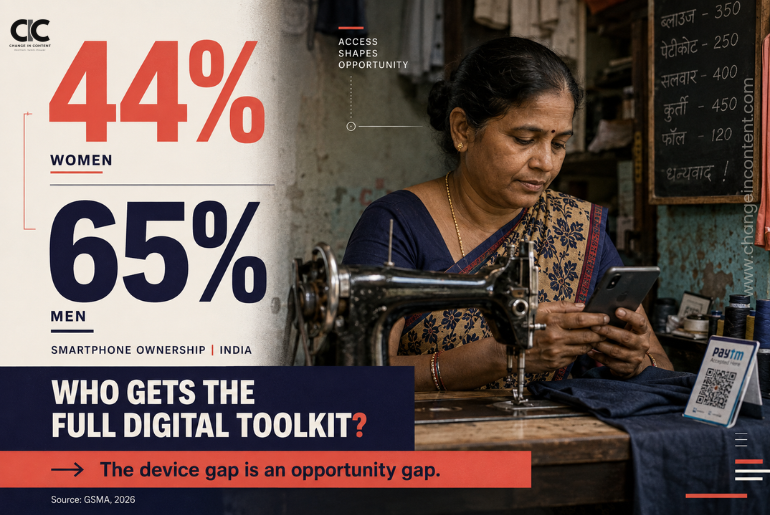
- In India, 44% of surveyed women own smartphones compared with 65% of men. Women’s ownership improved significantly, but the gap remains wide.
- The report suggests that digital inclusion is now less about putting any phone in a woman’s hand and more about affordability, skills, safety, meaningful use and the freedom to turn connectivity into income, information and opportunity.
The Mobile Gender Gap Report 2026
A smartphone is still easy to think of as a consumer product.
Something bought after the essentials. A better camera. WhatsApp. Videos. Shopping. Social media.
For millions of women, that description is already too small.
A smartphone can now be a bank branch, classroom, job board, storefront, identity tool, health information source, payment terminal, government-service gateway and, increasingly, an entry point into AI-enabled work.
That is why one figure in the Mobile Gender Gap Report 2026 deserves more attention than its size might initially suggest.
Women in low- and middle-income countries are still 13% less likely than men to own a smartphone. That works out to roughly 210 million fewer women with one.
The gap has barely changed. And perhaps that is the more important part.
Women are coming online. The gap is moving much more slowly.
There is good news in the report.
More than 1.5 billion women in LMICs now use mobile internet. Around 80 million women became users during 2025. The mobile internet gender gap also narrowed from 14% to 12%.
That is progress. But the headline numbers tell two stories at once.
One is about expansion. The other is about inequality surviving inside that expansion.
Across LMICs, 64% of women now own a smartphone compared with 73% of men. Around 840 million women still do not own one. And even among people who do own smartphones, access does not always become internet use.
In Ethiopia, 27% of female smartphone owners surveyed were not using mobile internet. In Bangladesh, the figure was 24%; in Nigeria, 19%.
Owning the hardware, in other words, is not always the same thing as entering the digital economy.
India is improving quickly. It is also still far apart.
India provides one of the report’s most interesting contradictions.
Women’s smartphone ownership rose sharply in the latest survey year, from 36% to 44%. Men’s ownership rose too, from 58% to 65%. That leaves India with a smartphone ownership gender gap of 33%, among the widest gaps in the countries covered by the report.
The internet-use journey shows something similar.
Among surveyed Indian adults:
- 86% of men owned a mobile phone. 75% of women did.
- 68% of men owned an internet-enabled phone. 47% of women did.
- And 62% of men were mobile-internet users, compared with 47% of women.
Those gaps occur before we even ask what somebody does once connected.
That matters in a country where employment, banking, government services, commerce and education are rapidly becoming digital by default.
India already has near-universal mobile broadband coverage, yet GSMA estimates that around 258 million women still do not own an internet-enabled device, compared with roughly 165 million men.
A network can reach a village. That does not mean every woman in that village has equal access to it.
Rural women are where the digital divide becomes much sharper
One of the strongest findings in the 2026 report is geographic in nature.
The gender gap in mobile internet adoption tends to be 2 to 3 times wider in rural areas than in urban areas across LMICs, particularly in South Asia, Sub-Saharan Africa and the Middle East and North Africa.
That is where the language of “digital inclusion” can become too abstract.
A rural woman may face several barriers simultaneously:
- the phone costs too much;
- data remains an expense;
- network quality is inconsistent;
- she has had fewer opportunities to build digital confidence;
- some services are not designed around her language;
- online fraud feels risky;
- family members may influence how freely she uses a device;
- and the phone itself may be shared.
None of those barriers exists in isolation. That is why simply counting SIM connections can overstate inclusion. The more useful question is whether a woman has reliable, private and usable access to digital tools.
That distinction becomes increasingly important as work itself becomes mobile.
The smartphone is becoming a work tool
The report contains another finding that deserves more attention.
Women and men who frequently use mobile internet report that it improves their livelihoods and incomes.
In several surveyed countries, the effect is particularly strong among the self-employed. GSMA also found that people who said mobile internet had improved their livelihoods tended to use a wider range of mobile internet services than those who reported no improvement in their livelihoods.
That suggests a progression: access → confidence → broader use → economic value
And women can be interrupted at every stage.
- A woman who owns a basic phone has less access to modern digital services.
- A woman who owns a smartphone but lacks confidence may use only a narrow set of functions.
- A woman who knows how to use the internet but fears fraud may avoid payments or commerce.
- A woman who shares her handset may not have the privacy required for banking, job applications or a business.
- A woman who cannot afford regular data may technically be “connected” while remaining economically constrained.
That is why digital inclusion should increasingly be treated as part of women’s economic participation rather than a separate technology issue.
- A smartphone can support a micro-enterprise.
- It can help a home-based worker find customers.
- It can give a woman access to remote work.
- It can allow her to learn a skill, receive payments, search for vacancies or compare prices.
- It can also be the first computer she personally owns.
The device gap may become more consequential as AI expands
There is another reason the 2026 numbers deserve attention now.
The smartphone is changing again. For many people in emerging economies, their first meaningful interaction with generative AI will not happen through an expensive laptop.
It will happen through a phone. Voice assistants, translation, AI search, business support, financial tools, learning apps, and conversational interfaces can potentially reduce some traditional barriers related to literacy and technical complexity.
But they cannot reduce barriers for somebody who does not have a capable device. That creates the possibility of a new inequality being layered onto the old one.
The first digital gender gap concerned access to phones. Then came internet access. Now we are moving towards differences in access to AI-enabled digital capability.
If women remain substantially less likely to own smartphones, they may begin that next transition from behind too. That is worth thinking about before AI inclusion becomes another problem we measure five years later.
Affordability is still doing a lot of the damage
Technology keeps improving. Household economics moves more slowly.
Affordability remains one of the strongest barriers identified by GSMA, particularly the cost of internet-enabled handsets.
Literacy and digital skills also remain important obstacles, while safety, fraud, harmful content and connectivity quality influence how much people use the internet once they are online.
That is where gender inequality outside technology enters the picture.
A phone that costs the same for a man and a woman is not equally affordable if the woman earns less, has less control over household expenditure or does not earn independently.
That may help explain why affordability metrics repeatedly show women facing a steeper effective cost of digital access.
The handset has one retail price. Its economic burden can still be gendered.
Closing the gap requires more than cheaper smartphones
Affordable devices matter enormously. But the report points towards a wider ecosystem.
- Telecom companies can improve handset affordability and financing.
- Training organisations can build practical digital skills around tasks people genuinely need.
- Platforms can design more carefully for low-literacy and first-time users.
- Governments and industry can improve online safety and fraud response.
- Businesses can create products that recognise how women actually use mobile technology rather than assuming the male customer represents everyone.
Families matter too.
A woman having independent use of a device can affect privacy, confidence and what she is able to do with it.
And digital-skilling programmes need to move beyond teaching somebody how to operate a phone.
The more interesting endpoint is whether she can use that phone to do something that matters to her.
Earn. Learn. Apply. Sell. Save. Bank. Navigate. Communicate. Build.
That is where access becomes agency.
Change in Perspective: The Phone is Only the Beginning
The 13% smartphone gender gap is easy to read as a technology statistic. It is much larger than that.
It tells us something about income. Education. Geography. Safety. Social norms. Work. And who gets to participate comfortably in an economy that increasingly assumes everybody is connected.
The encouraging part of the Mobile Gender Gap Report 2026 is that millions more women are getting online.
The harder part is that the distance between women and men is closing slowly, and in some places remains enormous.
India’s jump in women’s smartphone ownership shows that movement is possible. Its remaining 33% gap shows how much movement is still required.
The next stage of digital inclusion should therefore aim higher than connectivity.
A woman should not merely have access to a smartphone. She should have enough ownership, confidence, privacy and affordability to decide what she wants to do with it.
Because when work, money, information and increasingly AI sit behind a screen, equal opportunity increasingly begins with equal access to that screen.
Editorial Note & Sources
This article is based primarily on GSMA’s Mobile Gender Gap Report 2026, which draws on more than 16,000 face-to-face surveys across 14 low- and middle-income countries, as well as modelling to estimate regional and LMIC-wide gender gaps. Country survey findings should not be interpreted as national census counts. The article distinguishes mobile ownership, smartphone ownership, internet-enabled device ownership and mobile internet use, which are separate measures in the report. Change in Content has extended the report’s findings into a broader discussion of women’s economic and digital participation; observations concerning future AI access are editorial analysis rather than GSMA projections.
Sources
- GSMA — The Mobile Gender Gap Report 2026: Primary report covering mobile ownership, smartphone ownership, mobile internet adoption, barriers, rural gaps and economic use.
- GSMA — Mobile Gender Gap Report 2026 overview: Regional and global estimates, methodology summary and 2017–2025 trends.
- GSMA — 810 Million Women Still Not Using Mobile Internet, June 2026: Official release covering regional inequalities, rural gaps and barriers to adoption.
- GSMA — How Jio Is Improving Handset Affordability and Access for the Underserved in India: Additional India-specific context on internet-enabled device ownership and affordability.
