
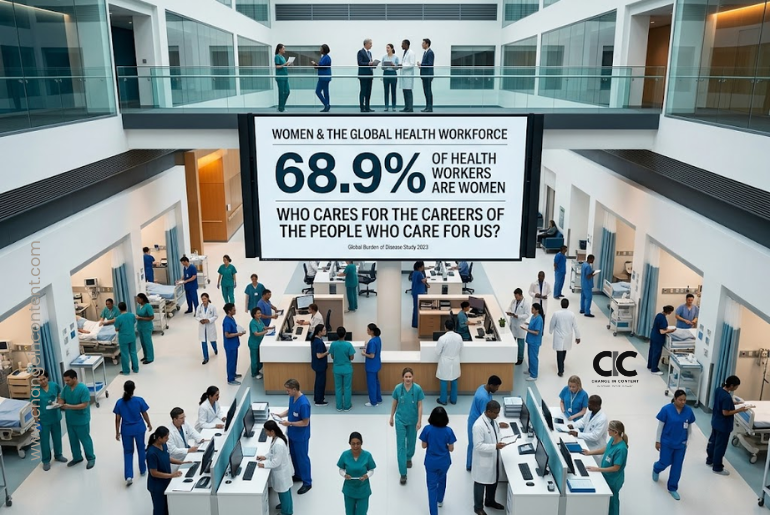
The Quick Read
- Women and the global health workforce are inseparable: women accounted for 68.9% of health workers worldwide in 2023 and drove 71.4% of the workforce’s net growth since 1990.
- The number of health workers across the 20 occupations studied increased from 40.9 million in 1990 to 122.1 million in 2023.
- Women dominate several essential care professions. In 2023, women were 80.7% of nurses, 96% of midwives and 89.5% of community health workers, but only 43.9% of doctors.
- The study estimates another 34.4 million doctors, nurses, midwives, dentists and pharmacists would be required for countries to reach their benchmark for moderate universal health coverage. South Asia and sub-Saharan Africa carry some of the largest deficits.
- Women being numerous in healthcare has not automatically given them equivalent economic or organisational power. WHO has previously found that women comprise almost 70% of the health and social workforce while holding only about 25% of senior roles and experiencing a substantial gender pay gap.
- Solving the health-worker shortage therefore presents two opportunities at once: train and employ more people, and improve the quality, pay, safety and career pathways of the workforce that women already overwhelmingly sustain.
Women and the global health workforce: An inseparable match
At 3 am, healthcare becomes very uncomplicated.
Someone needs a nurse, a midwife, a doctor, a pharmacist, a community health worker, and a laboratory professional.
Someone has to notice the change in a patient’s breathing. Administer the medication. Help deliver the baby. Explain the diagnosis. Comfort the family. Return for the next shift.
At that hour, the health system does not run on strategy documents. It runs on people. And around the world, most of those people are women.
New research gives extraordinary scale to that reality. Women and the global health workforce have become so closely connected that women accounted for nearly 7 in every 10 health workers in 2023. More remarkably, women accounted for 71.4% of the net expansion of the workforce between 1990 and 2023.
That should be one of the great stories of women’s economic participation. But the same research raises an awkward second question.
If women have done so much to build the global health workforce, why does the architecture of healthcare still keep so many of them farther from its best-paid jobs and biggest decisions?
That is the story behind the headline.
The world’s health workforce almost tripled in a generation
The scale of growth is striking.
The new Global Burden of Disease Study 2023 analysis covers 204 countries and territories and 20 categories of health workers. It estimates that the global health workforce grew from 40.9 million people in 1990 to 122.1 million in 2023.
An increase of more than 81 million workers. Women accounted for most of it.
By 2023, the world had an estimated:
- 33.2 million nurses
- 15.1 million doctors
- 7.6 million community health workers
- 6.8 million pharmacists and pharmaceutical assistants
- and millions more working as midwives, dentists, laboratory personnel and other health professionals.
This is enormous human infrastructure.
You can build hospitals, purchase equipment, and install digital systems. But without people trained to use them, health capacity remains largely theoretical.
Women have been central to turning that capacity into actual care.
Look inside the 68.9%, and another story appears
Women represented 68.9% of all health workers in 2023. But they were not evenly distributed across professions.
- Among doctors, women represented 43.9%.
- Among nurses: 80.7%.
- Among midwives: 96%.
- Among community health workers: 89.5%.
There is something familiar about that pattern.
The occupations closest to sustained, hands-on care are overwhelmingly female. And the closer we move towards some of the professions historically associated with higher earnings, prestige and organisational authority, the less dominant women’s representation becomes.
That phenomenon has existed long enough for WHO to give an earlier gender analysis of the health workforce a particularly memorable title: Delivered by Women, Led by Men.
The 2019 WHO analysis examined leadership, pay, occupational segregation, discrimination and working conditions across the global health and social workforce. 7 years later, the new workforce numbers suggest that the title still asks an uncomfortable question.
Women have clearly entered healthcare. They have expanded it. They have sustained it. But representation in the workforce and representation in power are not the same achievement.
A shortage of 34.4 million makes this more than a gender story
The world also needs considerably more health workers. Using a benchmark of 80 on the Global Burden of Disease universal health coverage effective-coverage index, researchers estimate a global gap of 34.4 million workers across five major professions.
That includes approximately:
- 23.9 million nurses and midwives
- 7.1 million doctors
- 1.8 million dentists
- 1.6 million pharmacists.
The shortages are extremely uneven. South Asia would need about 10 million additional nurses and midwives and 2.6 million additional doctors to reach that benchmark.
Sub-Saharan Africa would require around 5.7 million nurses and midwives and 2.5 million doctors. Nursing density illustrates the disparity particularly sharply: the study estimates 14.5 nurses per 10,000 people in sub-Saharan Africa, compared with 121.8 per 10,000 in high-income countries.
That creates a global policy problem. It also creates a massive labour-market opportunity.
Millions of health jobs will have to be created, trained for, financed and retained. Given the existing gender composition of healthcare, women are likely to occupy a substantial share of them.
The question is whether the world simply produces millions more women in the same unequal occupational structure. Or uses workforce expansion to improve the structure itself.
There are actually two shortage numbers, and both matter
Readers following global-health statistics may encounter another figure.
WHO estimates that the shortage of health workers was 14.7 million in 2023 and is projected to fall to approximately 11.1 million by 2030. That does not make the new estimate of 34.4 million wrong. The methodologies differ.
WHO’s shortage methodology examines workforce supply against health-system need and SDG workforce thresholds.
The new GBD analysis asks how many additional doctors, nurses and midwives, dentists and pharmacists countries would require to reach a specific benchmark of 80 on the UHC effective-coverage index.
So 34.4 million should not be casually described as “34.4 million healthcare vacancies”. It represents an estimated workforce gap against a defined level of health coverage.
That distinction matters. But whichever measure we use, the underlying conclusion survives: There are nowhere near enough health workers in many parts of the world.
So why isn’t a female-majority workforce necessarily a women-friendly workforce?
Because headcount is one measurement. Jobs have many others.
- How much does the job pay?
- How predictable are the hours?
- Is it secure?
- Is the worker protected from violence and harassment?
- Who gets promoted?
- Who runs the hospital?
- Who heads the department?
- Who controls the budget?
- Who moves into national health leadership?
- Who participates in policy?
- Who owns healthcare companies?
- Who sits on boards?
- Who gets recognised as possessing “leadership potential”?
WHO’s broader gender analysis has found persistent occupational segregation within healthcare. Women are disproportionately represented in care-oriented occupations and lower-status roles and underrepresented in senior decision-making.
A 2026 WHO report on ageing and inequities similarly states that women make up almost 70% of the formal global health and social workforce but hold only around 25% of senior roles. It also cites an adjusted global gender pay gap of 24 percentage points in the sector.
Think about the contradiction. A sector can be overwhelmingly female and still have a gender problem. Numbers alone cannot tell us where power sits.
Healthcare has another problem: We routinely undervalue care
Part of the occupational divide reflects a much older economic habit. Care has historically been associated with women.
Women care for children. Older people. People who are sick. People with disabilities. Families. Communities.
Much of that care began as unpaid work. When similar work moved into formal economies, its social value did not always translate into equivalent economic value.
- Nursing is skilled.
- Midwifery is skilled.
- Community healthcare is skilled.
Care work involves clinical judgement, technical training, emotional labour, physical effort, risk and responsibility. Yet because women are heavily concentrated in such professions, there is a danger of treating the workforce as naturally available rather than economically valuable.
Our Change in Content story on the history of Kerala nurses who helped sustain Germany’s healthcare system offers a human version of this same global story.
Decades ago, young women travelled thousands of kilometres because Germany needed nurses.
- They brought skills.
- They worked difficult shifts.
- They learnt another language.
- They became part of the country’s healthcare infrastructure.
Today, health systems continue recruiting nurses internationally because the demand for care has not disappeared. The underlying economic question remains: How highly do we value the people whose absence would make the system stop?
The world’s workforce shortage could become women’s career opportunity
That is where the story becomes more hopeful.
A shortage of health workers means countries need to expand education, training, employment, specialisation, management, technology, research, public health, and healthcare leadership.
Women are already inside this ecosystem at enormous scale. That should provide a platform for upward mobility.
- A nurse should have routes into advanced practice, specialisation, management, education, research, hospital administration, public-health leadership, and health entrepreneurship.
- A community health worker should be able to progress through recognised credentials rather than remain permanently positioned at the bottom of a care hierarchy.
- Women doctors should have clearer pathways towards departmental leadership, hospital management, professional bodies and health-system governance.
- Midwives should have professional authority proportional to their expertise.
The workforce gap can therefore be approached as both a capacity problem and a career-design opportunity.
Recruit more people. And design better careers for the people recruited.
Leadership matters because workers understand what systems miss
Putting more women into health leadership is sometimes framed as representation.
There is a practical argument too.
- A nurse who has spent twenty years on wards understands staffing.
- A midwife understands maternity systems from inside them.
- A community health worker knows why an apparently sensible health programme fails in a village.
- A woman doctor may notice aspects of institutional culture that somebody looking only at hospital finances will miss.
Different experiences improve the information available around the decision-making table.
WHO’s gender analysis has previously argued that removing barriers to women’s advancement is necessary for stronger health systems and universal health coverage itself.
The problem is therefore bigger than: “Women deserve leadership too.”
Health systems need leadership informed by the workforce actually delivering healthcare. And that workforce is predominantly female.
There is another dimension: Who cares for the carers?
The world needs millions more health workers partly because healthcare work can be difficult to sustain.
Long shifts. Night work. Violence. Staff shortages. Emotional exhaustion. Infection risks. Burnout. Migration. Care responsibilities outside the workplace.
A workforce shortage can worsen job quality.
- Fewer nurses mean more pressure on the nurses remaining.
- More pressure can produce departures.
- Departures deepen the shortage.
- Then the remaining workers carry even more.
A sector dominated by women can therefore disproportionately shift workforce shortages onto women through heavier workloads. That makes retention as important as recruitment.
WHO’s current health-workforce agenda explicitly emphasises the need for a workforce that is sufficiently staffed, appropriately distributed, competent, protected and motivated. WHO now estimates the global health workforce at more than 70 million under its narrower National Health Workforce Accounts definition and warns that shortages, migration, uneven distribution and workforce retention remain major challenges.
Producing another million nurses helps. Making nursing a profession in which people can build safe, financially sustainable 30-year careers helps too.
South Asia should pay particular attention
The shortage estimates make South Asia central to this conversation. The region contains some of the world’s largest healthcare needs and workforce gaps. It also has a long history of women entering nursing and care professions, including women migrating internationally to fill shortages elsewhere.
Change in Content recently documented how Kerala nurses became part of Germany’s healthcare story. Their experience showed something remarkable long before phrases such as “global talent mobility” became fashionable: women’s skills travel. But migration can create a difficult equation.
A high-income country solves its shortage by recruiting nurses from a country that may also need nurses. The individual woman gains income and opportunity. The destination country gains skills. And the source country risks losing scarce professionals.
There is no simple answer. Ethical international recruitment, better domestic pay, strong training pipelines and agreements that create benefits for both source and destination countries all become important.
The newest numbers make that conversation urgent.
India has another reason to care: Health systems affect women on both sides
Women occupy an unusual position in healthcare. They constitute a huge proportion of its workforce. They are also patients navigating systems that have not always understood women’s health particularly well.
Change in Content has previously examined the underrepresentation of women in drug trials and the consequences of medical gaslighting and gender bias in healthcare.
These are different issues from workforce inequality. But they share something.
Health systems are not merely buildings where scientific care happens automatically. They are institutions.
- Who researches?
- Who diagnoses?
- Who gets listened to?
- Who leads?
- Who determines priorities?
- Who gets promoted?
- Who has resources?
All of these can influence the system women eventually experience as patients and professionals. It makes gender equity inside the health workforce relevant beyond HR.
Women and the global health workforce: What should change?
The new study provides scale. The response now needs substance.
Health systems should start with compensation.
Essential jobs require wages that attract and retain skilled workers. Where large gender pay differences exist within healthcare, governments and employers should measure them by profession, seniority, and employment status, and identify their origins.
Then progression.
Female-majority professions need credible routes into senior clinical practice, management, academia, policy and executive leadership.
Then training.
Expanding health-worker education is unavoidable if the world is to narrow a 34.4 million UHC workforce gap under the study’s benchmark.
Then working conditions.
- Safe staffing.
- Protection against violence.
- Predictable scheduling where possible.
- Occupational health.
- Mental-health support.
- Maternity and parental systems.
- Flexibility appropriate to healthcare settings.
And finally, leadership.
If almost seven in ten workers are women while only around a quarter of senior roles are held by women, the pipeline deserves investigation.
- Where do women stop progressing?
- Which professions lead to executive authority?
- Who receives management experience?
- Which career stages produce the largest departures?
- What happens after maternity?
- Who gets research leadership?
- Who controls budgets?
Those answers would tell us whether women’s numerical strength is translating into institutional influence.
The Change in Content View: 70% Should Mean More Than Holding the System Together
There is something extraordinary about the newest global numbers. Between 1990 and 2023, humanity added more than 81 million health workers. Women drove more than 70% of that increase.
Think about what sits inside that statistic.
- Births attended.
- Medicines administered.
- Children vaccinated.
- Wounds dressed.
- Emergencies handled.
- Families counselled.
- Patients monitored.
- Villages reached.
- Night shifts completed.
- Pandemics survived.
- Lives extended.
Women have already proved their value to global healthcare. The next question should not ask them to prove it again. It should ask whether health systems have adequately valued that contribution.
A world facing enormous workforce shortages cannot afford to treat the people doing most of its healthcare work as an endlessly renewable supply of care.
Train more women, certainly. Create more jobs. Give young women access to health careers. But also improve the jobs already waiting for them. Pay. Safety. Professional status. Specialisation. Retention. Career mobility. Leadership. Power.
Adding millions more women to health systems without changing where women sit within those systems would solve only part of the shortage. The better outcome is a larger global health workforce and a better one.
One in which the woman who enters healthcare to care for patients can also become the person running the hospital, directing the research programme, shaping national policy or deciding how the next generation of health workers will work.
Nearly 70% is already a remarkable contribution. Now let it carry proportionate opportunity.
Editorial Note and Disclaimer
This article draws primarily on the 2026 Lancet Public Health analysis of health-worker availability and composition across 204 countries and territories, alongside WHO material on gender, leadership and workforce shortages. The study’s estimate of 34.4 million additional workers is based on the workforce required to reach an effective UHC coverage index score of 80. It differs methodologically from WHO’s separate health-worker shortage estimates. Figures should therefore not be treated as interchangeable. References to career design, remuneration, retention and leadership are editorial interpretations informed by the cited evidence.
Sources
- The Lancet Public Health/Global Burden of Disease Study 2023: Measuring the composition and availability of human resources for health by sex in 204 countries and territories, 1990–2023, and workforce gaps for universal health coverage, published 18 August 2026. The study provides the 122.1 million workforce estimate, the 68.9% female share, and the 34.4 million UHC workforce gap estimate.
- World Health Organisation — National Health Workforce Accounts: Health Workforce Levels and Trends 2026. WHO reports that women comprise 67% of the workforce captured in its NHWA framework and highlights shortages, unequal distribution and retention challenges.
- WHO — Delivered by Women, Led by Men, the Gender Equity Hub’s analysis of leadership, occupational segregation, pay and working conditions across the global health and social workforce.
- WHO — World Report on Social Determinants of Health Equity, 2026, including current evidence on women’s representation, seniority and pay in the health and care economy.
