
The Brief
- WEF gives India an educational-attainment parity score of 96.6%, against 44.1% for labour-force participation parity.
- These compare women with men; they are not the percentages of women educated or employed.
- August 2026 government data shows women’s labour-force participation rising nationally, with rural and urban trends diverging.
- Enrolment parity does not establish equal learning, job readiness or access for every community.
- Colleges, employers and public agencies should track the journey from learning to paid work, including who gets an offer and who can take it up.
Gender parity in education in India: The progress and the challenges
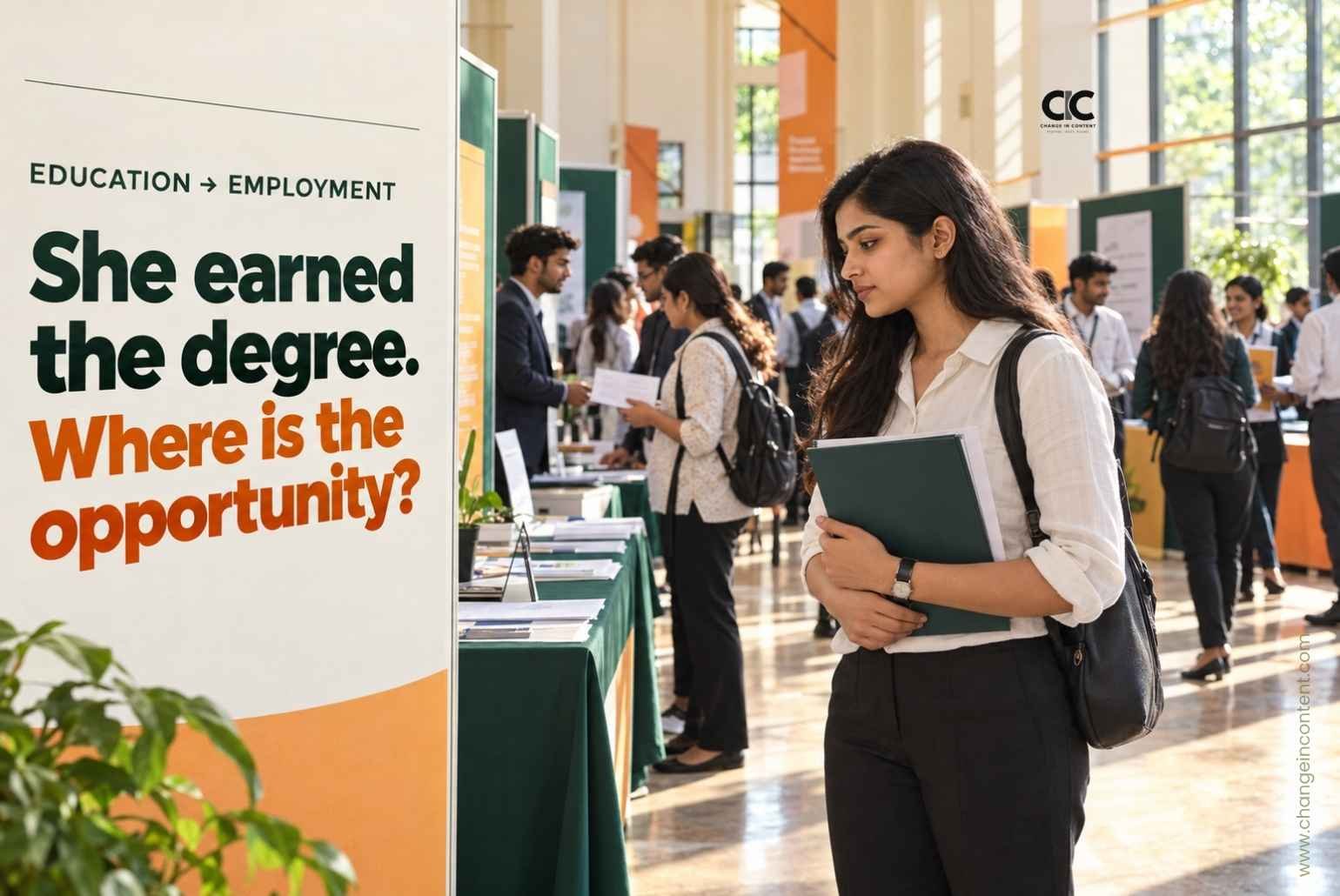
A graduation photograph records an achievement. But it cannot tell us whether the woman holding the degree will get an interview, accept the job offered or still be employed a year later. Gender parity in education in India deserves its celebration. We should be just as interested in what happens after the photograph.
The World Economic Forum’s Global Gender Gap Report 2026 places India’s educational-attainment parity score at 96.6%. Labour-force participation parity stands at 44.1%. The first reflects substantial progress in closing educational gaps; the second exposes how much further economic opportunity has to travel. (World Economic Forum)
The 44.1% figure compares female and male participation rates in WEF’s underlying data. It does not mean that 44.1% of Indian women work. Nor do these two measures follow the same graduating class into employment. Read together, they raise a question that an enrolment milestone cannot answer: How effectively does India enable educated women to build working lives?
Education has advanced. The finish line has not arrived.
WEF records full parity in secondary and tertiary enrolment. That is an achievement built through years of effort by students, families, teachers and institutions. We must recognise it without qualification about whether every graduate immediately earns a salary. Education also expands knowledge, autonomy and the ability to participate in public life.
But parity compares genders. It cannot, by itself, establish that everyone receives a good education. Similar enrolment rates can coexist with exclusions affecting both girls and boys. National averages also leave room for large differences between places and communities.
The education-to-employment gap for women therefore needs its own measures. A college can report strong female enrolment while knowing little about which graduates receive paid offers, what those offers pay or why some are unable to join.
Celebrating access should lead to that next set of questions. It should also preserve attention to girls and women whom the education system still fails to reach.
Rural gains deserve a closer look
MoSPI’s August 2026 PLFS release provides a more immediate view. Among women aged 15 and above, labour-force participation reached 34.8%, compared with 33.7% a year earlier. Its Current Weekly Status measure covers people working, seeking, or available for work during the preceding seven days.
|
Female labour-force participation, age 15+ |
August 2025 | August 2026 | Change |
|
Rural |
37.4% | 39.4% | +2.0 percentage points |
| Urban | 26.1% | 25.4% |
−0.7 percentage points |
| All India | 33.7% | 34.8% |
+1.1 percentage points |
Source: MoSPI, PLFS monthly release, Current Weekly Status. Press Information Bureau
The national improvement deserves acknowledgement. So does the urban decline. A city’s concentration of colleges and employers does not automatically translate into women participating in its labour market.
Rural participation, meanwhile, should be examined alongside earnings, hours, security and the nature of work. A higher rate alone cannot tell us whether women have gained better-paid jobs or more control over their income. Equally, it would be unfair to dismiss rural women’s economic contribution because it takes place outside a corporate office.
Our analysis of women’s access to formal employment points towards that broader assessment. Participation is one part of progress; the conditions under which people work are another.
Work readiness needs a route into real work
The education institutions have a responsibility here. Students need opportunities to apply what they learn, use relevant tools, solve practical problems and understand how recruitment works. Those opportunities should be built into the course rather than reserved for students who can purchase extra training or draw on family contacts.
Paid internships, supervised projects and employer-linked placements can make that transition more accessible. Career support should explain salary structures, contracts, workplace rights and the actual requirements of a role. Employers should help design practical assessments and entry-level training, rather than demanding experience that a first-time applicant has had no fair chance to acquire.
For women, access to those opportunities needs checking.
- Can students reach the placement safely?
- Is relocation affordable?
- Are they being offered substantive assignments? Do recruiters assess their skills consistently?
The gap between women’s STEM qualifications and technical roles makes it especially important to examine where graduates go, alongside how many finish a course.
None of the headline figures proves that women lack job readiness. Training can address an identified skills gap. It cannot, on its own, create vacancies, remove discriminatory selection or make an unaffordable commute manageable.
An equal chance has practical requirements
Consider a paid internship that requires relocation before the first stipend arrives. A capable applicant may need affordable accommodation or an advance to take it up. A parent returning to work may need childcare whose hours match the shift.
These are examples of how an opportunity can exist on paper yet remain difficult to use.
The government’s Time Use Survey 2024 provides relevant context. Among people aged 15–59 who undertook household caregiving, women averaged 140 minutes a day, against 74 minutes for men. Those figures do not explain every employment decision, but they show why time available for paid work cannot simply be assumed equal.
Equity means identifying such barriers and responding to them while maintaining meaningful standards.
- Colleges can make paid experience accessible.
- Employers can publish clear selection criteria and review who is shortlisted, offered work and promoted.
- Public agencies can improve transport and care provision.
- Families can share domestic responsibilities so that a woman’s career does not depend on completing a second working day at home.
A useful starting point is a shared follow-up after graduation. Track offers, joining rates, pay and employment at six and twelve months, with consent and appropriate privacy protections. Ask why offers were declined and why jobs ended. Separate further study and freely chosen breaks from unsuccessful job searches and constraints people would like help to overcome.
Such information would make it harder to count a placement offer as the end of an institution’s responsibility.
Gender parity in education in India: Change in Content view
A woman’s qualification should give her a fair chance to use her abilities. She should be able to pursue work, further study or another path without exclusion quietly making the decision for her.
India has reason to take pride in its educational progress. The next achievement will be visible in the opportunities women can actually accept, the incomes they control and the careers they choose to continue.
Editorial note and sources
This commentary uses WEF’s Global Gender Gap Report 2026, MoSPI’s August 2026 PLFS monthly release and the government’s Time Use Survey 2024. WEF parity scores and PLFS participation rates use different measures and reference data; they are not a single education-to-employment tracking study. Monthly CWS estimates should not be directly compared with annual usual-status figures. Recommendations are CIC’s analysis, and the practical examples are illustrative, not interviews. Sources were checked on 8 October 2026.
Sources
- World Economic Forum: Global Gender Gap Report 2026: benchmarking and India findings
- World Economic Forum: User’s Guide and interpretation of parity scores
- MoSPI/PIB: PLFS Monthly Bulletin, August 2026: official release
- MoSPI/PIB: Time Use Survey 2024: official findings
