In a world still catching up on inclusivity, celebrating diverse content is one of the simplest forms of allyship. By choosing what we watch and read, we choose what kind of world we normalise.
June marks Pride Month, a time rooted in cultural and historical significance. It reminds us to celebrate LGBTQ+ lives, stories, and rights, not just now, but throughout the year. In India, a content market dominated by family dramas, content around queer people, is not yet mainstream. We see influential personalities like Karan Johar talking about his queerness openly, but can you imagine a popular show having a queer person in the lead role? A coffee with Karan is not targeted at content consumers in ‘Bharat’.
Why celebrating diverse content matters
Queer stories haven’t always had space in mainstream media. For decades, representation remained limited or riddled with stereotypes. The lack of authentic stories often had hidden biases, especially in cultures where open conversations about gender and sexuality remained taboo.
One of the simplest and most impactful ways to support the community is through the content you consume. Media, whether films, books, music, or art, can influence how society sees queerness, break down stereotypes, and build empathy. That’s why watching, reading, and listening to LGBTQ+ creators is not only a celebration but also an act of allyship.
Representation in media matters
Media, particularly OTT platforms, now play a key role in changing this.
When stories by and about LGBTQ+ people get told truthfully and creatively, they help normalise queer identities. These stories aren’t just for entertainment. They spark conversations, push boundaries, and make room for acceptance.
Today, more creators are doing just that, telling stories that are honest, complex, and grounded in the lived realities of queer individuals. Telling LGBTQIA+ stories is just as important as telling cisgender ones, especially in a world where queer narratives often go unheard.
9 picks for celebrating diverse content this Pride Month
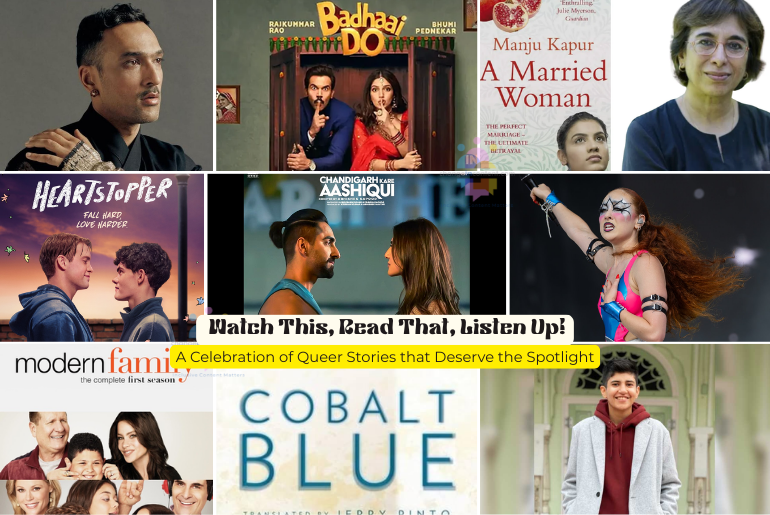
In that spirit, ChangeinContent presents a curated list of content that both entertains and educates, from films and series to books and LGBTQ+ artists, that reflect the community’s lived experiences. We are celebrating diverse content with our top picks, and we share the list with you below.
1. Badhaai Do (Netflix): A glimpse into lavender marriages in India
Directed by Harshavardhan Kulkarni and written by Suman Adhikary and Akshat Ghildial, Badhaai Do brings India’s complex relationship with queerness into focus. The story follows Shardul, a gay policeman, and Sumi, a lesbian teacher. To escape societal pressures, they enter a “lavender marriage”, a union that hides their real identities from a judgmental society.
The film does not romanticise this arrangement. Instead, it exposes how caste, age, and social expectations often outweigh a person’s truth. Families might celebrate a match without ever knowing the reality behind it. Badhaai Do makes it clear that queer people in India still face enormous pressure to conform, often at the cost of their happiness.
Don’t miss our piece on LGBTQ+ inclusion through the lens of Badhaai Do and what it means for queer representation in Bollywood.
2. Ali Sethi: Celebrating diverse content with a voice that broke barriers
Ali Sethi, the Pakistani singer behind the viral hit Pasoori, has long used his music to break down obstacles. His music has travelled across. Known for reviving the classic ghazal and blending it with contemporary sounds, Sethi’s work reaches far beyond Pakistan. He once said, “My music will travel to India even if I can’t”, and it has.
In a heartfelt Instagram post, Sethi publicly embraced his queer identity. That moment brought both support and backlash. Some began questioning his art through the lens of his sexuality, ignoring the very work that had once united people. In March 2021, Sethi released Rung, a music video filmed in Lahore and New York, celebrating queer identities through visuals and sound. It’s a beautiful, surreal tribute to the LGBTQ+ community and a timely pick for Pride Month.
3. Heartstopper (Netflix): Queer joy without the stereotypical drama
Based on Alice Oseman’s graphic novels, Heartstopper follows Nick and Charlie, two British teenagers navigating friendship, identity, and first love. What sets the series apart is its warmth. It doesn’t sexualise or monetise queer experience. Instead, it shows teenagers being teenagers with all their awkwardness, joy, and vulnerability.
Unlike many shows that centre queer identity around trauma or sexuality, Heartstopper lets its characters grow and feel safe. The fact that both the original comic and the show come from queer creators plays a significant role in its authenticity. The series explores common issues within the LGBTQ+ community like bullying, homophobic abuse, and identity crisis, but it also captures the pride and joy of being gay. That balance is what makes it widely praised as a realistic and honest portrayal of queer joy.
4. Modern Family (JioHotstar): Changing what prime-time looked like
Before queer storylines became common in television, Modern Family stood out. When it premiered in 2009, same-sex marriage hadn’t been legalised in the U.S., and LGBTQ+ representation in mainstream shows remained scarce. The characters Cam and Mitch offered many viewers their first glimpse into a same-sex family dynamic.
Though contrived and simplified at times, the show helped normalise irregular families (marriage to a migrant, adoption and homosexuality). For many millennials and boomers, it was often the first time they saw gay characters treated with warmth and humour. Today, Gen Z has more inclusive content to choose from, but Modern Family holds its place in history for opening doors that others would later walk through.
Modern Family, but make it Indian. Check out our fun spin on “What if Cam and Mitch lived in India?”
5. Cobalt Blue by Sachin Kundalkar: A queer classic from regional India
Originally written in Marathi and translated into English by Jerry Pinto, Cobalt Blue explores queer love with poetic restraint. The story revolves around siblings Tanay and Anuja, who both fall for the same man, a paying guest living in their home. Their separate narratives unfold back-to-back, giving the reader two distinct emotional journeys that slowly reveal a complete picture.
Through this literary lens, the book examines not only queer love but also the silent heartbreaks and hidden desires often buried in Indian households. Cobalt Blue captures the loneliness, beauty, and pain that define many queer relationships, especially in spaces where they remain unspoken.
6. A Married Woman by Manju Kapur: Quiet rebellion in Desi fiction
Published in 2003, A Married Woman remains a powerful critique of traditional expectations. The novel tells the story of Astha and Peeplika, two women caught between societal norms and personal desires. As they form a relationship, the book examines the cost of defying heteronormative roles.
Kapur doesn’t offer easy resolutions. Instead, she lays bare the emotional struggles of women forced into roles they didn’t choose. In doing so, the novel becomes a compelling look at the intersection of gender, marriage, and sexuality in Indian society.
7. Jay Anand: A rising voice in Queer Indian music
Jay Anand, a trans artist, made waves with his work on the soundtrack of Loop Lapeta, a 2022 action-comedy film. But long before that, he had already started building his musical journey. His early releases, Faces of Love, Fool to Want You, and Come Home, showcase not only his vocal talent but also a commitment to expressing his identity through music.
Anand uses his platform to speak openly about gender identity and the challenges faced by trans people in the arts. His work reflects both vulnerability and strength, helping others see what gender diversity can look and sound like.
8. Chappell Roan: The power of Queer pop
Chappell Roan is bold, theatrical, and unapologetically queer. Her album The Rise and Fall of a Midwest Princess is a deeply personal story about coming out, exploring sexual identity, and embracing queer love, all while resonating with both LGBTQ+ and straight audiences.
Chappell Roan’s song “Good Luck, Babe!” speaks directly to the emotional struggle many closeted lesbians face. It captures the pain of wanting to be with another woman but feeling forced to hide that love because of societal pressure and fear of judgment. The song’s chorus—“You can kiss a hundred boys in bars, shoot another shot, try to stop the feeling”—highlights trying to fit into heterosexual norms by dating men, even when it doesn’t feel right. The song became a sapphic anthem.
9. Chandigarh Kare Aashiqui (Netflix): A bold step for trans representation
Abhishek Kapoor’s Chandigarh Kare Aashiqui breaks away from Bollywood’s typical love stories by centring a romance between a cisgender man, Manu (Ayushmann Khurrana), and a trans woman, Maanvi (Vaani Kapoor). It’s one of the few mainstream Hindi films that portrays a transgender protagonist with dignity, steering clear of comic stereotypes.
Even more importantly, it brings attention to the emotional work that partners and families of trans individuals must be ready to do. Manu’s reaction when Maanvi comes out to him is far from ideal. He lashes out, accuses her of betrayal, and takes a while to process the truth. But the story doesn’t stop there. It takes viewers through his discomfort, denial, and eventual growth. Maanvi, meanwhile, holds her ground with grace, honesty, and vulnerability. It’s not an easy watch, but it’s a necessary one.
Final thoughts: Why celebrating diverse content should not be seasonal
True allyship involves more than waving a flag or reposting quotes. It means learning, unlearning, and listening. Queer representation in the media plays a crucial part in this process. Every book you read, every show you watch, and every song you stream has the power to shift conversations. The above list is only a small window into the broad spectrum of LGBTQ+ content, but it’s still a good starting point.
ChangeinContent believes Pride is more than a moment in June. We urge everyone to consume LGBTQ+ and diverse content with awareness and carry that support forward every day of the year. We also believe that content can either reinforce bias or dismantle it. Celebrating diverse content is a cultural correction that needs your attention every single day.
Disclaimer: The views expressed in this article are based on the writer’s insights, supported by data and resources available both online and offline, as applicable. Changeincontent.com is committed to promoting inclusivity across all forms of content. We broadly define inclusivity as media, policies, law, and history, encompassing all elements that influence the lives of women and marginalised individuals. Our goal is to promote understanding and advocate for comprehensive inclusivity.