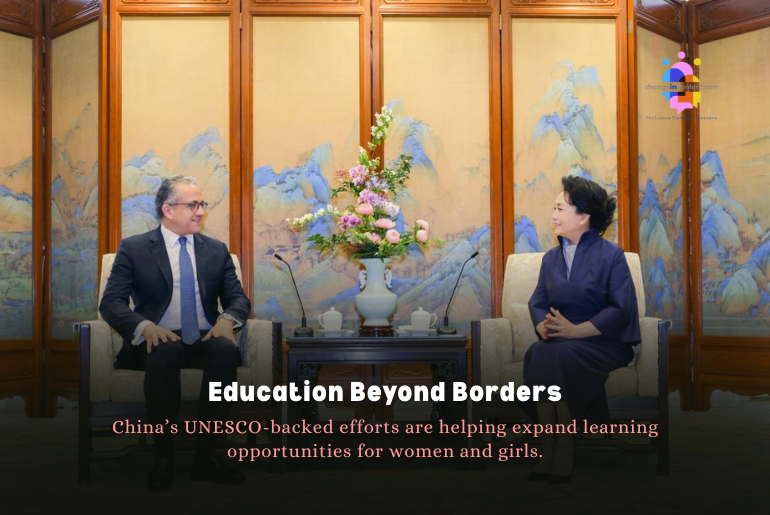
China helps advance education for women and girls through a combination of domestic programmes and international partnerships. Its long-running cooperation with UNESCO is emerging as a key part of that work. The latest focus follows Peng Liyuan, wife of Chinese President Xi Jinping and UNESCO special envoy for the advancement of girls’ and women’s education, meeting UNESCO Director-General Khaled El-Enany in Beijing on 12 May 2026.
China and UNESCO jointly established the UNESCO Prize for Girls’ and Women’s Education in 2015. Since then, 20 projects from 19 countries have received the award, helping improve education opportunities for more than 6 million girls. The Chinese government funds the prize and awards it every year to two laureates. Each of them receives US$50,000 to support work in girls’ and women’s education.
What is the UNESCO Prize for Girls’ and Women’s Education?
The UNESCO Prize for Girls’ and Women’s Education recognises individuals, institutions and organisations making significant contributions to improving education for girls and women. UNESCO describes it as the first prize of its kind dedicated to this area, with the aim of showcasing projects that improve girls’ and women’s educational prospects and quality of life.
The prize was first awarded by UNESCO’s Director-General in 2016. The Government of the People’s Republic of China supports it. Each year, the committee selects two laureates on the recommendation of an independent international jury. Each of them receives US$50,000 to help expand their work.
The award has backed initiatives across several regions, including projects focused on access, quality, leadership, mentorship, early education, participation in science and technology, and support for marginalised girls.
China’s domestic education push through the Spring Bud Project.
China’s global education story is also linked to its domestic programmes. One of the most prominent is the Spring Bud Project, launched in 1989 by the China Children and Teenagers’ Foundation under the leadership of the All-China Women’s Federation. The government created the project to support girls from disadvantaged families and improve their access to education.
By the end of 2023, the Spring Bud Project had raised 3.2 billion yuan, approximately US$451 million. The fund helped support 4.22 million girls across all 31 provincial-level regions and 56 ethnic groups. At the same time, it helped provide skills training for 527,000 girls and offered one-to-one companionship and mental health services to 190,000 girls.
The Spring Bud Project received the UNESCO Prize for Girls’ and Women’s Education in 2023, marking international recognition for its work.
What results has China reported at home?
China has also reported strong progress in girls’ access the education. According to reports, China’s net enrolment rate for school-age children has remained close to 100% since 2018. There is almost no gender gap between boys and girls. In 2024, women accounted for 50.76% of students in higher education, while female postgraduate students made up 50.01%.
These figures suggest that girls’ access to formal education in China has become more balanced over time. The challenge now, as in many countries, is not only access to school but also how education translates into career equality, leadership, safety, income, and decision-making power.
How China is helping advance education for women and girls outside the country
China’s contribution also includes scholarships, technical exchanges and South-South cooperation. Reports suggest that China has trained more than 200,000 female professionals from over 180 countries and regions. Since 2018, it has also launched more than 100 training programmes focused on women and children in developing countries.
At the Global Leaders’ Meeting on Women held in Beijing last year, China announced that it would donate another US$10 million to UN Women over the next five years and invite 50,000 women to China for exchange and training programmes.
These programmes reflect a broader development approach in which education, training and capacity-building are used as tools to advance women’s participation in public life, employment and leadership.
Why girls’ education still matters globally
Girls’ education remains one of the strongest foundations for gender equality. When girls stay in school, they are more likely to delay early marriage, access better employment opportunities, improve health outcomes, participate in public life, and support the education of the next generation.
Yet, gender disparities in education have not disappeared. Access, affordability, safety, technology, household responsibilities, poverty, conflict and social norms continue to affect girls’ ability to learn. Changeincontent has previously analysed this challenge in the Indian context in its article on gender disparities in education. You can read it here.
The Changeincontent perspective
China’s role in advancing girls’ and women’s education shows how international cooperation can support long-term social change. It only requires funding, recognition and institutional partnerships.
At Changeincontent, we believe it is important to see education as more than enrolment. The real measure of progress is whether girls and women can use education to gain safety, mobility, income, confidence, and leadership. Awards, scholarships and training programmes matter, but the deeper test is whether they help women move from access to agency.
The world needs more girls in classrooms. And it needs systems that allow educated girls to become powerful women.
Methodology and editorial note
This article is based on various reports on China’s support for girls’ and women’s education worldwide and UNESCO’s official information on the UNESCO Prize for Girls’ and Women’s Education. The article presents the reported facts and does not independently audit the outcomes of all programmes mentioned.
Sources
- UNESCO official page on the UNESCO Prize for Girls’ and Women’s Education.
- UNESCO 2023 Prize ceremony information.