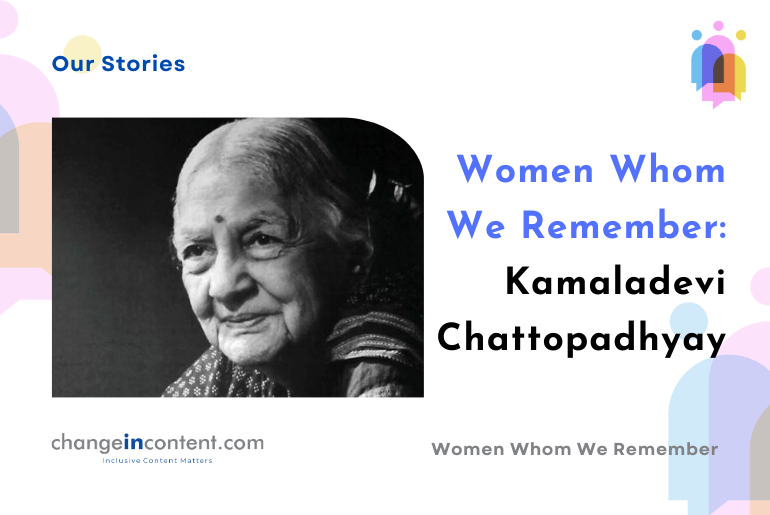
Born in Mangalore, Kamaladevi Chattopadhyay became the first woman to run for a legislative seat in India. She did so during the Madras provincial elections. She saw that Indian women faced not only oppressive colonial rule but also sexism, gender discrimination and class inequality.
Despite pushing for women’s rights like equal pay, better divorce laws, and birth control, Kamaladevi Chattopadhyay refused to be called a feminist. She thought feminism was a too Western label that didn’t fit the realities and challenges faced by women in India, even though she fought for everything feminists stand for today.
Kamaladevi Chattopadhyay’s life as an inspiration
For Kamaladevi, the women’s struggle was deeply personal because of her own life experiences and choices. Married at just 11 to Krishna Rao, Kamaladevi became a child widow shortly after her husband passed away. Following her father’s death, she faced further restrictions when patriarchal laws and customs limited her mother’s inheritance.
Widows in Indian society faced severe ostracisation. The society compelled them to shave their heads and wear white. Moreover, the society forbids them from remarrying. Defying societal norms, Kamaladevi later remarried outside her caste and region. When her second husband, the actor and poet Harindranath Chattopadhyay, continued to have affairs, Kamaladevi challenged another taboo by seeking a divorce.
In traditional Indian society, particularly during Kamaladevi Chattopadhyay’s time, divorce was highly stigmatised, especially for women. They were expected to stay married no matter how tough things got, and leaving a marriage brought a lot of shame. But Kamaladevi Chattopadhyay did something different. She showed that women deserved more rights and respect in society, especially when it came to marriage.
Kamladevi Chattopadhyay: Leading women’s role in the Salt Satyagraha
The Salt Satyagraha of 1930 is an important chapter in India’s fight for independence. More importantly, it was the first widespread participation of women in the freedom movement. But it was the 27-year-old Kamaladevi Chattopadhyay who convinced Mahatma Gandhi to let women join the Salt Satyagraha. This inclusion of women became a significant turning point, encouraging numerous women to join the freedom struggle alongside men.
Kamaladevi Chattopadhyay became the first woman arrested by the British during the Salt Satyagraha for breaking the salt laws. Her bold act at the Bombay Stock Exchange, where she sold packets of salt, led to her arrest. During her trial, Kamaladevi urged the Magistrate to purchase the salt, resign from his position, and join the Satyagraha Army.
Reflecting on those historic days later, Kamaladevi Chattopadhyay recalled how women were involved in the movement. She vividly described women carrying pots of salt water from the sea, defying the law by making salt at home. In her words, “Women, like men, were getting the first taste of liberation.“
Kamaladevi Chattopadhyay: Confronting racism in America
In the spring of 1941, Kamaladevi bravely took a stand against both sexism and racism on a train journey through the Southern United States. When told to leave a “whites only” car, instead of using her status as an Indian dignitary coming from meeting the US president to solve the problem, she boldly said, “I am a coloured woman obviously and it is unnecessary for you to disturb me for I have no intention of moving from here.”
Kamaladevi’s refusal to move challenged American racism and showed support for African Americans, who were called “coloured” at the time.
Kamaladevi Chattopadhyay: Empowering women and artistry
Kamaladevi was also deeply involved with the All-India Women’s Conference (AIWC). As its secretary from 1927 onwards, she didn’t just push for women’s empowerment; she urged AIWC members to support women in fighting for India’s freedom in every way possible.
After being arrested for civil disobedience in India, Kamaladevi Chattopadhyay spent nearly five years in British prisons. During this time, she learned about the lives of Indian peasant women and the importance of locally handmade products in village economies. She realised that these skills not only provided local livelihoods but also had the potential to be unique global exports.
With this insight, she passionately founded institutions that continue to uplift craftswomen today. These include the Cottage Industries of India, the Craft Council, the India International Centre, a craft village for refugees outside Delhi, the Sangeet Natak Akademi, the National School of Drama, the All India Handicraft Board, and the Craft Museum.
Disclaimer: The views expressed in this article are based on the writer’s insights, supported by data and resources available both online and offline, as applicable. Changeincontent.com is committed to promoting inclusivity across all forms of content, which we define broadly to include media, policies, law, and history—encompassing all elements that influence the lives of women and gender-queer individuals. Our goal is to promote understanding and advocate for comprehensive inclusivity.