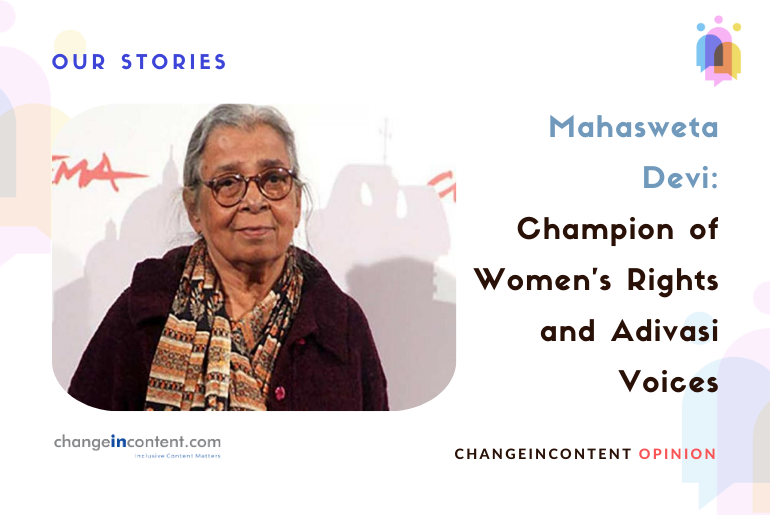
Mahasweta Devi, a celebrated and influential figure in Bengali literature, has consistently brought social issues to life through her relatively straightforward and politically engaged writing style. She began using fiction not just to tell stories but to spark conversations. These were conversations about and with real people who had been ignored for too long. Her stories gave a voice to women who suffered under the oppressive patriarchal system in India. Furthermore, her literature gave voice to the Dalits and Adivasis in Bengal, who have been marginalised and mistreated for generations.
Mahasweta Devi: The mother of Sabars
Born on January 14, 1926, in Dhaka, Bangladesh, Mahasweta Devi was the daughter of renowned poet and novelist Manish Ghatak and writer-activist Dharitri Devi. She began her education in Dhaka, but after the partition, she moved to West Bengal and completed her Master’s in English Literature at Calcutta University.
Mahasweta Devi began her career as a teacher while also working as a journalist and creative writer. Her focus? The oppression of women and Adivasis in West Bengal, particularly the Lodha and Shabar tribal communities. Through her literary works, she exposed the harsh realities inflicted upon these people.
Despite her affluent background, Devi cared little for comfort. She abandoned the luxuries of Calcutta to live with the tribal people, sharing their food, staying in their huts, speaking with them, and truly understanding their struggles. Her activism with the Sabars, a once-stigmatised tribal community in Purulia, West Bengal, earned her the nickname “The Mother of the Sabars.”
A voice for women’s dignity and equality: Mahasweta Devi
Mahasweta Devi’s work and actions show her commitment to improving women’s lives and standing up against injustice. She was a feminist icon who fiercely opposed the dowry system and gender discrimination. Her book “Jhansir Rani” (The Queen of Jhansi) shows her admiration for brave women like Rani Laxmibai. In the 1980s, she led protests to free women who had been wrongly kept in mental hospitals for years.
In “Douloti the Bountiful”, Devi focuses on modern-day slavery among tribal women in India. She exposes how capitalists exploit Adivasi women’s bodies for profit, treating them as commodities to be bought and sold. These women are denied money, healthcare, proper food, and shelter.
Mahasweta Devi’s feminist rendition of ‘Draupadi’
“Draupadi” is a roughly 20-page short story by Mahasweta Devi, acclaimed for its raw and haunting narrative. Originally written in Bengali, it was later translated into English by Gayatri Chakravorty Spivak. The story unfolds during the Naxalite movement in West Bengal, focusing on Dopdi Mehjen, a Santhal woman who joins a tribal rebel group. Their struggle is against the oppressive landlord, Surja Sahu, who denies lower caste people access to essential tube wells during a drought. As tensions rise, Officer Senanayak plans to capture Dopdi and uses violence, ordering his men to sexually assault her to extract information from her and her fellow rebels.
Ironically, the same officers who inflicted harm on her body insist she cover up once they’re finished. Defiantly, Dopdi tears off her clothes and boldly approaches Senanayak, displaying her bruised and wounded body. She spits at him and refuses to dress, declaring, “There isn’t a man here that I should be ashamed of. I won’t let you cover me up. What more can you do? Come on, challenge me—come on, challenge me—?” Confronting army officers with her bare body at the story’s end, Dopdi turns her violated form into a weapon of defiance.
The bare truth laid
“Draupadi” lays bare the truth that women are the most vulnerable victims of conflict and war. Women’s bodies become battlegrounds, subjected not just to physical violence but also to the brutalities of sexual abuse. Mahasweta Devi’s narrative skillfully exposes the harsh reality that, while both genders endure suffering, society expects women to endure an added layer of brutality and exploitation.
Mahasweta Devi’s “Draupadi” is undoubtedly a retelling of a Mahabharata episode in which Draupadi’s husband gambles her away. Both stories highlight how patriarchal forces strip women of their agency over their bodies. Unlike her namesake in Mahabharata, Dopdi did not have a divine saviour like Lord Krishna to intervene and prevent her humiliation. In Devi’s narrative, Dopdi relies on her strength and courage to defy patriarchy.
The final thoughts on Mahasweta Devi
Although Mahasweta Devi didn’t call herself an ecofeminist, her stories showed how the mistreatment of nature and women often go hand in hand. In her writing, she frequently symbolically shows how patriarchal societies see land (nature) and women as things to be conquered, exploited, and controlled by powerful men.
For example, in her story “Witch,” Devi paints a picture of how men in power exploit both nature and women. They manipulate the ignorance and superstitions of villagers to control them, showing their power over both women and the land. Through these stories, Devi criticises the unfair systems that harm women and the environment.
Disclaimer: The views expressed in this article are based on the writer’s insights, supported by data and resources available both online and offline, as applicable. Changeincontent.com is committed to promoting inclusivity across all forms of content, which we define broadly to include media, policies, law, and history—encompassing all elements that influence the lives of women and gender-queer individuals. Our goal is to promote understanding and advocate for comprehensive inclusivity.