
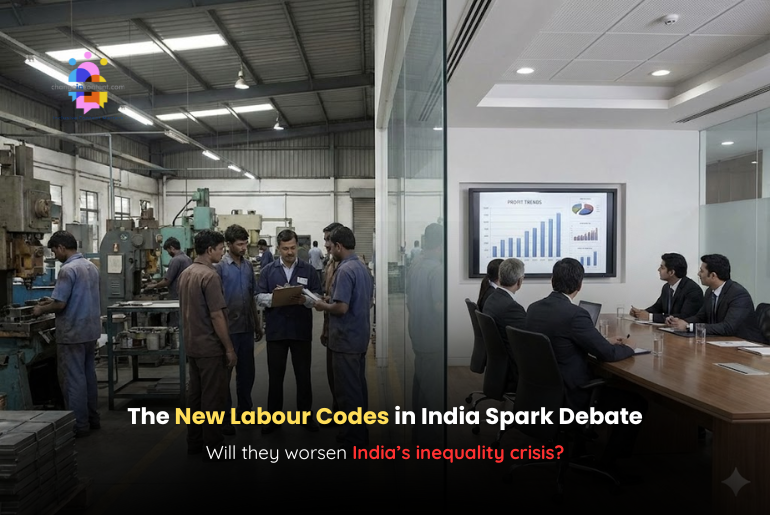
The New Labour Codes were presented as a historic reset. By merging 29 existing labour laws into four consolidated codes, the Union government promised simplicity, efficiency, and a modern labour market aligned with economic growth. Employers welcomed the move as overdue reform. Trade unions saw something else entirely: a dilution of worker protections that could permanently tilt the balance of power.
We cannot reduce the debate to ideology alone. We must examine it against India’s economic reality. Persistent unemployment, declining wage shares, and rising wealth concentration mark it. The real question is not whether labour reform was necessary. The question is whether the New Labour Codes risk exacerbating India’s inequality crisis at a moment when the gap between capital and labour is already dangerously wide.
What the New Labour Codes actually change
The four codes (the Code on Wages, the Industrial Relations Code, the Code on Social Security, and the Occupational Safety, Health and Working Conditions Code) reshape the legal architecture governing employment. Their stated objective is clear: reduce compliance burden, attract investment, and encourage firms to hire.
Yet beneath this consolidation lie substantive shifts. The Industrial Relations Code expands the conditions under which firms can retrench workers without prior government approval, raising the threshold from 100 to 300 employees. It also makes strikes significantly harder by imposing longer notice periods and treating mass casual leave as illegal industrial action. The Code on Social Security formalises fixed-term employment, offering benefits parity in theory but potentially accelerating the move away from permanent employment in practice.
Each of these changes has direct implications for job security, bargaining power, and income stability—key determinants of inequality.
Inequality as the backdrop, not a side issue
The timing of the New Labour Codes matters. The World Inequality Report 2026 paints a stark picture: India is among the most unequal countries globally, with the top 1% controlling roughly 40% of total wealth. More troubling is the persistence of this inequality. Between 2014 and 2024, the income gap between the top 10% and the bottom 50% has not narrowed, despite years of high-growth narratives.
National Account Statistics reinforce this concern. The share of profits in Gross Value Added has risen steadily across sectors such as mining, electricity, transport, and financial services. Wages have not kept pace. In fact, the compensation of employees as a share of GVA declined between 2019–20 and 2023–24.
This is not a new trend. Research has shown that the declining wage share in manufacturing dates back to the 1980s, and recent Economic Surveys indicate that corporate profits are at a 15-year high, while wage growth remains muted.
We must evaluate any labour reform introduced in this context not only on efficiency grounds but also on how it reshapes the distribution of income between labour and capital.
The bargaining power question at the heart of the New Labour Codes
At the macro level, inequality is shaped by who captures value in the production process. Wages reflect bargaining power. Profits reflect the ability of capital to extract surplus. Labour laws are one of the few institutional levers that influence this balance.
The New Labour Codes, particularly the Industrial Relations Code, alter this equation. By making strikes procedurally difficult across all establishments (not just public utilities), the codes weaken a key collective bargaining tool. It matters because wage disputes remain the single largest cause of industrial conflict in India. When workers lose leverage in wage negotiations, income growth at the bottom slows further.
Similarly, raising the retrenchment threshold reduces employment security for a vast majority of Indian workers. Over 90% of enterprises employ fewer than 300 workers. For employees in these firms, job loss becomes easier and protection thinner.
Research on labour flexibility in India consistently shows that easier hiring and firing have not translated into higher employment growth. In some cases, it has coincided with weaker employment performance, particularly in manufacturing.
From an efficiency standpoint, easy retrenchment may also undermine a firm’s competitiveness by eroding worker loyalty, discouraging skill accumulation, and reducing knowledge sharing. These factors are critical for long-term productivity.
Fixed-term employment and the normalisation of precarity
The Code on Social Security extends benefits to fixed-term employees, a feature often cited as progressive. Yet the broader implication is a structural shift away from permanent employment. When firms can rely on rolling contracts with minimal exit costs, employment becomes more uncertain by design.
This uncertainty has distributional consequences. Workers facing job insecurity are less likely to demand higher wages, less able to plan consumption, and more vulnerable to economic shocks. In an economy where domestic demand already struggles to keep pace with productive capacity, weakening wage security risks further suppressing demand.
The government’s argument (that reduced compliance will spur job creation) rests on an assumption that labour flexibility drives employment. The Indian evidence does not strongly support this claim. Structural issues such as weak demand, skill mismatches, and sectoral stagnation cannot be resolved through deregulation alone.
New Labour Codes and the demand side of inequality
Wages are not merely costs to firms; they are also the primary source of purchasing power for the majority of households. When wage growth lags behind profit growth, demand weakens. Firms respond by cutting output and employment, reinforcing a vicious cycle.
This dynamic is particularly dangerous in a volatile global environment. With trade tensions rising and export markets uncertain, India’s growth will depend increasingly on domestic consumption. That consumption cannot expand sustainably without stronger wage growth and employment security.
By weakening worker bargaining power and normalising precarious employment, the New Labour Codes risk exacerbating precisely the conditions that undermine demand.
Changeincontent perspective
The New Labour Codes are neither inherently regressive nor automatically progressive. Their impact depends on what they prioritise. At present, they appear to prioritise firm-level flexibility over worker security, at a time when inequality is already entrenched.
Policy reform cannot be evaluated in isolation from outcomes. If consolidation of laws leads to weaker wage growth, greater precarity, and reduced bargaining power, then efficiency gains for businesses may come at the cost of social cohesion and economic resilience.
A truly balanced labour reform would pair simplification with stronger mechanisms for wage growth, collective bargaining, and universal social protection. Without this balance, reform risks becoming a form of reverse redistribution.
Conclusion: Do the New Labour Codes deepen the divide?
India does not face a shortage of labour reforms. It faces a shortage of labour justice. The New Labour Codes may streamline processes and reassure investors, but they also risk widening the gap between wage earners and those who earn returns on capital.
In an economy where inequality is already high and demand is fragile, weakening worker protections is not a neutral act. It is a choice with long-term consequences. Whether the New Labour Codes worsen India’s inequality crisis will ultimately depend on whether future policy corrects this imbalance or allows it to harden into a new normal.
Also Read: New Labour Code 2025: A 4-day workweek may sound great—But what will it really take?
Disclaimer: The views expressed in this article are based on the writer’s insights, supported by data and resources available both online and offline, as applicable. Changeincontent.com is committed to promoting inclusivity across all forms of content. We broadly define inclusivity as media, policies, law, and history. It encompasses all elements that influence the lives of women and marginalised individuals. Our goal is to promote understanding and advocate for comprehensive inclusivity.
