
At Changeincontent, we consistently advocate for sustainable and inclusive practices that uplift people and communities. The story of Punjab’s Cancer Train is a chilling reminder of how unsustainable actions in the past can leave devastating social and environmental impacts for generations.
As we discuss this issue, it is important to reflect on how inclusivity in decision-making—both at the governmental and corporate levels—could have led to better outcomes. The crisis in Punjab underscores the urgent need for ethical accountability and sustainable practices in every sector.
From Bread Basket to Punjab’s Cancer Train
Punjab is one of the primary beneficiaries of the Green Revolution, which began in the 1960s to solve India’s food security problems. This agricultural reform significantly improved and multiplied crop yields in India. The rapid agrarian development during this period even earned Punjab the title “bread basket of India.” However, the progress came with severe consequences.
The Green Revolution depended on extensive use of fertilisers and pesticides, leading to rampant chemical application. Punjab, despite being just 1.5% of India’s land, uses 20% of the country’s pesticides.
Decades of excessive chemical use have saturated the soil with insecticides, fungicides, weedicides, and herbicides. We can find traces of these toxins in cereals, pulses, fruits, vegetables, oilseeds, and spices grown on this polluted soil. This contamination has turned the land of the Green Revolution into what some describe as an “island of poisons.” What once fed the nation has become a silent health hazard.
Punjab’s ‘Cancer Train’: A tragic result of agricultural chemicals pollution
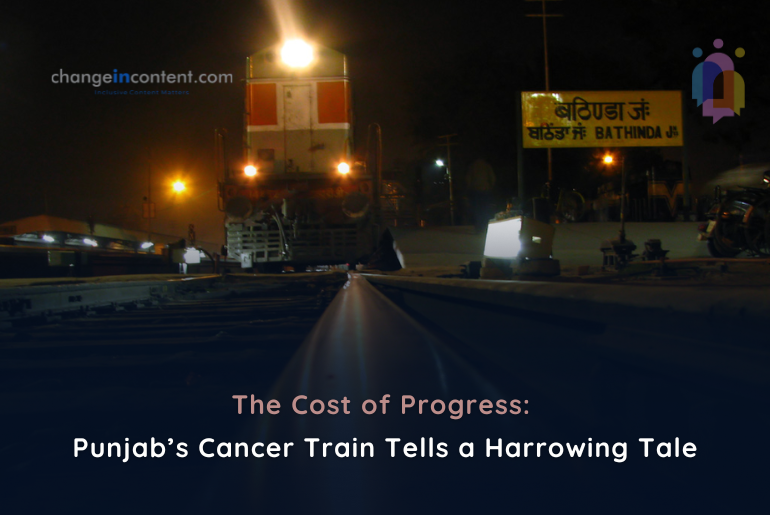
Every night at 9:30 PM, a dimly lit 12-coach train departs from Bathinda station in Punjab, carrying passengers of all ages. For about one-third of the 300 passengers, the destination is the Acharya Tulsi Regional Cancer Hospital and Research Centre in Bikaner, Rajasthan. Among these travellers, nearly 60% are cancer patients from across Punjab.
The journey is long, covering approximately 325 kilometres, and takes around eight hours to reach Bikaner. On any given day, this train carries roughly 100 cancer patients, along with 200 other co-travellers who accompany them. Despite the long journey and the discomfort of travelling in less-than-ideal conditions, the train remains packed to near capacity every night. Over the years, this train has earned a grim title; “Punjab’s cancer train.“
The current cancer crisis in Punjab goes to the agricultural practices introduced during the Green Revolution in the 1960s. In Punjab, where agriculture is the primary livelihood for many, this environmental contamination has been difficult to escape. People working on farms and those living nearby have borne the brunt of the health crisis.
“Progress without sustainability is a mirage. The story of Punjab’s Cancer Train is a wake-up call for us to prioritise inclusive and ethical practices that benefit people, not just profits.” – Saransh Jain, Founder, Changeincontent
Punjab’s Cancer Train: An epidemic worse than COVID
Punjab consumes an alarming 5,270 metric tonnes of pesticides annually, making it the third-largest user in India, with the highest per capita consumption of such chemicals. This excessive use results in pesticide contamination in groundwater, drinking water, and food, ultimately entering the human body.
A study from Ludhiana found that 6.9% of cow’s milk samples contained pesticide concentrations, such as hexachlorocyclohexane, DDT, endosulfan, and several others, that exceeded acceptable limits. Other research reveals the presence of harmful metals like arsenic, lead, and uranium in Punjab’s Malwa region groundwater, further contributing to the area’s health crisis. These pollutants are closely linked to the region’s high cancer rates, particularly among farmers.
According to the Pesticide Action Network data, male farmers are more likely to develop prostate cancer, while female farmers are at greater risk of ovarian and skin cancers. However, pesticide-related diseases extend far beyond cancer. Kidney, liver, and newborn health issues are spreading across the land that once symbolised agricultural progress. In fact, the health epidemic caused by the Green Revolution is now more widespread than the Covid pandemic.
The safety oversight by Punjab’s farming
The Green Revolution has undoubtedly improved the living standards of people in Punjab. At the time, it was essential to address the need for increased food production. Without it, feeding the growing population would have been impossible. However, this progress should not overlook the rising cancer cases in the region, which might reach 43,196 by 2025, a 13% increase since 2020.
The Punjab government has, from time to time, acknowledged the problems caused by harmful farming practices, but true action has been notably absent. Instead of genuinely exploring sustainable alternatives like ecological agriculture, natural farming, or organic methods, the focus remains squarely on conventional practices. Moreover, despite the global bans on pesticides like endosulfan and DDT, these harmful chemicals are still easily accessible in the region.
A major issue is that many pesticide labels and leaflets lack proper safety advice or health warnings. While the official language of Punjab is Punjabi, written in the Gurmukhi script, and Hindi is spoken by only about 8% of the population, it is surprising that very few pesticide labels are in Punjabi. Additionally, the small font on many labels makes it hard for farmers to read, and some can’t read it at all. By not providing clear warnings in the local language or using readable text, companies unintentionally withhold important safety information from consumers.
The final thoughts: A wake-up call for corporate accountability
The Green Revolution, while yielding certain benefits, has also contributed to a significant public health crisis. This issue remains largely unaddressed, primarily due to the greenwashing practices of corporations, which focus more on maintaining a positive image and profits.
The health crisis in Punjab, driven by decades of pesticide abuse, should be a wake-up call to both the government and the corporate sector. The cancer crisis, which is expected to continue rising, is a direct consequence of the very chemicals that companies are still allowed to sell despite their known dangers.
Without strong enforcement of standards and regulations, companies can easily make sustainability claims that are, in practice, meaningless. The absence of clear rules has allowed harmful chemicals to continue poisoning the land, air, and water, putting the lives of many at risk. While corporations boast about their ESG commitments, the reality on the ground tells a different story.
Changeincontent’s perspective
The haunting reality of Punjab’s Cancer Train goes beyond statistics. It reflects the human cost of unchecked industrial and agricultural practices. While the Green Revolution aimed to eradicate hunger, its unintended consequences highlighted the need for a balanced approach that values people over profits.
At Changeincontent, we believe that true sustainability cannot exist without inclusivity. Policymakers and corporations must engage local communities in meaningful dialogues to create innovative, ethical, and humane solutions.
For more on corporate accountability and its societal impact, read our insights on the key ESG Metrics.
Disclaimer: The views expressed in this article are based on the writer’s insights, supported by data and resources available both online and offline, as applicable. Changeincontent.com is committed to promoting inclusivity across all forms of content. We broadly define inclusivity as media, policies, law, and history—encompassing all elements that influence the lives of women and gender-queer individuals. Our goal is to promote understanding and advocate for comprehensive inclusivity.

1 comment
Unsustainable, without any foresight whatsoever.. not learning from what happened to the agricultural decisions in the West and China.. Not going forth with pesticides and synthetic fertilizers without promoting sustainable alternatives in parallel so that one might switch to that after some initial years… Just screaming progress.. Not doing anything about the drug problem.. I am betting on it – politicians will also hire cloud seeding services to attract votes of uneducated masses by giving relief from hard summers and droughts.. without foresight.. and without being held responsible if things go wrong..