
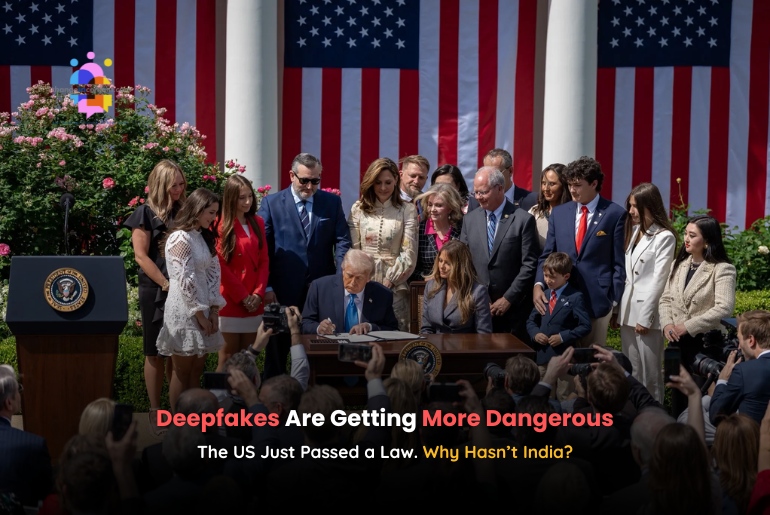
U.S. President Donald Trump has signed the Take It Down Act, a federal law that criminalises the non-consensual sharing of intimate images, including those generated using artificial intelligence. The legislation, passed with overwhelming bipartisan support, makes it a federal crime to “knowingly publish” or even threaten to publish explicit images without the subject’s consent. It includes AI-generated deepfakes. Under the law, online platforms must remove such content within 48 hours of receiving a complaint and must also ensure duplicates are deleted.
The Take It Down Act is a digital shield for women. As deepfake abuse rises globally, this U.S. law is a warning bell India cannot afford to ignore.
Take It Down Act: The fight against non-consensual content
The Take It Down Act was brought forth in light of the case of Elliston Berry, a 14-year-old whose AI-generated deepfake circulated online, with no response from platforms like Snapchat for nearly a year. Her traumatic experience brought the issue to national attention.
First Lady Melania Trump, who actively lobbied for the bill, described it as “heartbreaking” to witness what young girls face when victimised online. Public figures such as Paris Hilton also endorsed the law, calling it a “crucial step” to combat the spread of non-consensual content. Tech giants like Meta, Google, and TikTok have backed the legislation.
“Anyone who intentionally distributes explicit images without the subject’s consent will face up to three years in prison,” Trump said.
The first lady described the new law as a “national victory that will help parents and families protect children from online exploitation“.
AI is being weaponised against women
AI tools that generate fake explicit images have become alarmingly easy to use. While high-profile cases involving celebrities like Taylor Swift or Congresswoman Alexandria Ocasio-Cortez draw media attention, the majority of victims are not public figures. They are ordinary women, schoolgirls, and working professionals. These women find themselves targeted by someone with access to these tools, who is often a classmate, an acquaintance, or even a stranger.
Teenage girls face targeting by their peers who use apps to create sexually explicit deepfakes. These fake images are then shared through social media or messaging platforms. They are resulting in severe emotional consequences. Victims often face harassment, bullying, blackmail, and in many cases, long-lasting psychological harm. For many, the experience is isolating and traumatic, especially when platforms fail to respond quickly or take the images down.
The Take It Down Act acknowledges the speed and scale at which harmful content can spread online. Additionally, it offers a federal-level response that many survivors have long demanded. While it won’t undo the harm already caused, it gives victims a better legal standing and holds platforms accountable. For every woman and girl, it is a move toward safety and dignity. It is a move toward their right to exist online without fear of digital abuse.
The urgent need for similar action in India
According to a 2024 report by Pi-Labs, deepfake-related cases in India have increased by 550% since 2019. These incidents now account for 40% of all AI-related cyber crimes globally. Moreover, they include financial fraud, political interference, and non-consensual explicit content. Over one million deepfake videos have been reported worldwide this year. Surprisingly, more than 50 apps are currently available to create such content with ease.
Despite the gravity of the issue, India does not currently have a dedicated law to regulate deepfakes or AI-generated content. While existing provisions under the Indian Penal Code (IPC) and the Information Technology (IT) Act of 2000 cover some related offences, they are fragmented and lack the precision required to address revenge porn women face online.
For instance, if a fake video damages someone’s reputation, criminal defamation laws (Sections 499 and 500 IPC) may apply. Authorities can punish fake political content during elections under the Representation of the People Act. Cases involving identity theft or impersonation fall under Sections 66C and 66D of the IT Act, and deepfake pornography can be tackled using Sections 67 and 67A of the IT Act and Sections 292 and 354C of the IPC.
However, these laws don’t fully address how fast and anonymously deepfakes can be created and spread. Deepfakes can be made anonymously, shared worldwide, and hosted on servers outside India. That makes it hard for current laws to track and punish offenders. They also don’t require online platforms to act quickly or hold creators truly accountable.
A law similar to the Take It Down Act is urgently needed. It should have clear rules for content removal, platform accountability, and legal consequences for those who share or create such content without consent.
Take It Down Act: A blueprint India must not ignore
We need laws like the Take It Down Act everywhere because deepfake abuse is not limited to one country. It is a global problem. The number of deepfake cases is skyrocketing. Unfortunately, there are no clear laws designed to handle how fast and easily these fake images can be made and shared. As AI technology grows, laws must keep up to protect people’s privacy, safety, and dignity, no matter where they live. Privacy violations, harassment, bullying, and damage to reputation can happen to anyone, anywhere. Hence, legal safeguards should apply everywhere.
India cannot afford to delay this conversation. Read our earlier perspective: Gender Equality Must Lead AI’s Future, Says the Global Partnership for Action on Gender-Based Online Harassment and Abuse.
Disclaimer: The views expressed in this article are based on the writer’s insights, supported by data and resources available both online and offline, as applicable. Changeincontent.com is committed to promoting inclusivity across all forms of content. We broadly define inclusivity as media, policies, law, and history. It encompasses all elements that influence the lives of women and marginalised individuals. Our goal is to promote understanding and advocate for comprehensive inclusivity.
