
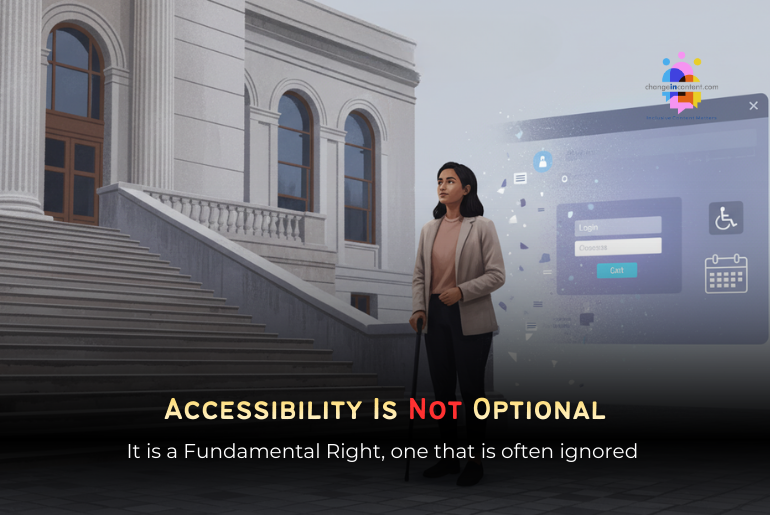
I once watched a woman wait outside a government office. She wasn’t sitting there because she lacked documents. Instead, she was there because the building lacked a ramp. She waited quietly, politely, invisibly. No one shouted. No one protested. The system worked exactly as designed. That is why the fundamental right of accessibility matters. Because exclusion in India is rarely loud, it is architectural. Digital. Procedural. Polite.
Most people often describe accessibility as kindness. But kindness is optional. Rights are not.
And that distinction changes everything.
The fundamental right of accessibility is about dignity, not design
When we talk about accessibility, we usually talk about infrastructure. Ramps. Elevators. Audio cues. Subtitles. Screen readers. Keyboard navigation. But the truth is simpler and more complicated to admit: accessibility is not about convenience, but about dignity.
- A school that a child cannot enter is not “ill-equipped.” It is violating her right to education.
- A website that a screen reader cannot read is not “technically limited.” It is denying equal participation.
- A metro station without tactile paths is not incomplete. It is exclusionary by design.
The moment a person has to ask for access, it is already a compromise of dignity.
The law has already spoken. Society just has not listened.
India is not silent on this issue. The Constitution never was.
- Article 14 promises equality before the law.
- Article 15 prohibits discrimination.
- Article 21 guarantees life with dignity.
Together, they demand one thing: equal participation.
The Supreme Court of India has gone further. In recent judgments, it has clarified that accessibility (including digital accessibility) is not an added service. It is intrinsic to the right to life.
The Rights of Persons with Disabilities Act, 2016, did not introduce generosity. It introduced an obligation. Public buildings. Transport systems. Information. Communication technology. Digital platforms. All of them are required to be accessible, not someday, not conditionally, not when budgets allow.
And yet, everyday reality tells a different story.
Digital Accessibility: The new gatekeeper of citizenship
If physical inaccessibility keeps people out of buildings, digital inaccessibility keeps them out of democracy.
- Forms that cannot be navigated without a mouse.
- Government portals incompatible with screen readers.
- Education platforms without captions.
- Job applications that time out before assistive tools can function.
Digital India, for many persons with disabilities, is not empowering. It is exhausting.
When access to welfare, education, healthcare, employment, and even voting increasingly moves online, digital accessibility becomes the difference between citizenship and exclusion. That is why courts recognise digital access as part of the fundamental right to life. Because rights that cannot be accessed are not rights, they are decorations.
Why calling accessibility “Charity” is dangerous
Charity depends on mood. Rights depend on duty.
When we frame accessibility as benevolence, it becomes revocable. Budgets change. Priorities shift. “Later” becomes permanent. But when we frame accessibility as a right, exclusion demands explanation.
The charity narrative also creates a power imbalance. Gratitude is expected where entitlement should exist. Silence is rewarded where accountability is due.
A rights-based approach does something radical: it removes the need for thankfulness. And systems hate that.
Universal design: When inclusion helps everyone
There is a quiet lie that accessibility is expensive or excessive. In reality, accessible design benefits everyone.
- Subtitles help commuters, language learners, and tired parents.
- Step-free transport helps elderly people, pregnant women, and injured workers.
- Clear signage helps first-time users, tourists, and neurodivergent individuals.
- Simple digital interfaces reduce friction for all users.
Accessibility does not dilute systems. It strengthens them.
A society that plans for disability is actually planning for humanity because disability is not an exception. It is a phase most people will encounter through age, illness, or accident.
The fundamental right of accessibility is also a women’s issue
Disability is not gender-neutral.
Women with disabilities face layered exclusion. It means less education, fewer employment opportunities, higher vulnerability to violence, and deeper invisibility in policy design. Add caregiving to the equation, and accessibility becomes essential not just for persons with disabilities, but for the women who support them. These women are often unpaid, often unseen.
An inaccessible world quietly extracts labour from women. Every step carried, every form filled, every system navigated on someone else’s behalf. Accessibility is gender justice. We just refuse to name it as such.
The changeincontent perspective
At Changeincontent, we are not interested in celebrating ramps like miracles or captions like charity.
We are interested in asking uncomfortable questions.
- Why are new buildings still inaccessible?
- Why do digital platforms launch without accessibility audits?
- Why are persons with disabilities expected to adjust endlessly to systems that refuse to adapt?
Let us not see the fundamental right of accessibility as aspirational. It is enforceable, constitutional, and long overdue for cultural acceptance.
Remember, inclusion does not begin with empathy, but with obligation.
The final thoughts
Accessibility is not a gift. It is not a favour. It is not a “nice to have.” Instead, it is the foundation of equality.
A society that forces people to wait outside (physically or digitally) cannot claim progress. A democracy that excludes by design cannot call itself representative.
The fundamental right of accessibility asks us one simple question:
Who is this world built for, and who is expected to keep asking for permission to enter?
Disclaimer: The views expressed in this article are based on the writer’s insights, supported by data and resources available both online and offline, as applicable. Changeincontent.com is committed to promoting inclusivity across all forms of content. We broadly define inclusivity as media, policies, law, and history. It encompasses all elements that influence the lives of women and marginalised individuals. Our goal is to promote understanding and advocate for comprehensive inclusivity.
