
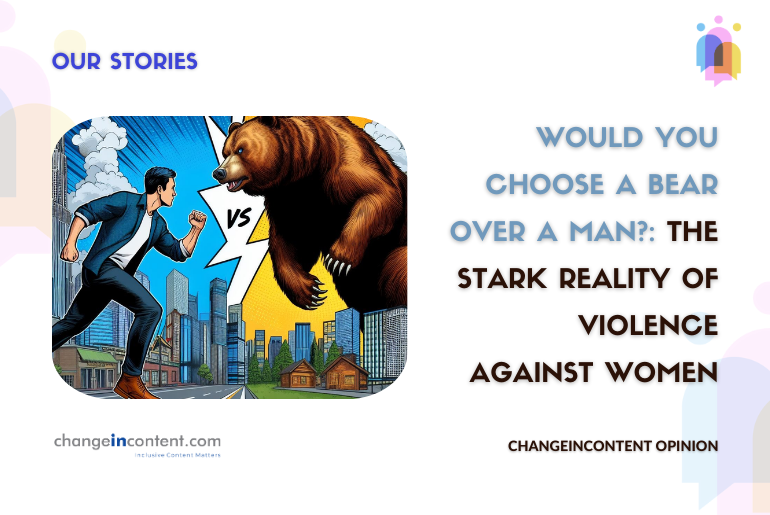
In a recent viral debate on social media, a hypothetical question is being asked to women: “Would you rather be stuck in a forest with a man or a bear?” Interestingly, the majority of women chose the bear, saying that the presence of a strange man evokes greater fear than that of a wild animal. It shows a disturbing impact of violence against women.
One video, which has over 2 million likes, shows some of the most distressing yet sadly valid reasons why women chose the bear. Among their responses were, “The worst thing the bear can do is kill me,” “The bear doesn’t get enjoyment out of it,” and “The bear sees me as a human being.” Another woman pointed out, “If a bear kills me, nobody will ask what I was wearing.”
It should be an easy choice, yet women can’t shake the feeling that they’d be safer with a bear despite the man being another fellow human being. Women feel so unsafe around men that they’d rather be alone with a dangerous wild animal than with a man when given only the choice between the two. If this trend tells us one thing, it’s the deeply troubling experiences women have had with men, including instances of domestic violence and sexual assault.
When dealing with a bear, the advice for safety is typically to play dead, though this may not always work with a man. In reality, a man can inflict harm on an unconscious woman in numerous ways that raise serious questions about humanity. Men instil fear in women that no other animal can replicate. It’s a sad situation.
So, what do men say?
Numerous men have expressed deep offence at this. They took to social media to criticise and troll women’s assumptions about their character. However, the very act of protest from these men arguably validates women’s concerns. Allow us to elaborate.
One particularly intriguing TikTok video featured a wife asking her husband the question, “Would you prefer your daughter to encounter a man or a bear?” Despite his numerous inquiries for further context, his spouse insisted, “No, that’s the only information you have. Bear or man?” Eventually, the man said that a bear would be the safer option. When asked, “Woman or bear?” he quickly chose a woman without hesitation.
One dad explained, “I feel like I would know the outcome with a bear, even if it was aggressive. But with a bad man, I have no idea what the outcome would be like.” Even in rare cases where a dad might choose the man, it’s often after serious hesitation and minutes of contemplation. However, when the choice is between “bear or woman,” the same dad doesn’t hesitate and picks the woman without a second thought.
Another TikTok dad has his reasoning: “A bear only has the potential to kill her or leave her alone. However, a man presents countless possibilities. So, honestly, I chose the bear.” It is utterly depressing that men only begin to understand women’s experiences by a TikTok trend and hypothetical scenario, but that’s the reality we find ourselves in.
Indeed, not all men fall into this category. However, statistics show that 71% of women face sexual harassment from men. Additionally, more than half of female homicides worldwide are carried out by their husband, boyfriend, or male relative. These stats show that it is actually challenging to know who’s safe and who’s not.
Violence against women
Worldwide, roughly 736 million women, representing one in three, have faced physical or sexual violence at least once. About 41% of women have encountered cyberflashing online. Moreover, over 640 million women, constituting 26% of those aged 15 and older, have experienced intimate partner violence. Shockingly, in the UK, an average of two women are murdered by their partner or ex-partner every week.
The most recent global data from the U.N. Office on Drugs and Crime reveals a troubling statistic. On average, more than five women or girls are killed every hour, equating to one every 11 minutes, by someone within their own family. In 2020, an estimated 47,000 women and girls worldwide lost their lives at the hands of their intimate partners or other family members.
Violence against women: Fears of women
When you ask a woman about her fears or worst nightmares, it’s almost guaranteed that a man will be on the list. Women often fear being attacked by a man. They avoid going out alone at night and refrain from wearing headphones while running to stay aware of their surroundings. They’re constantly on edge in situations where a man could easily overpower them. However, if you ask a man the same question, he might not even understand what you mean. For him, the idea of being afraid of working a late shift or going to the car alone at night is so foreign that he might be puzzled and bewildered.
While men often feel safest among familiar faces or within their own homes, the grim reality is that women face a higher risk of being killed or sexually assaulted by people they know. Unlike men, women frequently encounter violence from people they trust. Every day, we hear distressing reports of women being harmed by family, friends, close relatives, uncles, step-parents, and even fathers. Even within the supposed safety of marriage, women may not find refuge at home, especially considering the alarming surge in domestic violence cases during the COVID-19 lockdowns.
Even if a bear were to attack, it seems less terrifying than if a man were to do so. After all, a bear wouldn’t sexually degrade, torture, or rally a group of other bears to continue the assault.
The final thoughts
It is a harsh reality that women are safer in the woods with a bear than they are with a man, and that’s truly disheartening. A bear behaves like a bear. They generally don’t bother humans and don’t commit acts of violence like rape or acid attacks. They don’t stalk women or send unsolicited explicit photos. If a bear attacks a woman, no one would blame her or say she was “asking for it. Therefore, it’s hardly surprising that a woman chose a bear over a random man. Rather than dismissing this as merely a feminist trend, men should engage in conversations about gender-based violence. They should discuss ways to prevent the tragic experiences women endure.
Disclaimer: The views expressed in this article are based on the writer’s insights, supported by data and resources available both online and offline, as applicable. Changeincontent.com is committed to promoting inclusivity across all forms of content, which we define broadly to include media, policies, law, and history—encompassing all elements that influence the lives of women and gender-queer individuals. Our goal is to promote understanding and advocate for comprehensive inclusivity.
