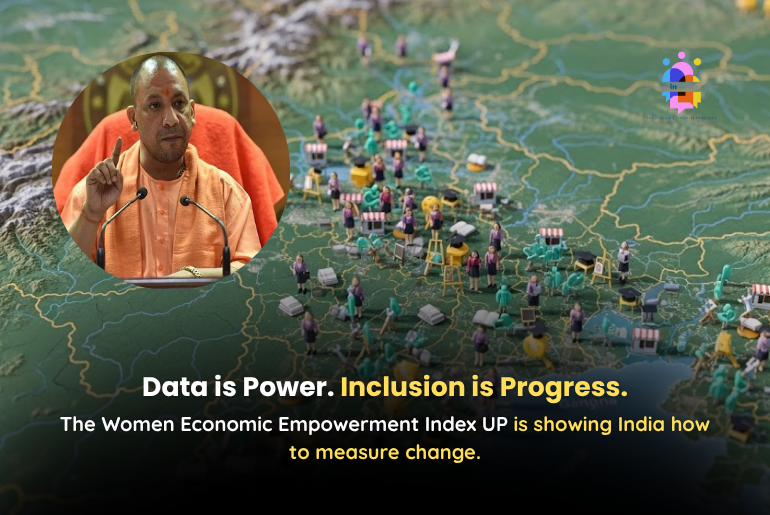
In a country where gender-based data is often underreported or ignored, the introduction of the Women Economic Empowerment Index UP could signal a new era. This initiative not only identifies the gaps but also provides a framework to bridge them, making women’s economic participation a measurable goal.
The Department of Planning, Government of Uttar Pradesh, in partnership with the Udaiti Foundation, has developed the Women Economic Empowerment (WEE) Index. This new initiative aims to track the impact of government schemes on women’s economic participation across all 75 districts of the state.
The Chief Minister received the WEE Index report earlier this year, which provides both an assessment of where women stand economically in different districts and a roadmap to close the existing gaps. The WEE index will focus on gender-inclusive, data-driven decision-making in policymaking at every level.
The Women Economic Empowerment Index UP: A closer look
The WEE Index evaluates district performance using five core parameters: entrepreneurship, employment, education and skill development, livelihood, and safety and transportation infrastructure. The index takes data from 49 indicators across 15 departments, providing a detailed overview of women’s participation in the state’s economy.
District performance categories
The index categorises districts into four segments based on performance:
Champions: These districts have good results in terms of well-executed government schemes, high levels of women’s participation, and institutional support. In these areas, women are making visible progress in entrepreneurship, education, and the job market. Districts include Lucknow, Kanpur Nagar, Varanasi, Jhansi, and Gautam Buddha Nagar, among others.
Leaders: These districts have delivered commendable results but must maintain their pace to avoid losing ground. Examples include Pratapgarh, Moradabad, Barabanki, and Bareilly.
Contenders: Districts in this category have shown potential but still need focused efforts, especially in improving access to jobs and skill training. Ghazipur, Jalaun, Muzaffarnagar, and Bulandshahr fall under this group.
Aspirational: These areas face deeper challenges in education, safety, self-employment, and awareness. The government plans to roll out dedicated campaigns in districts like Chandauli, Baghpat, Amroha, and Shravasti to address these gaps.
Tackling the gender data deficit
Gender-disaggregated data (GDD) remains a major missing link in public policy. Without it, targeted interventions for women’s empowerment cannot succeed. The Udaiti Foundation’s study in Uttar Pradesh identified major gaps in how data is collected, analysed, and used, especially in areas like financial access, entrepreneurship, and digital literacy.
In lending institutions such as banks, for example, the absence of gender-specific data makes it challenging to track why loan applications from women are rejected, or how many succeed. In skilling programs, the data fails to reflect how many women trainees go on to start their ventures or find employment.
Digital access shows a similar concern. Only 46% of women in Uttar Pradesh own and use mobile phones, and their internet usage and digital literacy levels fall below the national average. The situation becomes more worrying when looking at the safety of working women. Out of 41 sanctioned hostels for working women, only eight are currently operational.
Linking women’s progress to economic growth
Uttar Pradesh aims to become a $1-trillion economy by 2027. The state cannot meet this goal without women’s active involvement across all economic sectors. However, gender-disaggregated data continues to block progress. Without systematic data collection and gender-focused planning, policy efforts will remain scattered and ineffective.
The Planning Department has recognised this and is working to build a structured system for monitoring progress. The WEE Index serves as the state’s tool to address the data gap and improve the efficiency of women-centred policies. Its integration into core governance structures will help track results in real-time and adjust interventions as needed.
Using the Women Economic Empowerment Index UP for better governance
The government will integrate the WEE Index into the Chief Minister’s Control Room to ensure regular monitoring. Departments have been asked to prepare district-level action plans that focus on women’s empowerment and tailor state schemes to local needs.
In specific districts, such as Banda, Jalaun, Mahoba, Jaunpur, Shravasti, and Sitapur, campaigns under the ODOP Margin Money Scheme will help increase women’s financial inclusion and entrepreneurship.
The state also plans to prioritise women in recruitment drives for roles like home guards and teachers. Building on the success of police recruitment drives that saw increased participation of women, the state now aims to mirror that success in other sectors.
1. Education, skills, and public transport
As per the WEE Index analysis, women’s enrollment in technical and vocational programs will receive more attention. The government will create “Re-enrolment Units” to help women who left courses return and complete their training. Paramedical institutes will expand opportunities for women to pursue careers in healthcare and service-related fields.
Public transport is another area of focus in the WEE Index. Programs will provide women with specialised training to become bus conductors and drivers, along with necessary support facilities. These steps aim to improve both economic independence and mobility.
2. Impact of Government schemes
Initiatives like Mission Shakti, Pradhan Mantri Ujjwala Yojana, Swachh Bharat Mission, and vocational training schemes have played a key role in improving women’s safety, mobility, and awareness. These schemes have not only encouraged women to seek employment or start enterprises but have also changed how communities view women’s roles in public and professional spaces.
Recruitment of women in public transport roles has paved the way for their financial independence. With more women entering these traditionally male-dominated sectors, this change in social norms improves opportunities for future generations.
The final thoughts
The Women Economic Empowerment Index helps the government focus on where and how to improve. It allows departments to monitor progress, adjust their actions, and ensure women benefit from every public program. Uttar Pradesh’s recognition of the need for better gender-specific data shows a shift in how policies are made. Real-time tracking, local planning, and regular assessments can help the state deliver better results.
Integrating gender-specific data into everyday governance is the only way to ensure that schemes deliver results where they are needed most. The success of any economy depends on how fully it includes its women.
Changeincontent perspective
At Changeincontent, we see the Women Economic Empowerment Index UP as a timely and transformative step. This is not just a numbers exercise but a call for accountability in public policy. When data is gender-disaggregated and integrated into governance, it does not just inform; it transforms. By aligning economic targets with women’s progress, Uttar Pradesh has an opportunity to lead by example.
Also read: 15 years of UN Women: A global commitment to gender equality.
Disclaimer: The views expressed in this article are based on the writer’s insights, supported by data and resources available both online and offline, as applicable. Changeincontent.com is committed to promoting inclusivity across all forms of content. We broadly define inclusivity as media, policies, law, and history. It encompasses all elements that influence the lives of women and marginalised individuals. Our goal is to promote understanding and advocate for comprehensive inclusivity.