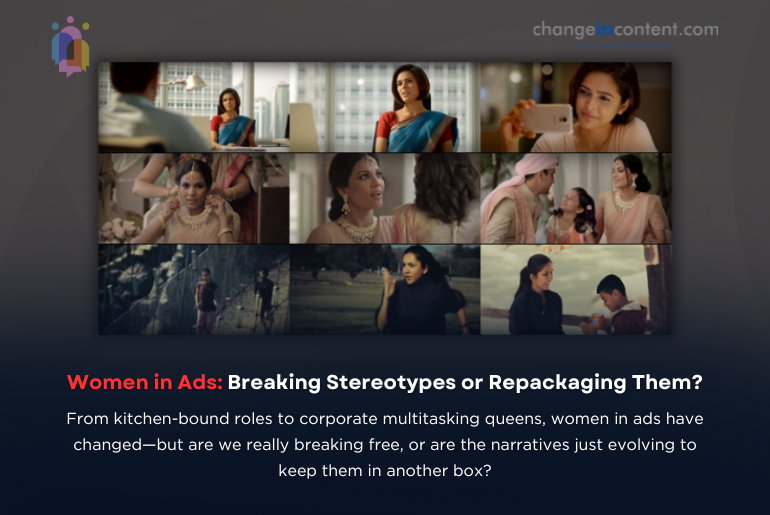
The way women in ads are portrayed has changed over the years—but has it really evolved? Brands are quick to swap outdated visuals of women in kitchens for empowered, multitasking superwomen. But the expectations remain the same. Women are limited to balancing a family, excelling at work, and managing a household, and somehow ads make it all look effortless. Have we truly broken stereotypes, or have we just repackaged them?
In this thought-provoking guest article, Soumita Das—creative director, storyteller, and brand strategist—dives deep into the illusion of progress in advertising. She challenges the narratives we keep seeing and calls out the industry for continuing to box women into predefined roles.

About the author
Soumita Das is a seasoned Creative Director, brand strategist, and storyteller with over 11 years of experience crafting impactful 360-degree campaigns. She has led creative teams, developed award-winning brand narratives, and championed innovative storytelling across platforms. With a passion for challenging stereotypes and redefining narratives, she brings a sharp and insightful perspective to advertising, branding, and cultural storytelling.
Women in ads are beyond the stereotypes.
Let’s give women the respect they deserve, shall we?
The way women are portrayed in advertisements has evolved (kind of). We have moved from the days of depicting women as house-bound caregivers who only show up to serve tea to their husbands to ads where women balance meetings, spreadsheets, and toddler tantrums. Progress, right?
Well, hold your applause.
Sure, we have come a long way from the “kitchen queen” trope, but here is the catch! We are still stuck in the same old narrative. Our modern ads still tell women that they must balance family, career, and their quest to “have it all.” What if the real evolution in ads is simply showing women living their lives without the constant pressure of proving they can juggle a million things—perfectly?
Family First: Why not just “Career First”?
Let us be clear: there is nothing wrong with women having families. They are wonderful, magical beings. But why, oh why, must ads still remind us that a woman’s worth is directly linked to her ability to not only slay at work but also manage the household while raising little humans? The “Share the Load“ campaign was a great start. It pushed for shared responsibility in households. But here is the thing: why is it still assumed that women must have a family to be a “complete” woman? Why does every ad featuring a successful woman have to show her taking care of the family, as though managing a household is the ultimate achievement?
We get it, society.
Women are strong multitaskers. However, when you show women’s professional success only alongside their personal lives (read: family), you are essentially saying, “You can be a boss, but make sure you are also a mom in your downtime.” Can we just have a career-driven woman who is simply killing it in her professional life? Why do we need to constantly remind her that she must also pack lunches, clean up, and attend school plays to “complete” the story? How about a woman who decides her career is her priority, and a family unit must not define her identity?
Superwoman? Please, We are not flying high without a jetpack.
Oh, and let us talk about the pressure to be a Superwoman. Do you see how effortlessly women balance everything? They are juggling careers, cooking, cleaning, the emotional labour of raising kids and saving the world, all in one day. Sure, the media tells us we can do it all.
Here is a little secret: being told you must do it all is like having a weight on your shoulders that refuses to get off. Women are under constant pressure to be flawless, perfect, and always on their A-game. The problem is this sets women up to fail because no one is perfect. And yet, society expects us to wear that cape like we were born with it.
The portrayal of women in Ads: Can’t we make mistakes?
What happened to ‘letting women make mistakes?’ The idea that a woman needs to balance every aspect of her life flawlessly is absurd. Why can’t we just be without the pressure to have a side hustle, a pristine house, and a picture-perfect family to post about on social media? Where is the space for us to mess up? To experiment, to breathe, to simply exist without the expectation that we are somehow “less than” if we are not multitasking every second of the day?
Maybe, just maybe, ads should show women making mistakes. They should show that women are learning and growing instead of trying to maintain an illusion of perfection.
Social Media: Memes, but not the good kind
Let’s take a detour into the land of memes and social media humour.
Oh, how it loves to reinforce stereotypes. “Women be like: shop till you drop,” or “She’s on her way to buy more shoes she doesn’t need.” Ha-ha. Hilarious. Except it is not.
This kind of humour plays into the idea that women are just always emotional consumers. They buy on impulse because they can’t possibly think logically about their purchases. Don’t get us wrong! There’s NOTHING WRONG with a spontaneous shopping spree (we have all been there). But why does it always have to be framed as an emotional outburst, as though women’s financial decisions are purely based on whimsy rather than need or desire?
Why not portray women as savvy, intelligent buyers who balance their emotional instincts with practical decision-making? Why are women only shown shopping in a flurry of emotions, like they are on a never-ending quest for something they can’t quite define? It is time to retire this tired stereotype.
Women have a high EQ (emotional quotient) for a reason. They are capable of making logical, rational decisions that balance both emotional and practical concerns. Yet, the marketing world insists on portraying women as impulse-driven consumers. It is like they are using an outdated playbook, stuck in a 90s sitcom, where women are always the dramatic shoppers, caught in a whirlwind of emotions.
Let’s talk about real choices, shall we?
Now, here is the kicker! All of these portrayals of women in ads feed into something more significant. They reinforce societal beliefs that women’s choices are less valid because they are too emotional or impractical.
The reality is that women are multi-dimensional creatures with the ability to think critically, feel deeply, and make sound decisions that consider both their emotions and logic. Yet, when ads continue to paint them as emotional consumers, they are not only insulting women. Instead, they are perpetuating a narrative that diminishes women’s intelligence and self-agency.
Ads should celebrate the Whole Woman—her emotions, intelligence, and decision-making. It is not just about what she buys or why she does it. Instead, it is about showing her as a fully realised person with goals, thoughts, and dreams that do not come along with the pressure to be “everything” to everyone. Moreover, ads must show that women can be driven, logical, and emotionally intelligent without falling into the traps of tired stereotypes.
The harmful effects of ads: Reinforcing the status quo
These representations of women in ads have real-world consequences. The more we see women portrayed as either emotional shoppers or stressed-out multitaskers, the more we internalise those stereotypes.
Women start thinking, “Oh, this is what I’m supposed to be.” Society, especially in more traditional communities, is only too happy to perpetuate these beliefs. It reinforces the idea that women are meant to be defined by their relationships to others, be it their families, their husbands, or society’s expectations. The ad world plays a pivotal role in this cycle because advertising doesn’t just reflect society; it shapes it.
Harmful portrayal of women in ads needs to stop
So here is the thing! We need to stop trying to force women into these neat little boxes. Women should not have to be the perfect mother, wife, career woman, or emotional shopper to be deemed worthy. They deserve to be seen as complex, multi-faceted individuals capable of making their own choices without the constant weight of societal expectations on their shoulders.
Ads should showcase women as they are imperfect, bold, funny, and smart without putting them in a box labelled “family caretaker” or “emotional shopper.” Just give them the room to be themselves already.
Soumita Das on women in ads: The final thoughts
Let’s cut to the chase!
Women are not here to meet societal expectations or serve as the punchline of a meme. They are complex individuals who deserve authentic representation. Ads that continue to portray women only in terms of family or shopping stereotypes are doing a disservice to all of us. It is time for a change in content. It is time to stop asking women to juggle it all. Instead, we should give them the respect they have always deserved. Represent them as the full, empowered individuals they are, not as a stereotype designed to make you a quick sale.
Women are ready for the real deal in advertising. The question is, are advertisers prepared to catch up?
Changeincontent’s perspective: Time for authentic representation of women in ads
At changeincontent.com, we believe that brands have a responsibility beyond selling products. Representation matters. Narratives shape realities. When women are consistently shown juggling it all flawlessly, it reinforces unrealistic expectations and deep-rooted gender biases.
That is why we advocate for #NoWomensDay. It is a call to action against the tokenism and consumerism surrounding women’s empowerment. Instead of celebrating women for a day and boxing them into stereotypes the rest of the year, we need real, structural change in how women are represented in media, advertising, and the workplace.
Thank you to Soumita Das for sharing her insights. The question is no longer whether women in ads have evolved. The real question is whether brands are ready to truly break the cycle of outdated narratives.
Disclaimer: The views expressed in this article are based on the writer’s insights, supported by data and resources available both online and offline, as applicable. Changeincontent.com is committed to promoting inclusivity across all forms of content. We broadly define inclusivity as media, policies, law, and history, For us, inclusion encompasses all elements that influence the lives of women and marginalised individuals. Our goal is to promote understanding and advocate for comprehensive inclusivity.