
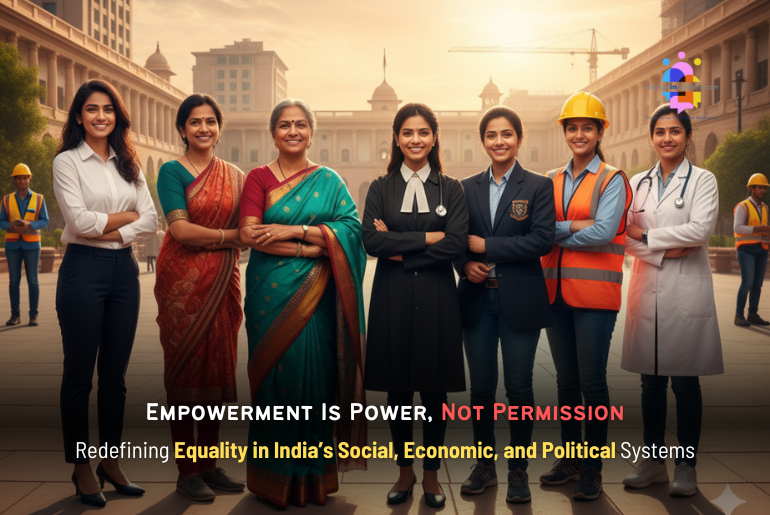
Women’s Empowerment is more than a policy goal. It is the foundation of an equitable, progressive, and sustainable society. It refers to granting women the freedom, opportunity, and capability to participate fully in all aspects of social, economic, and political life. Yet, despite global recognition of gender equality as a fundamental human right, women continue to face systemic barriers that restrict their growth and independence.
In India, the movement for women’s empowerment has evolved through decades of struggle, reform, and resistance. From constitutional guarantees of equality to national campaigns like Beti Bachao Beti Padhao and Mission Shakti, the journey has been marked by both progress and persistence. However, empowerment cannot be measured solely through laws or statistics. Instead, it must be evident in lived realities, decision-making power, and freedom from discrimination.
What is women’s empowerment?
Women’s empowerment refers to the process of removing barriers that prevent women from realising their full potential. It encompasses access to education, employment, healthcare, property rights, political participation, and freedom of choice.
At its core, empowerment means agency. It means the ability to make one’s own decisions and influence the circumstances of one’s life. For centuries, patriarchal structures and social conditioning have denied women this agency. Empowerment, therefore, is not about replacing men’s authority. Instead, it is about restoring balance, justice, and equality across all spheres of life.
The United Nations declared 1975–1985 as the Decade for Women, recognising gender equality as a global development priority. India, too, adopted the vision through national policies and the declaration of 2001 as the International Year for Women’s Empowerment.
The types of women’s empowerment
Women’s empowerment is multidimensional. Each aspect (such as social, educational, economic, and political) intersects with the others. It creates a network of opportunities and challenges. Understanding these dimensions helps identify where systemic gaps persist and how they can be bridged.
1. Social Empowerment: Reclaiming dignity and agency
Social Empowerment is the foundation upon which all other forms of empowerment rest. It involves ensuring that women have the right to make independent decisions about their health, marriage, family, and lifestyle, which is free from coercion or societal control.
Historically, Indian women faced deep-rooted inequalities stemming from caste hierarchies, religious norms, and patriarchal customs such as sati, child marriage, and dowry. While legal reforms have curbed many of these practices, social conditioning continues to limit women’s mobility and choices.
True social empowerment demands more than awareness—it requires cultural transformation. It is about dismantling stereotypes that define women by their relationships rather than their individuality.
2. Educational Empowerment: Learning as liberation
Education is the single most powerful tool for empowerment. It enables women to think critically, earn independently, and participate meaningfully in society. Yet, education has long been a privilege denied to women, particularly in rural and marginalised communities.
In states like Kerala, where female literacy rates are among the highest in India, the ripple effects of education are evident—lower child mortality rates, higher workforce participation, and greater gender sensitivity. In contrast, states such as Bihar and Rajasthan continue to struggle with low female literacy rates and high school dropout rates.
Government initiatives, such as Beti Bachao Beti Padhao and Sukanya Samriddhi Yojana, aim to bridge this gap, but education must extend beyond enrollment numbers. It must empower women to question, create, and lead.
3. Economic Empowerment: The road to independence
Economic Empowerment gives women financial autonomy, which is the power to earn, invest, and control resources. It allows them to break cycles of dependence and participate equally in economic growth.
Despite progress, women’s labour force participation in India remains below 25%, one of the lowest in the world. Gender wage gaps, unpaid care work, and occupational segregation persist, making women’s economic independence an uphill task.
Schemes such as Stand-Up India, Mudra Yojana, and the Mahila E-Haat platform are enabling women entrepreneurs to access credit and expand their market reach. Globally, women-owned enterprises are among the fastest-growing segments of the economy. Empowerment, therefore, is not a moral choice; it is an economic imperative.
4. Political Empowerment: From representation to influence
Political Empowerment is crucial for creating systemic change. When women participate in governance, laws become more inclusive and policies more responsive to community needs.
India’s Panchayati Raj Act (1992) was a landmark step, reserving one-third of local governance seats for women. Today, over 1.4 million women serve in rural panchayats. Yet, at the national level, women occupy less than 15% of parliamentary seats.
The passage of the Women’s Reservation Bill (2023) is expected to change this trajectory, ensuring that women have a stronger voice in national decision-making. However, representation must translate into influence. That is because empowerment is not just about occupying seats, but shaping systems.
Challenges and difficulties in women’s empowerment
Despite policy progress and awareness campaigns, women’s empowerment in India remains hindered by persistent inequalities. The following challenges continue to slow the pace of change:
1. Demographic and cultural imbalances
Gender bias begins even before birth. The sex ratio at birth remains skewed at 937 females per 1,000 males, reflecting a preference for sons that fuels female infanticide and selective abortion. States like Haryana and Delhi continue to record low ratios, showing that patriarchal attitudes still overpower policy efforts.
Cultural expectations often dictate that women must prioritise family over personal aspirations, limiting their participation in higher education or formal employment.
2. Health inequality
Women’s health remains one of the most neglected areas of development. According to the National Family Health Survey (NFHS-5), nearly 70% of adolescent girls in India suffer from anaemia. The maternal mortality rate (MMR), though improved, still stands at 113 per 100,000 live births (2016–18).
Access to reproductive health services, menstrual hygiene awareness, and mental health support remains uneven across regions. Empowerment must include the right to safe healthcare and bodily autonomy.
3. Educational disparities
Education is still not equally accessible. As per UNESCO 2022, India’s female literacy rate is 70.3%, compared to 84.7% for men. High dropout rates among adolescent girls, particularly due to early marriage and lack of sanitation facilities in schools, continue to undermine progress.
Without education, women remain vulnerable to exploitation, unemployment, and poverty. It creates a cycle that disempowers entire communities.
4. Violence against women
Violence remains the most visible and devastating barrier to empowerment. Data from the National Crime Records Bureau (2021) shows a 15.3% rise in crimes against women, including domestic abuse, sexual assault, and human trafficking.
Violence silences voices, limits mobility, and destroys confidence. Empowerment begins when safety becomes a right, not a privilege.
Types of violence against women
Violence is not monolithic; it manifests in many forms, often overlapping across physical, psychological, and digital spaces. Recognising these forms is the first step towards prevention and justice.
- Domestic Violence: Includes verbal, emotional, physical, and sexual abuse by intimate partners.
- Female Infanticide and Feticide: The killing of girl children before or after birth, rooted in gender bias.
- Honour Killing: Murder of women by family members to preserve the so-called family honour.
- Cyber Violence: Online harassment, cyberstalking, or the circulation of morphed images targeting women.
- Sexual Violence: Includes harassment, rape, and coercive exploitation.
- Human Trafficking: Women and girls forced into labour or sex work under coercion.
- Child Marriage: The marriage of girls under 18, which violates their rights to education and safety.
Government schemes for empowering women
The Indian government has implemented numerous schemes aimed at improving women’s safety, education, health, and participation. Some of the major initiatives include:
- Beti Bachao Beti Padhao (2015): Promotes survival, protection, and education of the girl child.
- Ujjawala Scheme: Focuses on preventing trafficking and rehabilitating victims of commercial sexual exploitation.
- Mission Shakti: Integrates various women’s safety and empowerment schemes under one umbrella.
- One Stop Centre Scheme: Provides integrated support for women facing violence.
- Mahila E-Haat: An online marketing platform supporting women entrepreneurs.
- Stand-Up India and Mudra Yojana: Facilitates financial inclusion and entrepreneurship for women.
The way forward: Women’s empowerment as a collective responsibility
Empowerment is not an isolated outcome. Instead, it is a collective and continuous process. It requires collaboration between governments, corporations, civil society, and individuals.
To truly empower women, India must:
- Reform education to prioritise gender equality.
- Bridge the digital divide that limits women’s access to technology.
- Ensure equal pay and inclusive workplace policies.
- Increase women’s representation in leadership roles.
- Strengthen the enforcement of anti-violence and anti-discrimination laws.
Only when women are equal stakeholders in growth can India achieve its vision of inclusive development.
Conclusion: Women’s empowerment and the change in content
Women’s Empowerment is not a favour extended to women. Instead, it is the recognition of a fundamental right that has been denied for centuries. It is the process of restoring balance in a society that has long tilted towards inequality.
At Changeincontent.com, we believe empowerment begins with narratives that challenge bias and amplify truth. The content we create, consume, and circulate has the power to either perpetuate stereotypes or dismantle them. If we wish to empower women, we must first empower the content that shapes their stories.
Related Article: The rise of the female workforce in India: A milestone or just a statistical win?
Disclaimer: The views expressed in this article are based on the writer’s insights, supported by data and resources available both online and offline, as applicable. Changeincontent.com is committed to promoting inclusivity across all forms of content. We broadly define inclusivity as media, policies, law, and history. It encompasses all elements that influence the lives of women and marginalised individuals. Our goal is to promote understanding and advocate for comprehensive inclusivity.
