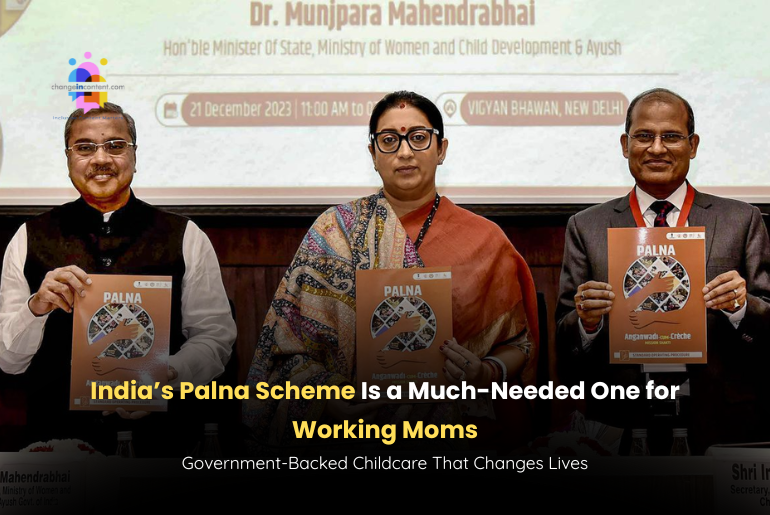
The Government of India’s launch of the Palna Scheme under Mission Shakti marks a decisive step. It is a step towards creating an inclusive ecosystem where women can participate equally in the workforce. The idea is to do so without compromising the care their children deserve. Rolled out by the Ministry of Women and Child Development, this scheme bridges two critical gaps. These gaps are in women’s economic participation and quality child care. The government aims to solve them with a single, well-structured solution.
In a country where nuclear families are fast replacing joint family structures, traditional support systems for working mothers are rapidly vanishing. Many women still bear the sole responsibility for unpaid child care, forcing them to give up career ambitions or settle for low-paying, part-time jobs. The Palna Scheme is a bold response to this crisis. It is a much-needed reform that recognises care work and institutionalises it in a way that supports both women and children.
At its heart, Palna is a promise that a mother’s career should not come at the cost of her child’s care or safety. It is also a promise that a child’s safety should not come at the expense of a mother’s independence.
The Palna Scheme under Mission Shakti: What it is and why it matters
Palna, under the umbrella of Mission Shakti, is a Centrally Sponsored Scheme designed to deliver crèche and day-care services to children aged 6 months to 6 years. Its aim is two-fold: to empower working women and provide their children with a safe, stimulating environment that supports holistic development.
The scheme, funded in a 60:40 ratio between the Centre and State governments (and 90:10 in NE states), ensures shared responsibility and better implementation. For UTs without legislatures, the central government bears 100% of the cost.
Palna directly addresses one of the most pressing challenges for working mothers (the lack of affordable, accessible, and quality daycare). It turns child care into an institutional right rather than a private burden.
A structured, thoughtful vision for early childhood care
Palna goes beyond just providing supervision. It promises a structured integrated service package that supports children’s early growth and learning. It includes:
- Day care with proper sleeping arrangements
- Age-appropriate stimulation for children under 3
- Preschool education for children aged 3–6
- Nutritional support and health checkups
- Regular monitoring, referrals, and immunisations
In convergence with Mission Poshan 2.0, these offerings create a robust system that supports children during their most crucial developmental years while relieving working women of the invisible burden of round-the-clock caregiving.
Palna Scheme under Mission Shakti and the Anganwadi-Creche Convergence
A key feature of the scheme is the Anganwadi cum Crèche (AWCC) model. It merges existing Anganwadi infrastructure with new crèche services. Moreover, it ensures last-mile delivery without reinventing the wheel.
Each AWCC is staffed by existing Anganwadi Workers and Helpers, along with new Crèche Workers and Helpers. As of March 2025:
- 11,395 AWCCs have been approved across 34 States/UTs
- 1,761 are operational, supporting 28,783 beneficiaries
- In addition, 1,284 Standalone Creches are running across India with 23,368 children
These facilities are not just buildings. They are care hubs that ensure physical safety, hygiene, cognitive growth, and nutrition for children, especially in economically vulnerable communities.
The human force behind the Palna Scheme: Crèche workers and their role
At the heart of Palna’s success are its frontline workers (Crèche Workers and Helpers). These workers are trained to provide personalised care, maintain hygiene, assist with toilet training, and support health interventions.
Though honorary in status, they receive monthly honorariums:
- ₹6,500 for Standalone Crèche Workers, ₹3,250 for Helpers
- ₹5,500 for AWCC Workers, ₹3,000 for Helpers
States are free to offer top-ups from their own funds, which can make a huge difference in recognising and professionalising care work. It is work that is often invisible and unpaid.
The Palna Scheme under Mission Shakti: Crèche operations tailored to local needs
Flexibility is built into the framework. Crèches under Palna operate 26 days a month for 7.5 hours a day, aligning with working mothers’ schedules. States can adjust timings based on local needs.
Each crèche accommodates up to 25 children, ensuring individual attention. Locations are strategically chosen, ideally within 1 km of residential or workplace zones. The idea is to facilitate breastfeeding, drop-offs, and emergency access.
This level of customisation makes Palna not just a scheme but a community-responsive public service.
Compliance, legislation, and the bigger policy push
The Palna Scheme also addresses compliance with Section 11A of the Maternity Benefit Act. It mandates crèche facilities for establishments with 50+ employees.
States are encouraged to build registration portals in collaboration with Labour Departments to monitor compliance. It will create accountability for the private sector.
Through this, the Palna Scheme becomes a dual-policy instrument. It offers services directly and nudges employers to shoulder their share of responsibility.
Conclusion: Why the Palna Scheme under Mission Shakti deserves applause
The Palna Scheme under Mission Shakti is more than just a policy rollout; it is a paradigm shift. It institutionalises care work, empowers mothers, and gives young children a better start in life. At a time when women’s workforce participation needs revival and India’s demographic dividend needs investment, the Palna Scheme addresses both with a single, integrated approach.
The government’s vision, backed by cross-ministry collaboration, targeted budgeting, and policy convergence, shows what it truly means to walk the talk on gender equality.
The changeincontent perspective
We often talk about increasing women’s participation in the workforce, but rarely do we address the invisible care economy that keeps millions of women trapped at home. The Palna Scheme under Mission Shakti disrupts this silence. Institutionalising early child care frees women to participate in the economy — not just as employees but as leaders.
As part of our #NoWomensDay campaign, we believe empowerment is not in tokens but in systems. This scheme is not just a win for working mothers — it is a win for inclusion.
Disclaimer: The views expressed in this article are based on the writer’s insights, supported by data and resources available both online and offline, as applicable. Changeincontent.com is committed to promoting inclusivity across all forms of content. We broadly define inclusivity as media, policies, law, and history—encompassing all elements that influence the lives of women and marginalised individuals. Our goal is to promote understanding and advocate for comprehensive inclusivity.