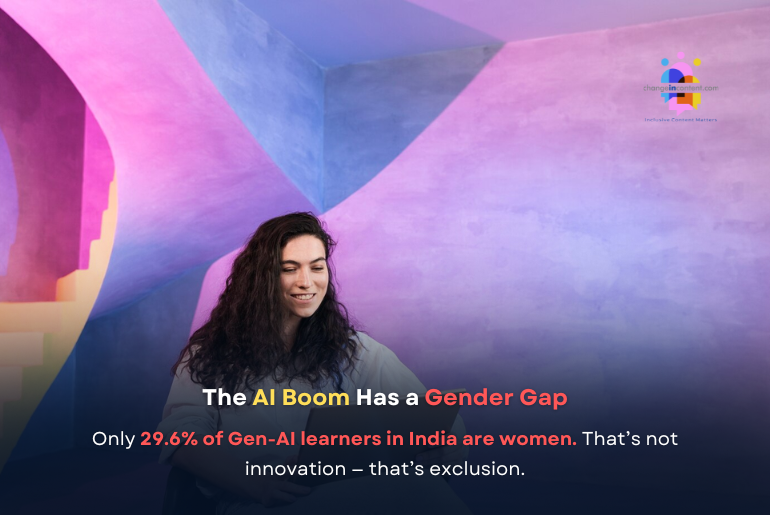
Women’s underrepresentation in Gen-AI is not just about coding; it is about access, confidence, and visibility. The gender gap in AI education reveals deeper systemic barriers that require urgent attention.
Generative AI is no longer limited to tech experts. From healthcare to marketing, AI is changing how industries operate. As more organisations today explore how generative AI can transform their work, understanding and using AI tools has become essential for anyone looking to grow in their career. Even a basic skill like running prompts in ChatGPT is now considered valuable. However, as global interest in AI grows, women are falling behind in AI upskilling.
The gender gap in Gen-AI skills
As AI literacy becomes a global priority, learning platforms have seen a rise in the number of people enrolling in AI-related courses. However, there is a significant gender disparity between those who are gaining these skills and those who are not. Although more people are learning AI, women remain underrepresented in many of these upskilling efforts.
Coursera, a popular online learning platform, reports that India saw a massive increase in AI course enrollments. In 2024 alone, Gen-AI enrollments in the country reached 1.3 million, more than in any other country. Despite this progress, women in India remain underrepresented in the AI learning space. Women make up only 29.6% of Gen-AI enrollments in India. This number is very low, primarily since women represent 40% of all learners on platforms like Coursera.
Regional disparities in AI upskilling
India isn’t the only country facing women’s underrepresentation in AI upskilling. Just 32% of Gen-AI enrollments on Coursera come from women worldwide, making it clear that the gender gap in AI education is a global concern.
According to Coursera’s report, the largest gaps in AI course enrollments appear across the Middle East and Asia. Pakistan shows the highest gender gap on Coursera’s platform. Women make up only 15.9% of all Gen-AI learners in the country. The United Arab Emirates also shows a notable disparity, with only 23.8% of women learners. In Egypt, the figure stands at just 22.2%, and in Israel, women represent only 23.4% of Gen-AI course learners.
Emerging markets in Europe and Latin America report smaller gender gaps in AI learning. These regions show more balanced participation between men and women. For instance, in Uzbekistan, 49.7% of overall Gen-AI enrollments are women.
Women’s underrepresentation in Gen-AI: What is holding them back from AI upskilling?
India has seen a sharp increase in AI learning overall. Enrollments by Indian women in Gen-AI courses grew by 296% in 2024, outpacing the 191% growth among men. Despite this progress, women still make up only 29.6% of total Gen-AI enrollments in the country. This low share raises important questions about the barriers that continue to limit women’s participation in AI upskilling.
Coursera’s Closing the Gender Gap in Gen-AI playbook outlines key challenges faced by women and shares clear actions that can make AI learning more inclusive.
Confidence remains a key barrier
A lack of confidence prevents many women from enrolling in advanced AI courses. Even when they have the skills, self-doubt often holds them back. On platforms like Coursera, women are six times more likely than men to choose beginner-level courses. They tend to prefer structured, easy-to-follow programs. In India, the most popular Gen-AI courses among women are also introductory, showing a clear preference for accessible learning pathways.
Time constraints
Many women also face challenges managing their time. Balancing work, caregiving, and household duties often leaves little space for upskilling. Although 90% of women recognise the importance of Gen-AI for career growth, only 35% feel prepared to take it on or find time to pursue it.
The need for role models
Another significant issue is the limited visibility of women in AI leadership and education. When women do not see others like themselves in leadership roles, teaching positions, or successful careers in the AI field, it becomes harder for them to imagine a place for themselves in the field. This gap reduces both interest and retention, making it harder to close the gender disparity in AI learning.
Three simple ways to support women in Gen-AI learning
Even as more women show interest in learning generative AI, many still face practical and emotional barriers that hold them back. Small, targeted steps can make a big difference in how women engage with and complete AI courses.
Use AI tools for personalised support
Women use Coursera Coach, an AI-powered learning assistant, 11.1% more than men. It shows that women benefit from consistent, personalised support. Making these tools more available can help women stay on track and complete their courses.
Use confidence-boosting messages
Many women drop out of courses due to self-doubt. Coursera tested short, encouraging messages during online STEM courses, such as “You are making great progress” or “You can do this.” These messages led to a 50% increase in course completion among women aged 18 to 24. Positive feedback helps build confidence and keeps learners motivated.
Increase access to beginner-level courses
One of the biggest reasons women hesitate is the fear of not being “tech-savvy enough.” Many assume they need advanced coding skills or deep technical knowledge before they can even begin. This mindset creates a barrier before they’ve had the chance to explore the field.
Women want structured, easy-to-follow entry points into AI. These introductory courses offer a sense of clarity and confidence. But in many cases, these beginner-friendly options are limited, hard to find, or come with hidden prerequisites. When such courses aren’t visible or accessible, potential learners may give up before they even start.
Women’s underrepresentation in Gen-AI: The final thoughts
As the world increasingly turns to AI as a core skill for career advancement, we must remove the barriers preventing women from engaging in this field. It means understanding their unique challenges, from time constraints to a lack of representation, and tailoring solutions that address these issues head-on. While the interest is growing, support systems haven’t fully caught up.
For deeper insight into how women are shaping (and being shaped by) the future of artificial intelligence, read our companion article: Women in AI. It is time we centre women in the AI revolution, not leave them trailing it.
Disclaimer: The views expressed in this article are based on the writer’s insights, supported by data and resources available both online and offline, as applicable. Changeincontent.com is committed to promoting inclusivity across all forms of content. We broadly define inclusivity as media, policies, law, and history, encompassing all elements that influence the lives of women and marginalised individuals. Our goal is to promote understanding and advocate for comprehensive inclusivity.