
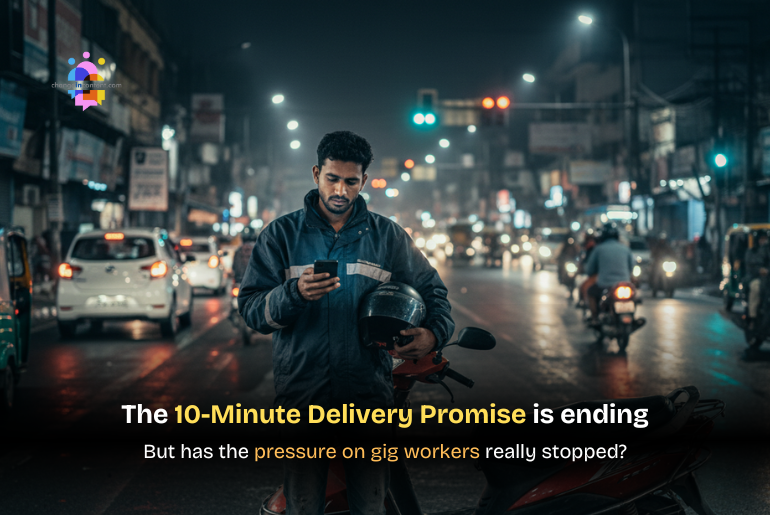
The 10-minute delivery promise was once a symbol of the speed and convenience of India’s quick-commerce boom. For customers, it meant groceries at lightning speed. For gig workers, it meant tighter timelines, constant pressure, and growing safety risks.
On December 25 and December 31, 2025, gig worker unions called for a nationwide strike to demand the removal of 10-minute delivery targets. Workers argued that unrealistic timelines pushed them to rush, increased road accidents, and made everyday deliveries unsafe.
In January 2026, after Union Labour Minister Mansukh Mandaviya met senior executives from quick-commerce platforms, including Blinkit, Zepto, Zomato, and Swiggy, the companies agreed to remove or gradually step back from 10-minute delivery promises across apps, branding, and advertisements.
What followed marks a quiet but significant shift in how we are renegotiating speed, safety, and responsibility in India’s gig economy.
Blinkit drops 10-minute delivery claim
Blinkit, owned by Eternal, has taken down its ’10-minute’ delivery claim across all its platforms. Reports suggest Blinkit became the first quick-commerce company to respond to the directive. With a market share of more than 40%, the company holds the largest share in the quick-commerce segment. The company changed its tagline from “10,000+ products delivered in 10 minutes” to “30,000+ products delivered at your doorstep.” Other platforms are likely to move in the same direction.
How the 10-minute delivery model worked
Platforms such as Blinkit, Swiggy Instamart, and Zepto built their fast delivery systems around dark stores. These are warehouses that look like small retail outlets but do not allow walk-in customers. Delivery partners collect orders from these locations and deliver the items.
The rise of dark stores changed the neighbourhood retail scene in many ways. Because these warehouses are close to homes and deliver goods quickly, many customers began ordering online rather than visiting nearby kirana and small shops. It reduced footfall and sales for local store owners, especially for daily items like groceries, snacks, and household basics.
At the same time, dark stores also opened new kinds of work. Many of these hubs were set up and run entirely by women, from store managers to packers and coordinators.
What 90,000 users say about 10-minute delivery
LocalCircles conducted an extensive, nationwide study to understand how people who use quick commerce feel about ultra-fast delivery and which items they actually want delivered in such short time frames. The study collected more than 90,000 responses from people in 180 urban districts. Among them, 61% were men and 39% were women. By location, 49% came from tier 1 cities, 28% from tier 2 cities, and 23% from tier 3 and tier 4 cities.
While people value convenience, most users do not see 10-minute delivery as a priority. 74% of quick commerce users support the government’s advisory to remove the 10-minute delivery target. In fact, 38% of users said they do not want anything delivered within 10 minutes at all.
Among the people who still prefer a 10-minute delivery option, medicines matter the most, followed by daily essentials. Among the 25,621 users who still want to keep using 10-minute delivery, each of them (100%) chose medicines. 55% picked essentials, while 25% included discretionary items. This makes it clear that when people ask for ultra-fast delivery, they mostly mean urgent and necessary items rather than everyday shopping.
Safety needs more than a banner change.
Removing the 10-minute delivery banner does not solve the whole problem. Even if the promise disappears from apps and ads, pressure can still exist behind the scenes. Delivery workers may continue to get bonuses for completing orders faster than the set time. When platforms reward speed with higher pay or special perks, riders still feel pushed to rush, even if the public message says otherwise.
If faster deliveries bring better incentives, workers will keep taking risks to earn more.
Delivery workers do not earn a fixed amount each day. Their pay can go up or down depending on how many orders come in, what bonuses are running at that time, or minor changes made inside the app that they are not always told about.
One day, a rider might earn well, and the next day they might struggle to make the same amount, even if they work just as hard. That is why fixing delivery times alone is not enough. To really improve their lives, platforms need to offer more stable, predictable pay so workers can feel secure about their income and make better choices about their time and safety.
The final thoughts
Fast delivery has become a hallmark of modern convenience, but it comes with hidden costs that are rarely discussed. Gig workers form the backbone of these services, yet their day-to-day realities are often overlooked. Dropping the 10-minute delivery promise is a welcome move, but it doesn’t fully address the challenges gig workers face.
Quick commerce and delivery platforms can continue to grow, but they cannot do so at the expense of the people who make the system run. Stable pay, predictable schedules, and safer working conditions are essential for building a sustainable and ethical gig economy.
Changeincontent perspective
Phasing out the 10-minute delivery promise is an important symbolic shift, but symbolism alone does not protect workers.
Safety cannot depend on branding decisions. We must build into pay structures, incentive design, and workload expectations. If platforms continue to quietly reward speed, risk will simply move out of sight, not out of the system.
A sustainable gig economy demands predictable income, transparent incentives, and timelines that respect human limits, not marketing milestones.
Disclaimer: The views expressed in this article are based on the writer’s insights, supported by data and resources available both online and offline, as applicable. Changeincontent.com is committed to promoting inclusivity across all forms of content. We broadly define inclusivity as media, policies, law, and history. It encompasses all elements that influence the lives of women and marginalised individuals. Our goal is to promote understanding and advocate for comprehensive inclusivity.
