
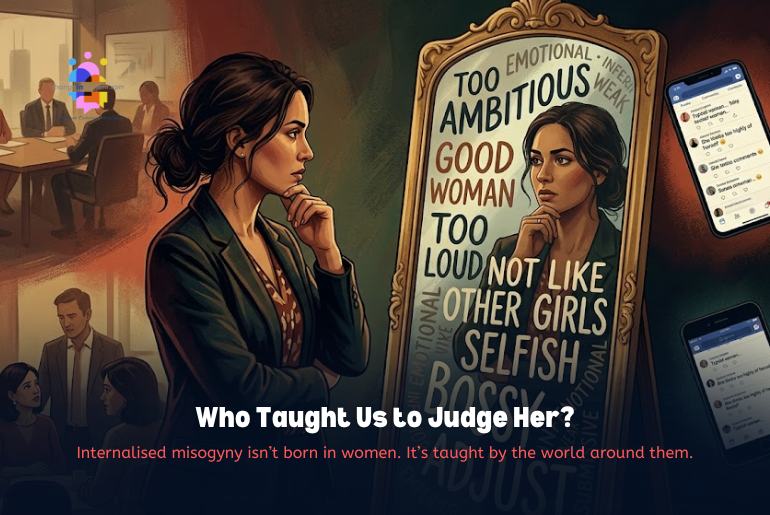
Internalised misogyny is not as alien as it sounds. Let’s make it simple to understand. There is a familiar scene in many homes, offices and WhatsApp groups.
- A woman gets promoted, and another woman says, “She must have played smart.”
- A young girl wears something bold, and an older woman says, “Good girls do not dress like that.”
- A working mother leaves early for childcare, and someone says, “Why did she take the role if she cannot manage?”
- A woman speaks firmly in a meeting, and another woman whispers, “She has too much attitude.”
- A daughter-in-law rests for one afternoon, and the women around her call her lazy.
That is where internalised misogyny becomes uncomfortable to discuss. It does not always come from men. Sometimes, it travels through women. Sometimes, it sounds like advice. Sometimes, it sounds like discipline. Sometimes, it sounds like “I am only saying this for your own good.”
But underneath that sentence often sits an old belief: women must be controlled, softened, judged, compared, corrected and kept within acceptable limits.
Internalised misogyny is not a personal failure of women. It is a social inheritance. It is the patriarchy learning to speak in women’s voices.
What is internalised misogyny?
Internalised misogyny is the process through which women absorb sexist ideas from society and then direct those ideas towards themselves or other women. It can show up as self-doubt, shame, judgement, competition, moral policing, body policing, suspicion of women’s ambition, or preference for male validation.
A 2024 paper in the Journal of Integrated Social Sciences describes internalised sexism as learned sexist behaviour adopted by women towards themselves and other women. The paper notes that this can reinforce a male-dominated culture and sustain patriarchy through horizontal oppression. That is where the members of an oppressed group turn bias against their own group.
Put simply, internalised misogyny is not born inside women. Society teaches it to women.
Girls grow up watching who gets the praise and who gets the punishment. They learn that “good” women are quiet, adjusting, attractive but not too attractive, ambitious but not too ambitious, modern but not too free, educated but still obedient. They learn that women who cross these lines are called selfish, shameless, aggressive, difficult, characterless or irresponsible.
Over time, some women begin to enforce these rules themselves.
The everyday face of internalised misogyny
Internalised misogyny does not always look dramatic. Most of the time, it appears in ordinary sentences.
“Women are too emotional to lead.”
“Men do not like women who are too successful.”
“She is not like other girls, she is sensible.”
“A woman’s real priority should be family.”
“Female bosses are worse than male bosses.”
“She got ahead because of her looks.”
“Girls today have too much freedom.”
“A working mother can never give enough time at home.”
“Why is she so ambitious?”
“She should dress according to her age.”
These statements do not only judge individual women. They protect a larger system that expects women to compete for approval under rules they did not create.
At Changeincontent, we speak to women and realise that they are often pitted against each other by the “not like other girls” mindset and the “pick-me” mentality. Those patterns remain relevant because they reward women for distancing themselves from other women rather than questioning why we treat femininity as inferior in the first place.
Why internalised misogyny is so hard to notice
Internalised misogyny is difficult to identify because it often wears the mask of culture, concern, humour or practicality.
- A mother may restrict her daughter because she genuinely fears society.
- A female manager may judge women employees because she faces similar judgments.
- A woman may mock feminism because her surroundings taught her that “good women” do not complain.
- A colleague may criticise another woman’s clothes because she has learned that women’s respectability is always under public inspection.
That does not make the behaviour harmless. But it helps us understand why it survives.
Internalised misogyny works because it does not always feel like hatred.
- Sometimes, it feels like safety.
- Sometimes, it feels like tradition.
- Sometimes, it feels like discipline.
- Sometimes, it feels like survival.
Many women learn that obeying sexist rules brings temporary protection. Questioning them brings punishment. So they pass the rules on.
Internalised misogyny at the workplace
The workplace is one of the clearest places where internalised misogyny shows up.
- A woman leader is called “bossy” for the same behaviour that makes a man “decisive”.
- The workplace may see a woman who negotiates salary as demanding.
- It may judge a mother asking for flexibility as less committed.
- People may treat a young woman with suspicion if she networks with senior leaders.
- A woman who does not join office gossip is called arrogant.
- They may judge a friendly woman as too available.
- And they may tag a quiet woman as cold.
Sometimes men say these things. Sometimes women do.
Why does it matter?
It matters because internalised misogyny can affect hiring, promotions, feedback, team culture and leadership pipelines. That can make women less likely to support other women, not because they are naturally competitive, but because workplaces often create a sense of scarcity around women’s success.
- If the workplace expects only one woman to rise, other women become threats.
- If colleagues judge women more harshly, they begin judging each other harshly too.
- If the workplace codes leadership as masculine, women may mistrust women who lead differently.
- If we treat motherhood as a liability, women may distance themselves from mothers at work.
That is how bias becomes self-policing.
Research using thousands of workplace sexism accounts from the Everyday Sexism Project found themes such as women being paid less, ignored, talked over, denied opportunities, passed over for promotion, bullied through sexist hostility and subjected to unwanted sexual attention. These are not isolated problems. They show how everyday sexism shapes workplace experience.
Internalised misogyny often grows in the same environment. When women repeatedly see other women facing punishments for stepping out of line, some begin to enforce the line before the punishment comes.
The “female boss” myth
One of the most common examples is the claim that women are worse bosses than men.
Many women continue to hear this. Some say it; some have experienced a difficult female manager and generalise that experience to all women leaders.
But we must ask a better question.
When a male boss is harsh, do we say men are bad leaders? Usually not. We call him demanding, strict, toxic or difficult as an individual.
When a female boss is harsh, the judgement often becomes collective: women cannot handle power.
That is internalised misogyny at work.
It holds women leaders responsible not only for their own behaviour, but for the reputation of all women. It also ignores the fact that women leaders often operate under impossible expectations. They must be strong but not intimidating. Warm but not soft. Ambitious but not selfish. Clear but not rude. Empathetic but not emotional.
No leadership style is enough because the standard keeps moving.
The “good woman” trap
Internalised misogyny survives through the idea of the “good woman”.
- The good woman adjusts.
- The good woman does not argue.
- The good woman sacrifices.
- The good woman does not speak too loudly.
- The good woman does not make others uncomfortable.
- The good woman does not want too much.
- The good woman is respected because she stays within limits.
That is why women who choose differently often face negative judgments from other women, too.
- The unmarried woman faces judgments.
- The divorced woman faces judgments.
- The child-free woman faces judgments.
- The ambitious woman faces judgments.
- The sexually confident woman faces judgments.
- The woman who rests faces judgments.
- The woman who spends on herself faces judgments.
- The woman who refuses caregiving faces judgments.
The system creates a narrow model of acceptable womanhood, then teaches women to measure each other against it.
How language carries internalised misogyny
Language is one of the strongest carriers of internalised misogyny.
Words do not only describe women. They teach us how to value women.
- A man is assertive. A woman is aggressive.
- A man is focused. A woman is selfish.
- A man is unmarried. A woman is “still single”.
- A man is ambitious. A woman is career-obsessed.
- A man is ageing. A woman is “past her prime”.
- A man is confident. A woman is attention-seeking.
Changeincontent has previously examined how language and misogyny are connected. The article noted that phrases such as “career woman,” “lady doctor,” and “female athlete” make women’s presence seem like an exception, while similar labels are rarely applied to men. It also discussed how derogatory terms and gendered labels keep bias alive in everyday speech.
Read: Language and Misogyny: The Impact of Words on Gender Bias
That is why unlearning internalised misogyny requires attention to language. The words we use reveal the rules we have absorbed.
Internalised misogyny on social media
Social media has given internalised misogyny a new stage.
- The social media mocks women for being “pick me”.
- Women face judgments for posting pictures.
- People shame them for ageing.
- They receive attacks for being feminists.
- Social media tells them that they are too traditional or too modern.
- And women creators are judged for their clothes, voice, body, marriage, motherhood, ambition, and opinions.
Sometimes women participate in this pile-on. They may think they are being funny, honest or morally correct. But social media often rewards women for humiliating other women in public.
The “not like other girls” performance also receives significant amplification online. A woman may gain approval by saying she is not dramatic, not materialistic, not feminist, not like “today’s girls”, not like women who complain, not like women who want equality.
That approval comes at a cost. It asks women to earn value by separating themselves from other women.
Internalised misogyny inside families
Families often become the first classroom of internalised misogyny.
- The family may tell a daughter to help in the kitchen while her brother studies.
- The daughter-in-law may face judgments by women who once suffered the same treatment.
- The surroundings may warn a girl not to laugh loudly, sit openly or speak too directly.
- A mother may tell her daughter to tolerate disrespect because “all women do”.
- A woman may defend unequal inheritance because “sons carry the family name”.
These examples are painful because they often involve women who love each other.
That is why we must be careful. The goal is not to blame mothers, mothers-in-law, sisters, aunties or grandmothers. Many of them survived in systems where obedience was rewarded, and resistance was dangerous.
But love does not make bias harmless. When women pass patriarchal rules to the next generation, even with protective intent, the rules survive.
Why internalised misogyny hurts women’s mental health
Internalised misogyny can create deep emotional harm. It teaches women to doubt themselves, distrust other women, dislike their bodies, fear judgement, shrink ambition and feel shame for wanting autonomy.
The 2024 Journal of Integrated Social Sciences article notes that internalised misogyny can have negative consequences for women’s mental health and society, especially because it promotes shame, self-hatred and discrimination towards other women.
That can show up as:
- Feeling guilty for wanting success.
- Feeling ashamed of ageing.
- Feeling superior for being “low maintenance”.
- Feeling threatened by other women’s confidence.
- Feeling uncomfortable when women speak openly about sex, money or power.
- Feeling the need to be chosen by men over being trusted by women.
Internalised misogyny damages solidarity. But it also damages the self.
How to recognise internalised misogyny in yourself
Everyone raised in a patriarchal society absorbs some gender bias. That does not make someone bad. It makes unlearning necessary.
Here are questions worth asking.
- Do I judge women more harshly than men for the same behaviour?
- Do I trust male authority more easily than female authority?
- Do I feel uncomfortable around ambitious women?
- Do I call women “dramatic” or “attention-seeking” without asking why?
- Do I believe women must sacrifice more for family?
- Do I mock women who are openly feminist?
- Do I feel proud of being “not like other women”?
- Do I expect women to be nicer, softer or more adjusting than men?
- Do I excuse men’s behaviour but blame women for reacting?
- Do I assume a woman’s success has a hidden shortcut?
The idea os aksing these questions is not to create guilt. They aim at creating awareness.
Internalised misogyny loses power when it is named.
How organisations can reduce internalised misogyny at work
Workplaces cannot treat internalised misogyny as a personal attitude problem alone. Organisational culture can either reduce it or reward it.
Companies must stop creating scarcity among women. If there is only one woman in leadership, organisations may force women into competition for symbolic space. Build broader representation instead.
They must audit feedback language. Words like abrasive, emotional, aggressive, not confident enough, too ambitious, not leadership material and lacks executive presence often carry gendered bias.
They must ensure that they do not punish women for motherhood, flexibility, assertiveness, salary negotiation or boundary-setting.
They must train managers to recognise both hostile and benevolent sexism. Benevolent sexism can sound like praise or protection, but still reinforces women as weak, pure, dependent or naturally suited to care. Research on ambivalent sexism shows that hostile sexism and benevolent sexism are different but connected forms of gender bias, with benevolent sexism often appearing positive while still limiting women.
They must stop assigning invisible office labour to women. Taking notes, planning parties, mentoring everyone, softening conflict and doing emotional clean-up should not automatically fall on women employees.
They must create fair promotion systems. When women see other women rise transparently, with real authority, the belief that women’s success is suspicious begins to weaken.
How women can unlearn without carrying all the burden
Dear women, do not feel responsible for dismantling the system that harmed you. But unlearning internalised misogyny can still be liberating.
Start by noticing judgement. When you judge a woman, ask whether you would judge a man the same way.
Replace competition with curiosity. If another woman’s confidence irritates you, ask what rule she is breaking that you were taught to obey.
Stop using male approval as the measure of female worth. A woman’s value is not decided by whether men find her respectable, desirable, manageable or impressive.
Refuse the “not like other girls” compliment. It is not a compliment if it insults other women to praise you.
Support women publicly, not only privately. Recommend women for roles. Defend women when they are unfairly judged. Credit women’s ideas. Interrupt gossip that reduces women to character, clothes or marital status.
And most importantly, extend softness to yourself. Many women are harsh towards other women because they have been trained to be harsh towards themselves.
What men must understand?
Internalised misogyny should not become a way for men to say, “Women are women’s worst enemies.”
That sentence is itself a distraction.
- Women did not create patriarchy.
- Women did not design the systems that reward male authority and punish female autonomy.
- Women may sometimes reproduce misogyny, but the source remains structural.
Men must ask how they benefit when women compete, doubt each other or police each other. They must notice when they reward women for being “different from other women”. They must stop using women’s internalised bias as evidence that sexism is not real.
The goal is not to blame women. The goal is to expose how deeply misogyny has travelled.
Changeincontent Perspective: The bias inside us still belongs to the system outside us
Internalised misogyny is painful because it forces us to look inward. But looking inward does not mean forgetting the system.
At Changeincontent, we believe this conversation is necessary because patriarchy survives not only through laws, workplaces, media, families and institutions, but also through habits. Through jokes. Through advice. Through gossip. Through silence. Through the small ways women are taught to fear becoming “too much”.
The answer is not to shame women for carrying internalised misogyny. Most women were taught these rules before they had the language to question them.
The answer is to unlearn them honestly.
When women stop policing each other, something powerful happens.
- Ambition becomes less lonely.
- Leadership becomes less suspicious.
- Rest becomes less shameful.
- The difference becomes less threatening.
- Solidarity becomes more possible.
Internalised misogyny teaches women to compete for safety inside an unfair system. Unlearning it teaches women to question the system itself.
Methodology and Editorial Note
This article draws on Changeincontent’s earlier research on internalised misogyny, its article on language and misogyny, and research on internalised sexism, misogyny, ambivalent sexism and workplace sexism. The article is written as an explanatory Knowledge Hub piece and does not intend to blame women for patriarchal systems. It aims to help readers recognise how they can learn, repeat and unlearn bias.
Sources
- Changeincontent article on language and misogyny.
- Maria Evteeva’s 2024 paper, ” Internalised Misogyny: The Patriarchy Inside Our Heads.
- Research review on benevolent and hostile sexism.
- Research using Everyday Sexism Project accounts to analyse workplace sexism and harassment.
