
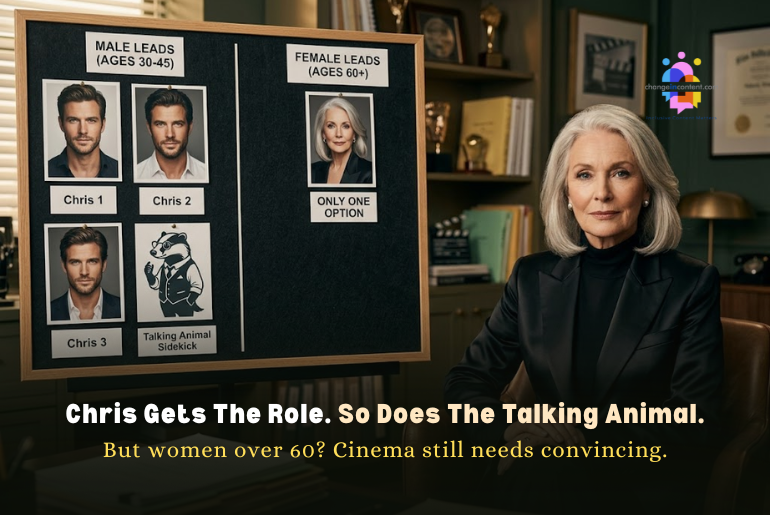
The UK Anti-Ageism Study has exposed a strangely comic but deeply uncomfortable truth about cinema. According to the survey, among the 100 highest-grossing films released in the UK in 2023, 2024, and 2025, 6 featured a lead actor named ‘Chris’, while only 5 featured a woman over 60 in a leading role. Films were also 4 times as likely to feature a talking animal as a lead character as to feature an older woman.
At first, it sounds like a joke written for a film awards monologue. But the joke fades quickly. The film industry has long allowed male actors to grow older on screen while still being seen as heroic, desirable, complicated, powerful, and commercially valuable. Women, meanwhile, often start disappearing from leading roles long before their male peers do. The result is a cultural world where ageing men keep getting stories, while the industry keeps pushing the ageing women into the margins.
Key Takeaway
Older women have not disappeared from life. They lead homes, companies, friendships, communities, creative work, politics, care systems, and culture itself. But cinema still struggles to imagine them as central characters. The issue is not talent. It is opportunity, visibility, and the industry’s stubborn belief that women’s stories become less valuable with age.
Talking animals, men named ‘Chris’, and the missing older women of cinema
The film industry has followed an unspoken timeline for actresses. Men are often allowed to age into prestige, authority, eccentricity, action, romance, and late-career mythology. Audiences continue to watch male actors they grew up with take on major roles well into their 50s, 60s, and 70s. Many actresses who debuted alongside them, however, slowly disappear from leading roles as they age.
This unequal reality has once again come into focus through a new analysis by the Age Without Limits campaign, run by the Centre for Ageing Better. The research examined the 100 highest-grossing films released in the UK in 2023, 2024, and 2025, using British box-office data from Box Office Mojo.
The findings are almost too absurd to ignore. Among those top films, six featured a lead actor called Chris, while only five featured a woman over 60 as a lead character. Films were also four times more likely to have a talking animal as the lead than a woman over 60.
The “Chris” list included Chris Pratt in The Super Mario Bros. Movie, Guardians of the Galaxy Volume 3, and The Garfield Movie, Chris Pine in Dungeons & Dragons: Honour Among Thieves, Chris Hemsworth in Transformers One, and Christian Friedel in The Zone of Interest, who was a part of the list because he is known as Chris among friends.
The joke lands because the pattern is real.
The comparison is funny because it is ridiculous. It is uncomfortable because it is believable.
Cinema has always known how to make space for older men. They can be action stars, mentors, villains, geniuses, lovers, detectives, presidents, warriors, widowers, billionaires, and broken men with beautiful lighting. Older women, when they appear, are far more likely to be written as mothers, grandmothers, side characters, comic relief, warnings, or ghosts of someone else’s plot.
That is why this finding travelled so easily. It gave people a simple image of a much larger cultural failure. Apparently, in major cinema, a talking raccoon, a cartoon cat, and several Chrises can find space more easily than a woman over 60 with a story of her own.
That is exactly why Changeincontent has earlier examined quiet ageism in campaigns and media. Ageism rarely announces itself. It often appears through absence, casting choices, storylines, jokes, costumes, camera angles, and the quiet assumption that older women are less interesting.
The 5 films that actually let older women lead
Only five films led by a woman over 60 made it into the top 100 highest-grossing UK releases across the 3-year period. These were Allelujah, starring Jennifer Saunders; My Big Fat Greek Wedding 3, led by Nia Vardalos; Book Club: The Next Chapter, featuring the late Diane Keaton; The Substance, starring Demi Moore; and Freakier Friday, starring Jamie Lee Curtis.
Bridget Jones: Mad About the Boy, which became the second-highest-grossing film in the UK in 2025, almost made the list. Its lead actor, Renée Zellweger, missed the age cut-off by just three years.
Even though the number is small, these films show that stories centred on older women can still connect with audiences. Beyond box-office figures, several other films led by older actresses also received strong critical attention during the same period. Titles such as Hard Truths, I’m Still Here, and Thelma were widely appreciated, proving that the problem is not audience resistance. It is industry imagination.
Dame Emma Thompson, who supported the Age Without Limits call, asked where the stories about older women are. She also said older women do not need permission to exist on screen because they already exist in the world.
That line matters because cinema often behaves as if older women need justification before being centred. The industry treats male ageing as ‘depth’. Unfortunately, the same ageing for women is a ‘casting risk.’
The UK Anti-Ageism study shows that audiences want older women on screen. So why is cinema so slow?
The Centre for Ageing Better also surveyed around 4,000 UK adults through Opinium between 2 and 10 April 2026 to understand public appetite for films led by older women. The results were clear enough for the industry to stop hiding behind assumptions.
- 1 in 3 people said there are not enough films featuring female actors over 60 as lead characters.
- Among women, that figure rose to almost 2 in 5.
- Only around 1 in 30 people said there are too many films featuring women over 60 as leads.
- Around 1 in 6 people said they would be more likely to watch a film if it had a female lead over 60. That is almost twice the share of those who said it would make them less likely to go.
Dr Carole Easton, Chief Executive at the Centre for Ageing Better, noted that up to 1 in 5 UK cinema attendees are aged 55 and above. She also notes that this group spends hundreds of millions of pounds every year on cinema. She called the lack of older women in major film roles insulting, given their presence in the audience.
It is not a demand for ‘Charity Casting.’
The point is not that older women should be cast out of pity. The point is that they already have stories worth telling.
Older women fall in love. They lose things; they want things; they make mistakes; they have ambition, anger, humour, regret, desire, politics, friendships, money problems, secrets, power, contradictions, and bad decisions. In other words, they are perfect for cinema.
The problem is not that older women are not cinematic. The problem is that the industry has trained itself to see men’s ageing as a plot and women’s ageing as a decline.
Representation is not only about fairness. It is also about better storytelling. When films keep centring the same limited idea of who deserves a main character arc, cinema becomes smaller than life.
The UK Anti-Ageism study shows that older women still get smaller and stereotypical roles.
Previous research by the Centre for Ageing Better had already pointed to the same problem. Its Cast Aside research examined more than 1,200 speaking characters across nearly 50 popular films released between 2010 and 2022. It shows that only 1 in 3 speaking characters was aged 50 or over, even though nearly 1 in 2 UK adults is in that age group.
The study, conducted by academics from the University of West London School of Film, Media and Design, also revealed a sharp gender gap among older characters. Female characters aged 65 and above were more than 3 times less likely than men of the same age to appear in British films over the past decade. Women characters over 50 also had 14% fewer speaking roles than older men in the sample.
Even when older women appeared, they were often portrayed in limiting ways. The research found that empowered, rounded, and active older female characters were rare. Movies often show older women as passive, pitiable, ridiculous, irrelevant to the main plot, or punished for not “acting their age”.
That is where representation becomes more than screen time. It becomes texture.
- Are older women being shown as people, or as symbols?
- Are they driving the story, or decorating someone else’s?
- Are they allowed to be funny, sexual, ambitious, flawed, difficult, powerful, and alive?
The Changeincontent perspective on the UK Anti-Ageism study findings
The UK Anti-Ageism Study gives us a headline that is almost too perfect: cinema is more likely to make space for a man named Chris or a talking animal than a woman over 60.
It is witty and shareable. But it is also a little embarrassing for an industry that loves calling itself progressive.
Because the real issue is not the Chrises. No offence to the Chrises. The issue is that cinema still treats ageing women as if they have crossed an invisible border from story to background.
Men get older and become legends. Women get older and are too often asked to disappear gracefully.
That idea does not stay inside films. It leaks into advertising, workplaces, beauty culture, media, relationships, hiring, leadership, and everyday social behaviour. When older women rarely appear as full, complex protagonists, society receives the same message again and again: your visibility has an expiry date.
But real life disagrees.
Older women are not supporting characters in the world. They are leaders, workers, artists, voters, consumers, caregivers, entrepreneurs, friends, lovers, activists, decision-makers, and cultural memory keepers. They do not become less interesting because they cross 60. Often, they become more interesting because they have lived enough to stop performing neatness for everyone else.
Cinema should know that. Good storytellers should know that.
The next time a studio says audiences are not ready for older female leads, perhaps it should look at the audience first. They are already there, buying tickets, watching stories, and waiting to see themselves as more than someone’s mother, warning, joke, or memory.
A talking animal can lead a film. Fine. But surely, a woman over 60 can too.
Editorial Note and Disclaimer
This article is part of Changeincontent’s Mosaic section, where we examine culture, media, representation, ageing, gender, and public narratives through an editorial lens. The article draws on research and public material from the Centre for Ageing Better’s Age Without Limits campaign, including its analysis of the 100 highest-grossing films released in the UK between 2023 and 2025, public polling conducted by Opinium, and previous Cast Aside research on older characters in film.
Changeincontent has used these findings for public-interest commentary and does not claim to independently audit the full dataset beyond the information made available by the campaign.
Sources
- Centre for Ageing Better, Age Without Limits news release: Reported that among the 100 highest-grossing UK films from 2023 to 2025, six featured a lead actor called Chris, while only five featured women over 60 as lead characters. It also reported that films were four times more likely to have a talking animal as a lead.
- Centre for Ageing Better methodology notes: Explains that the film dataset was based on the top 100 films released in the UK in 2023, 2024, and 2025, using British box-office gross figures from Box Office Mojo and lead-cast information verified via IMDb and desk research.
- Centre for Ageing Better Press Release: Discusses public appetite for older female leads and why representation of older women in cinema matters.
- Centre for Ageing Better polling: Reported that 33% of people said there are not enough films with women over 60 in lead roles, rising to 39% among women, while only 3% said there are too many.
- Centre for Ageing Better, Cast Aside research summary: Reported earlier findings on older characters in films, including that women aged 65 and above were more than three times less likely than men of the same age to appear in British films, and women over 50 had 14% fewer speaking roles than older men.
