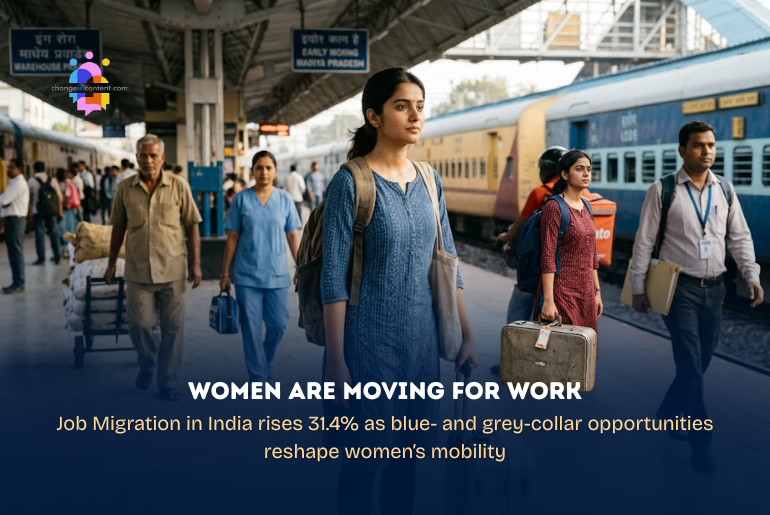
Job migration in India is rising sharply, and this time, the story is not only about men leaving home for work. A new WorkIndia Report shows that job-related migration grew by 31.4% year-on-year between January and April 2026. More women, freshers, and blue- and grey-collar workers are applying for jobs outside their home cities.
For decades, migration for work in India was largely a male workforce pattern. Women moved too, but mostly due to marriage, family relocation, or social circumstances. That distinction matters. When women move for work, the shift is not just geographical. It speaks to economic independence, changing family expectations, access to better wages, and the quiet rewriting of who gets to pursue opportunity.
WorkIndia’s findings suggest that more women are now willing to relocate for better employment, especially in blue- and grey-collar roles. That does not mean the barriers have disappeared. Safety, housing, transport, workplace dignity, and family approval still shape women’s mobility. But the rise in cross-city applications shows that a growing number of women are beginning to treat migration as a career decision, not merely a life event decided by others.
What the latest data on job migration in India shows
The new report by WorkIndia, a recruitment technology company focused on blue-collar and entry-level jobs, highlights a major shift in India’s workforce.
More women, freshers, and workers across the blue- and grey-collar sectors are increasingly looking beyond their home cities for better jobs. They are seeking higher wages and stronger career prospects.
According to the report, workers submitted 8.6 million job applications for positions outside their home cities between January and April 2026. It marks an increase from 6.5 million applications during the same period in 2025, representing a 31.4% year-on-year increase.
Cross-city applications are growing faster than local job searches
The growth in cross-city job applications is significantly higher than the 20.2% increase seen in applications for jobs within the same city. This number suggests that the pool of workers willing to relocate for employment is expanding at more than 1.5 times the rate of the local job-seeking workforce.
As a result, nearly 1 in 4 workers on the platform (24.1%) is now actively applying for jobs outside their home city, up from 22.5% a year earlier.
The findings are based on an analysis of more than 35 million job applications submitted on WorkIndia’s platform between January and April 2026.
This shift also connects with a larger labour story that Changeincontent has been tracking closely: the growing visibility of women in India’s blue- and grey-collar workforce. As more women enter sectors once seen as male-dominated, their willingness to relocate for better work adds another layer to the conversation around opportunity, safety, wages, and workplace inclusion.
Job migration in India is no longer only a male workforce story
For decades, men have been driving the workforce mobility in India. Women often faced social, financial, and safety-related barriers to relocating for work. However, that trend is beginning to change. The report shows that more women in blue- and grey-collar roles are now willing to move beyond their home cities in search of better employment opportunities.
Cross-city job applications among first-time job seekers increased by 11%, compared to a more modest 5% rise among experienced workers. The data suggests that younger workers are increasingly open to relocating early in their careers if it means better pay, more stable employment, or greater growth opportunities.
Sectors such as labour, office administration, sales, and healthcare saw an increase in workers applying for jobs outside their home cities. At the same time, traditional mobility-heavy sectors continue to account for a large share of cross-city job applications. Manufacturing, delivery and driving services, automobile-related jobs, and domestic work remain among the biggest contributors to workforce migration.
A shift in women’s job migration patterns
The rise in job-related migration among women is particularly significant when viewed against India’s broader migration trends. Historically, women in India have moved primarily for social reasons rather than for employment.
According to the Periodic Labour Force Survey (PLFS) 2020–21, the migration rate was estimated at 47.9% among women, much higher than the 10.7% recorded among men. However, the reasons behind these movements were very different.
From marriage-led migration to work-led mobility
The survey found that marriage accounted for nearly 86.8% of all female migration in India. In other words, most women who moved from one place to another did so because of family and social circumstances rather than career opportunities.
For men, the pattern was almost the opposite. Employment and the search for better jobs were among the leading reasons for migration, accounting for 22.8% of male migrants nationwide.
Against this backdrop, WorkIndia’s findings point to an important change. More women in blue- and grey-collar jobs are now actively choosing to relocate for work. It suggests that employment is becoming a stronger reason for migration among women than in the past.
While marriage and family continue to shape migration patterns for many women, a growing number are also moving to secure better wages, improved working conditions, and greater financial stability.
The trend is particularly visible in sectors such as domestic work, where women have traditionally relied on local employment opportunities and informal networks.
“Migration has stopped being a male, metro-bound, last-resort decision. It is now a deliberate career choice being made by millions of Indians, including a fast-growing share of women and first-time job seekers,” WorkIndia co-founder and CEO Nilesh Dungarwal added.
The closing thoughts
As an industry, we must now treat the movement of women moving for work as a small labour-market update. It is a sign of changing aspiration. It tells us that more women are viewing employment not as supplementary income but as a route to independence, mobility, and self-determination.
But this shift also comes with responsibility. If more women are applying for jobs outside their home cities, employers, recruiters, platforms, and policymakers must ask harder questions.
Are these jobs safe? Are wages fair? Is accommodation available? Is transport reliable? Are grievance redressal systems real, or only written into policy documents? Are women being hired into roles with growth, or only absorbed into the lowest-paid end of the labour chain?
The Changeincontent perspective
Job migration in India can become a force for inclusion only when mobility is matched with dignity. A woman moving cities for work should not have to choose between opportunity and safety. She should not have to depend on informal networks to survive in a new city. She should not be celebrated as “empowered” while being left alone to negotiate unsafe housing, irregular shifts, low wages, and social judgement.
The WorkIndia report points to a hopeful shift. More women are moving to pursue better futures. The next step is making sure those futures are not built on fragile promises. India does not just need more women willing to move for work. It needs workplaces, cities, and systems worthy of their movement.
Editorial Note and Methodology
This article is part of Changeincontent’s DEI Insights coverage, where we examine labour trends, workplace inclusion, gendered employment patterns, and the changing realities of women in India’s workforce. The article uses publicly reported findings from WorkIndia’s 2026 job migration analysis. It places them in the context of India’s broader migration data, especially the gendered reasons behind movement for work, marriage, and family.
This article draws on reported findings from WorkIndia’s analysis of more than 35 million job applications submitted between January and April 2026. The article also cites official migration indicators from the Periodic Labour Force Survey 2020 to 2021, as reported by the Government of India, to compare employment-led and marriage-led migration among men and women. Changeincontent has used these data points to interpret the gender and inclusion implications of rising cross-city job applications in India’s blue- and grey-collar workforce.
Sources
- Economic Times report on WorkIndia’s job migration data
- ET HRWorld coverage of the WorkIndia report
- PTI report on women and freshers migrating for blue- and grey-collar jobs
- Government of India PIB release on PLFS migration data