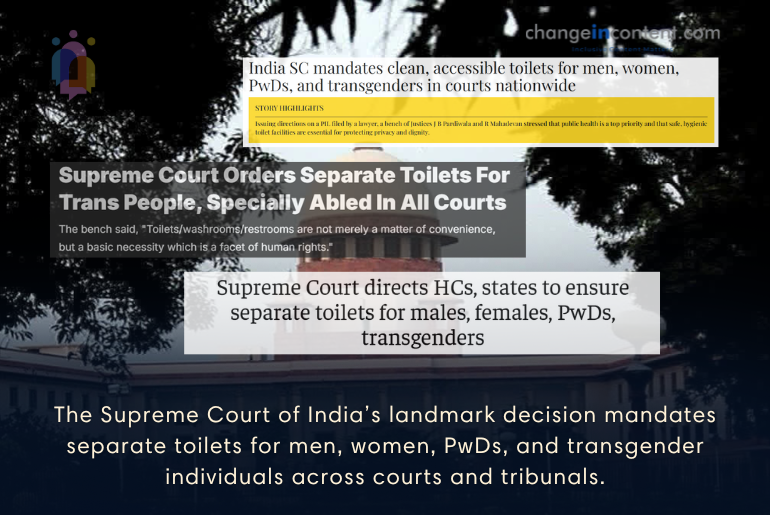
In a groundbreaking decision addressing basic human dignity and accessibility, the Supreme Court of India has mandated the provision of separate toilet facilities for men, women, people with disabilities (PwD), and transgender individuals across all courts and tribunals in the country. This directive is a crucial step toward ensuring equality in judicial premises and reflects the judiciary’s commitment to upholding human rights and fairness.
The court’s ruling, in response to a 2023 plea by Rajeeb Kalita, highlights the lack of adequate sanitation facilities in judicial environments and their impact on the fair administration of justice.
In its judgment, the Supreme Court said,
“It is the duty of the Government and local authorities to provide basic toilet and sanitation facilities within the Court premises and ensure that they are constructed, maintained and kept in a hygienic condition for men, women, people with disabilities, and transgender persons.”
A grim reality: The state of toilets in court tribunals
For years, courts and tribunals across India, particularly in rural areas, have struggled with inadequate or non-existent washroom facilities. This issue has impacted not just litigants but also advocates, staff, and even judges. In its 34-page judgment, the Supreme Court acknowledged the dire state of affairs, emphasising that sanitation is not merely a convenience but a human right.
The court observed, “Failure to provide adequate washroom facilities is not just a logistical issue; it reflects a deeper flaw in the justice system.” This stark commentary underscores the systemic neglect of basic infrastructure within judicial spaces.
Disparities across regions
The lack of washroom facilities in rural district courts is especially concerning. Judges who uphold constitutional values often lack access to proper sanitation during court hours. This disparity between urban and rural judicial facilities further exacerbates inequalities within the system.
By highlighting these gaps, the Supreme Court’s directive aims to bring uniformity and dignity to all judicial spaces, regardless of location.
Supreme Court’s directive: A comprehensive action plan
The court has mandated the construction of separate toilets for men, women, PwDs, and transgender individuals across all courts and tribunals in the country. These facilities must be designed to meet the needs of all individuals, with a focus on accessibility and inclusivity.
Committee oversight
As per the decision, each high court must form a committee led by a senior judge, which will oversee the implementation of this directive. Members of this committee will include registrars, finance and PWD secretaries, representatives from state governments, and Bar Association members. Their responsibilities include:
- Auditing existing facilities.
- Estimating daily footfall in courts.
- Formulating a comprehensive infrastructure plan.
- Ensuring proper funding and resource allocation.
Temporary solutions and modernisation
The court has suggested temporary mobile toilets to bridge the gap during construction. To ensure eco-friendly sanitation solutions, it has also recommended the adoption of bio-toilets modelled on the sustainable practices of Indian Railways.
Toilets in Court Tribunals: Special provisions for women, PwDs, and transgender individuals
Women’s facilities
The court directed the inclusion of sanitary napkin dispensers, child-safe washrooms, and separate nursing rooms for mothers. These additions are crucial for ensuring that women feel comfortable and supported in judicial premises.
Accessibility for PwDs
Ramps, handrails, and specially designed washrooms are mandatory to accommodate individuals with disabilities. The court also emphasised the importance of clear signage to guide users to these facilities.
Inclusivity for transgender individuals
For the first time, the Supreme Court has explicitly called for separate and identifiable facilities for transgender persons, reaffirming the judiciary’s commitment to inclusivity.
A broader perspective: Bridging the gap between infrastructure and justice
The absence of proper washroom facilities in courts often forces individuals, especially women, to endure physical discomfort. It affects their ability to engage fully in judicial processes, creating barriers to access and participation. By addressing this issue, the Supreme Court’s ruling seeks to ensure that judicial spaces uphold the principles of dignity and equality for all.
Challenges in implementation
While the directive is a step forward, its success depends on consistent monitoring and adequate funding. State governments and high courts must prioritise this issue to ensure that the facilities are built and maintained effectively.
The road ahead: Accountability and action
The Supreme Court has introduced a grading system to evaluate the quality of maintenance in judicial premises. This system will hold officials accountable and incentivise better upkeep of facilities.
High courts, state governments, and Union Territories are required to submit status reports within four months. These reports should detail the progress made in implementing the court’s directives. It will ensure transparency and keep the focus on timely execution.
Conclusion: Toilets in court tribunals as a symbol of progress
The Supreme Court’s directive on toilets in court tribunals is a monumental step toward ensuring dignity, equality, and accessibility in judicial spaces. However, it also raises a larger question: why has it taken so long to address such a fundamental need in a country aspiring to be a global superpower?
This decision is not just about sanitation; it is about creating an environment where justice is accessible to all without the barriers of physical discomfort or indignity. As India moves forward, it must ensure that such reforms are implemented promptly and sustainably, paving the way for a more inclusive future.
To learn more about the state of toilets in the workplace, read our insights here.
Disclaimer: The views expressed in this article are based on the writer’s insights, supported by data and resources available both online and offline, as applicable. Changeincontent.com is committed to promoting inclusivity across all forms of content. We broadly define inclusivity as media, policies, law, and history—encompassing all elements that influence the lives of women and gender-queer individuals. Our goal is to promote understanding and advocate for comprehensive inclusivity.