
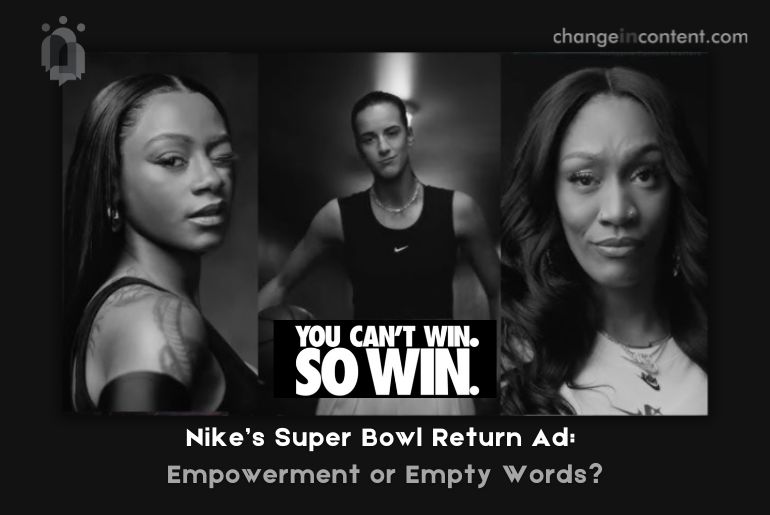
Nike’s Super Bowl Return Ad arrived with a bold message—one that claimed to celebrate women in sports and challenge the barriers they face. But beyond the powerful visuals and compelling narration, a question lingers: Is this truly a step forward, or just another moment of brand marketing capitalising on empowerment?
Nike’s long-awaited return to the Super Bowl ad stage undeniably makes waves. However, does it shift the conversation in a meaningful way? Or are we still asking women to push through systemic inequalities without holding institutions accountable?
An Overview of Nike’s Super Bowl Return Ad
The Super Bowl is not just a football game in America. It is a national spectacle, and for brands, it is the most prominent advertising stage of the year. No other event offers a chance to reach, engage, and influence millions of people at once. Americans may tolerate ads on most days, but on Super Bowl Sunday, they welcome them with open arms. Audience data even suggests that more eyes stay glued to the screen during commercial breaks than during the game itself.
Super Bowl commercials are as much a tradition as the game itself. The tradition of high-budget, highly anticipated ads began with the very first Super Bowl, when a 30-second slot cost a staggering $42,000, a bargain compared to today’s multimillion-dollar price tags. A forgettable Super Bowl ad is worse than no ad at all. That is why, every year, brands try to outdo each other with over-the-top creativity, celebrity cameos, narratives, and anything to make people talk.
This year, Nike made a grand return to the Super Bowl ad lineup after 27 years. However, what made Nike’s return especially noteworthy was not just the timing. The 60-second commercial, titled “So Win,” was a celebration of women athletes.
Nike’s “So Win” campaign to celebrate women in sports
The 60-second black-and-white commercial with an all-women cast is Nike’s first Super Bowl commercial since 1998. Narrated by Grammy-winning rapper Doechii, the ad features sports stars Caitlin Clark, A’ja Wilson, JuJu Watkins, Sabrina Ionescu, Alexia Putellas, Aryna Sabalenka, Sha’Carri Richardson, and more.
Nike introduced the ad with a post on X: “There’s one guarantee in sport. You’ll be told you can’t do it. So do it anyway. You can’t win. So Win.“
The tagline, “You can’t win. So win.” points out that women athletes are often judged for things that male athletes are praised for. If they are aggressive, people see them as “too much.” If they celebrate a win, they are called arrogant. If they show emotion, they are “overreacting.” The ad takes all these criticisms and flips them. It encourages women to push forward despite the limitations placed on them.
[penci_video url=”https://www.youtube.com/watch?v=b0Ezn5pZE7o” align=”center” width=”720″ /]
The full transcript of the Nike’s Super Bowl Return Ad
“You can’t be demanding. You can’t be relentless. You can’t put yourself first. So, put yourself first. You can’t be confident. So be confident. You can’t challenge, so challenge. You can’t dominate, so dominate. You can’t flex, so flex. You can’t fill a stadium, so fill that stadium. You can’t be emotional, so be emotional. You can’t take credit. You can’t speak up. You can’t be so ambitious. Break records. You can’t have any fun. You can’t make demands. You can’t be proud. You can’t keep score. You can’t stand out. Whatever you do, you can’t win. So win.“
Nike clearly wanted to make a bold statement, and for the most part, it worked. But was it perfect? Not entirely. It’s fair to ask how much of it is genuine and how much is just performative marketing.
Nike’s “So Win” message: Motivating or missing the point?
Nike’s “You can’t win. So win.” feels like just another way of telling women to grin and bear it. For generations, women have been told to push through, work harder, and prove themselves again and again. So the real question is, how much longer do women have to keep pushing?
The slogan puts the burden squarely on women’s shoulders. But why is the responsibility always on women? Why not ask the institutions, the workplaces, and the industries that underpay, undervalue, and overlook women to finally step up and change? Instead, the ad simply acknowledges that these obstacles exist, then shrugs and says, deal with it.
It’s eerily similar to the way society excuses bad behaviour from men with phrases like “boys will be boys” or “men will be men.” It acknowledges the problem but refuses to hold anyone accountable for fixing it.
Of course, Nike isn’t entirely wrong. Women continue to win despite the odds. They break records, dominate their fields, and prove time and again that they belong. Yet, here we are, still telling them to “push through.” At what point do we stop glorifying the struggle and start demanding change?
Nike’s Super Bowl Return Ad: Flaws and all, Nike got one thing right
Nike’s “So Win” ad does get something right. It features an all-women cast, a woman narrator (Grammy-winning rapper Doechii), and a woman director (Kim Gehrig for W+K Portland). But what really matters is where it aired. The Super Bowl.
The NFL isn’t exactly known for women’s empowerment. It has more than its share of misogynistic baggage. Just last year, Kansas City Chiefs kicker Harrison Butker made headlines by declaring that one of the most important titles for women is a homemaker. He also targeted the LGBTQIA+ community, calling Pride Month “the deadly sin sort of pride” while condemning abortion, IVF, and surrogacy.
And that’s just one example. The league has long been a “Boy’s Club.” The Super Bowl remains a male-dominated event, from the teams on the field to the corporate execs behind the scenes. So, Nike chose this moment, after nearly three decades, to return to Super Bowl advertising with an ad focused entirely on women in sports? That’s a move worth acknowledging.
Nike’s Super Bowl Return Ad: The final thoughts
Nike is a business, and empowerment sells. If Nike truly wants to back women in sports, it will take more than a well-produced ad. That means pushing for equal pay, better contracts, and actual support beyond the commercial breaks. So yes, the ad makes a statement. But at some point, the conversation needs to shift from women overcoming barriers to making those barriers nonexistent.
Disclaimer: The views expressed in this article are based on the writer’s insights, supported by data and resources available both online and offline, as applicable. Changeincontent.com is committed to promoting inclusivity across all forms of content. We broadly define inclusivity as media, policies, law, and history—encompassing all elements that influence the lives of women and gender-queer individuals. Our goal is to promote understanding and advocate for comprehensive inclusivity.
