
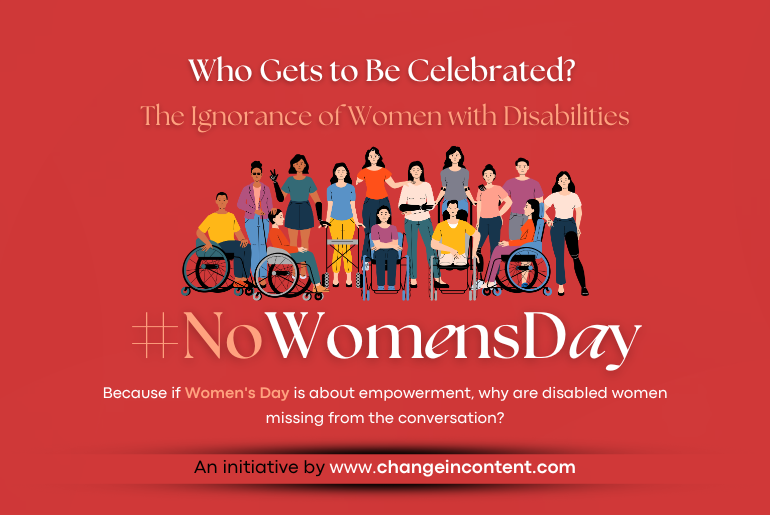
International Women’s Day has come and gone. Leaving behind a trail of campaigns, social media posts, WhatsApp stories, and the usual flood of well-meaning but surface-level gestures. Companies, big and small, regardless of their industry, scrambled to put out something (anything) about women’s issues. Yet, for all the noise, one thing remained the same: the erasure of marginalised women or the ignorance of women with disabilities.
Look at most Women’s Day posts, and you will see a familiar image. A young, conventionally attractive woman who neatly fits society’s idea of empowerment. Women are strong; women are unstoppable; women are breaking barriers. But which women are we talking about? Because if you scan these campaigns, it’s clear who is missing. Women with disabilities. Women who don’t fit the polished, Instagram-ready version of progress.
Ignorance of women with disabilities: The selective celebration of women
The reality is that inclusion often stops at aesthetics. Brands want diversity, but only the kind that photographs well. Women with disabilities, who face barriers in employment, public spaces, and even basic representation, are often left out of the conversation, both on March 8th and every other.
Most women’s day campaigns often promote a narrow idea of empowerment. 9 out of 10 times, we see an able-bodied woman breaking barriers in a corporate office, a confident athlete, or a stylish entrepreneur. While these stories matter, they don’t represent all women. This intentional or unintentional exclusion (hard to tell these days) sends a harmful message that only certain groups of women are worth celebrating.
Even when a brand includes women with disabilities in a campaign, the effort is often short-lived. It usually lasts only until March 8th, or at best, through Women’s History Month.
The overlooked struggles of disabled women
Women with disabilities are “excluded within an exclusion.” They experience discrimination both as women and as people with disabilities. Reports show that women and girls with disabilities are among the most marginalised groups in society.
Women with disabilities face barriers in nearly every aspect of life. Yet, these issues rarely make it into mainstream discussions on gender equality. One of the most significant issues is the lack of reliable data. The official statistics on women with disabilities are often outdated, inaccurate, or difficult to find.
Access to education
Less than 5% of children with disabilities receive formal education, and for disabled women, the literacy rate is a shocking 1%. Schools lack accessibility, materials are not designed for diverse needs, and social stigma discourages families from educating disabled girls.
The employment gap no one talks about
Men with disabilities are almost twice as likely to get jobs than women with disabilities. When disabled women do find work, they face lower wages, limited training, and discrimination in hiring and promotion.
Poor healthcare
Every minute, over 30 women experience serious injury or disability during childbirth. Yet, these 15 to 50 million women remain invisible in healthcare discussions. Many hospitals and clinics still lack accessible facilities, forcing disabled women to rely on inadequate or nonexistent care. If maternal care is a priority in global health campaigns, then women with disabilities deserve to be part of the conversation.
Access to housing
Women with disabilities struggle to find safe, accessible homes, often facing discrimination from landlords or being denied necessary accommodations. While schemes exist to help women from disadvantaged backgrounds own homes, it’s time to extend that focus to disabled women, too.
When we talk about diversity, the focus is mostly on gender, race, and sexuality, leaving disability out of the conversation.
The final thoughts on the ignorance of women with disabilities
Representation is about acknowledging different experiences and making space for them. Until brands, organisations, and even well-intentioned campaigns stop treating inclusion like a checklist, these efforts will remain exactly what they are; “performative.” And no amount of pink-themed social media posts can change that.
My aunt, a strong woman who lives with polio, never saw herself in the Women’s Day celebrations around her. That is exactly why #NoWomensDay exists—because empowerment should include all women, not just the ones who fit a curated image. – Saransh Jain, Founder of Changeincontent.com
It is not about criticising Women’s Day campaigns but highlighting a gap that needs attention. It is a reminder to recognise the challenges disabled women face.
References
- UN: Women with Disabilities Fact Sheet
- Exposure of Women With and Without Disabilities to Violence and Discrimination
Disclaimer: The views expressed in this article are based on the writer’s insights, supported by data and resources available both online and offline, as applicable. Changeincontent.com is committed to promoting inclusivity across all forms of content. We broadly define inclusivity as media, policies, law, and history—encompassing all elements that influence the lives of women and marginalised individuals. Our goal is to promote understanding and advocate for comprehensive inclusivity.
