
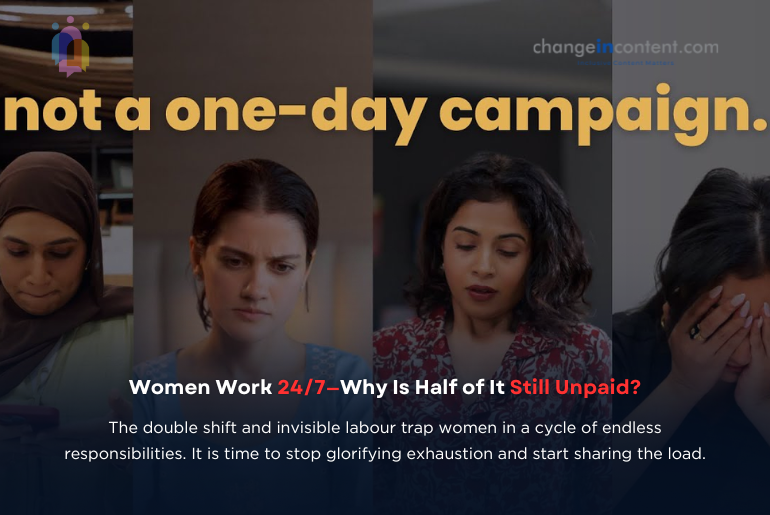
Leap.club’s video, Not a One-Day Campaign, captures a reality women know all too well: doing twice the work for half the credit. It is not just about office hours; it is also about being the default parent, the household manager, and the emotional support system—all at once. This leads to the ignored notion of the double shift and invisible labour that women live with.
The video begins with a working mother answering her kids’ calls while their father, very much at home, remains undisturbed. Another mother, struggling to focus on a meeting, gets interrupted by the house help announcing the electrician’s arrival because, of course, she is the go-to person for every minor crisis. Her husband, meanwhile, yells across the house, demanding to know where his wallet is. Desperate for uninterrupted time, she locks herself in the bathroom as it’s the only way to get work done.
The video also highlights the relentless guilt working women feel, whether for leaving household chores unfinished or missing a parent’s doctor’s appointment. Most importantly, it exposes the invisible labour women do every single day.
[penci_video url=”https://www.youtube.com/watch?v=-E4uStt27AQ” align=”center” width=”770″ /]
The unpaid double shift and invisible labour that women carry
American sociologist Arlene Kaplan Daniels defined “invisible work” as unpaid labour performed outside of the market economy and, therefore, gets neither status nor validation. Invisible labour exists due to the assumption that women are naturally better at caregiving, so they see it as something women should do rather than work that deserves recognition or reward.
The Time Use Survey India found that in 2024, women spent 305 minutes a day on unpaid domestic work. In the U.S., the American Time Use Survey shows that even in egalitarian marriages, wives take on more household responsibilities than their husbands. On average, they spend 6.9 hours per week caring for family members and 4.6 hours on housework, while husbands spend just 5 and 2 hours, respectively.
Even when earnings are similar, men still get more time for paid work and leisure, while women handle most of the unpaid caregiving and housework. In 2024, 50% of women said they take on the majority of childcare, while only 12% said their partner does. Nearly 60% of women also reported being the primary caregivers for other adults, a jump from 44% in 2023. (The “Women @ Work 2024” report by Deloitte)
Meanwhile, studies show that LGBTQ+ couples divide housework more equitably than heterosexual couples. Without gendered expectations dictating who should scrub the dishes or manage doctor’s appointments, responsibilities get shared more fairly. Yes, the household work is split based on ability rather than outdated stereotypes.
The mental load trap: Panning, reminding, repeating
Who remembers to buy groceries before the milk runs out? And who keeps track of birthdays, doctor’s appointments, and school deadlines? Who plans vacations and makes sure the kids have packed everything they need? More often than not, the answer is women. The mental load is also work. Yet, it remains invisible.
Remembering everything, anticipating needs, and coordinating tasks is real work that takes time and effort. Keeping a family running smoothly is not magic. It is a mental load of multitasking skills with constant planning, tracking, and organising. By the time a woman sits down to relax, she’s already thinking about what needs to be done next.
The trap women fall into with this double shift and invisible labour
Many women find themselves not only managing everything but also having to remind their partners to pitch in. “Did you fix that leaky tap?” “Can you pick up the dry cleaning?” “Did you remember to pay the electricity bill?” Even asking for help becomes extra work.
The superwoman illusion
Growing up in a patriarchal society like India, we watched women in our families handle most of the housework. Many of us naively assumed this imbalance would disappear once women had careers. But instead of easing their burden, the world created the superwoman narrative, where women are expected to juggle it all effortlessly.
She must excel at work, maintain a spotless home, be a perfect mother, and still have the energy to organise weekend family gatherings. If she stumbles, society questions her choices: Why have kids if you can’t be there for them? Why work if you can’t manage the house?
Work-from-home is supposed to offer flexibility, but for many women, it has blurred the lines between professional and domestic responsibilities even further. Their meetings are interrupted by chores, childcare, or house help.
Young girls watch their mothers handle everything, only to grow up and face the same exhausting cycle. A career-driven woman feels guilty for not cooking a full meal before leaving for work. A daughter struggles with missing her mother’s doctor’s appointment, while her brother is rarely expected to step in. Society doesn’t question why men don’t share the load. It only questions why women struggle to manage it all.
The real question: Who is listening to these campaigns?
Before rolling out yet another campaign on women’s unpaid work, let’s pause and ask: Does it actually change anything? Yes, women relate to these messages. They feel seen, they share their stories, and for a moment, there’s a sense of recognition. But then what?
If the goal is awareness, we are there. If the goal is action, then it is time to rethink the messaging. The messaging should promote more than just awareness. It should challenge all genders to step up at home, encourage companies to support better work-life policies and force policymakers to rethink economic structures that take women’s labour for granted.
How does that happen? We have several years to go before we find an answer.
The final thoughts: Let us not ignore the double shift and invisible labour
This Women’s Day, let’s stop glorifying invisible labour and the superwoman myth. Women don’t need praise or campaigns for “doing it all.” They need real support and shared responsibilities. If we truly want change, the first step is to recognise that unpaid labour is still labour. We must stop romanticising overworked women as supermoms and start supporting better work-life balance. Men need to be taught to act like passive participants in their own homes. And society needs to drop the guilt-tripping because a woman prioritising herself isn’t neglecting her family.
Let us also embrace a small change- every day should be a “Woman’s Day” and say no to tokenistic gestures on the 8th of March: let’s all say #NoWomensDay. It is a changeincontent.com original initiative. Please note that we respect IWD and its impact; when we say #NoWomensDay, it means we say no to tokenism, bias and pinkwashing.
Disclaimer: The views expressed in this article are based on the writer’s insights, supported by data and resources available both online and offline, as applicable. Changeincontent.com is committed to promoting inclusivity across all forms of content. We broadly define inclusivity as media, policies, law, and history—encompassing all elements that influence the lives of women and marginalised individuals. Our goal is to promote understanding and advocate for comprehensive inclusivity.
