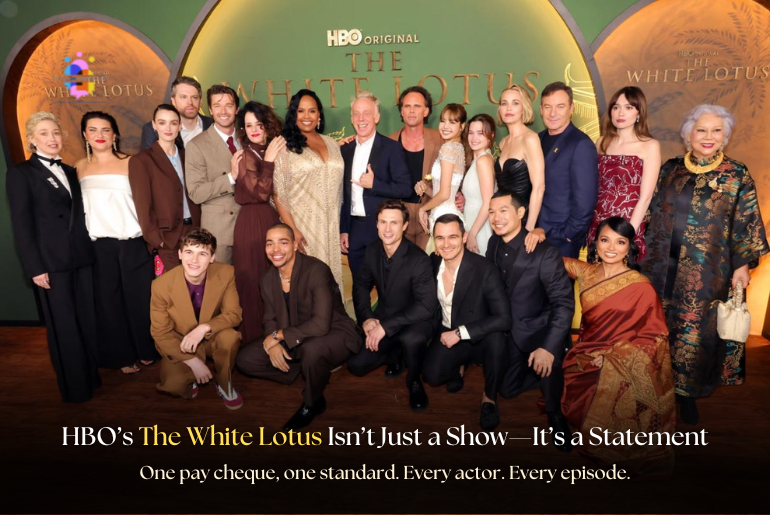
HBO’s The White Lotus has built its name on satirising the lives of rich people on vacation and biting social commentary on wealth inequality. With its mix of dark comedy and social critique, the anthology TV series digs into privilege, class divides, and pay gaps. Surprisingly, the show’s message doesn’t stop once the cameras do. The show practices what it preaches, even off-screen.
Producer David Bernad confirmed in an interview with The Hollywood Reporter that the show gives all its regulars equal pay regardless of their fame, screen time, or number of awards. “Everyone is treated the same on The White Lotus,” Bernad said. “They get paid the same, and we do alphabetical billing, so you are getting people who want to do the project for the right reasons, not to quote The Bachelor.”
Same script, same pay: The White Lotus keeps it even
According to reports, each regular receives $40,000 per episode. With eight episodes in the season, that adds up to $320,000 for six months of shooting in Thailand. For some, it is a generous fee. For others used to seven-figure payouts, it might feel like pocket change. Still, everyone signs the same contract. That includes seasoned actors like Parker Posey, Jason Isaacs, and Walton Goggins, who share the same pay with rising stars like Sam Nivola and Tayme Thapthimthong.
News of The White Lotus giving equal pay to all its regular cast has drawn strong praise. That is particularly because wage gaps continue to affect not just entertainment but nearly every industry. Gender pay gaps still exist, even in 2025. Women, particularly women of colour, continue to earn less than men across industries.
Big screens, bigger gaps: Women still earn less
At the highest level of stardom, men earn over $2.4 million more per film than women. Even in the most generous comparisons, the gap doesn’t drop below $1 million. Women in cinema earn around 25% less than men, despite having similar levels of experience, popularity, and box office draw. Even among the highest-paid stars, women earn about 56% less. That is a significant difference for doing the same job, sometimes doing it better.
Many defend this gap by pointing to “market value,” claiming men generate more revenue. But the industry builds that narrative. Studios pour money into male-led films, market them harder, and give men longer careers. Naturally, male actors look more “profitable” because the system was built to make them so.
Star status has a gender bias
Many critics argue that star status should influence an actor’s paycheck. Someone with more experience, a larger fan base, and a long career in the industry surely deserves more, right? No.
Let’s talk about how this so-called “star status” actually works. In most cases, people measure it by the number of years someone has spent in the industry, the success of their past projects, and their ability to draw viewers. But wait, you have to ask who gets to build that kind of career in the first place. The answer is simple. Men.
Men, especially in entertainment, enjoy longer, more stable careers. A male actor can hit 60 and still land heroic leads or romantic roles without raising eyebrows. Meanwhile, women often see their opportunities shrink dramatically once they reach their 30s. Getting married or having children can also make casting directors magically forget their existence. By the time a woman turns 40, the industry often pushes her into mother roles, background parts, or out of the picture entirely.
So, when people use career longevity to justify higher pay, they ignore the fact that women rarely get the same chance to build that kind of career. The system sets them up to fall behind and then blames them for not catching up.
“Equal pay in entertainment should not feel like a plot twist. HBO’s The White Lotus proves that fairness is not a creative compromise—it is a creative commitment. When status and screen time stop dictating value, we all get a better story.” — Arunima Bhattacharya, Founder, The Big Pitchr
Equal pay standard by HBO’s The White Lotus: The final thoughts
Equal pay on The White Lotus might not undo years of unequal wages or solve the gender pay gap. However, it shows what fair practices can look like and invites others in the industry to do the same. Critics may argue that equal pay removes the incentive for actors to build star power. But it’s time to stop pretending that stardom has ever followed a fair set of rules.
If the industry still hands out opportunities based on gendered ideas of who can lead, who can age, and who gets replaced, then a reset like this feels long overdue.
Disclaimer: The views expressed in this article are based on the writer’s insights, supported by data and resources available both online and offline, as applicable. Changeincontent.com is committed to promoting inclusivity across all forms of content. We broadly define inclusivity as media, policies, law, and history—encompassing all elements that influence the lives of women and marginalised individuals. Our goal is to promote understanding and advocate for comprehensive inclusivity.