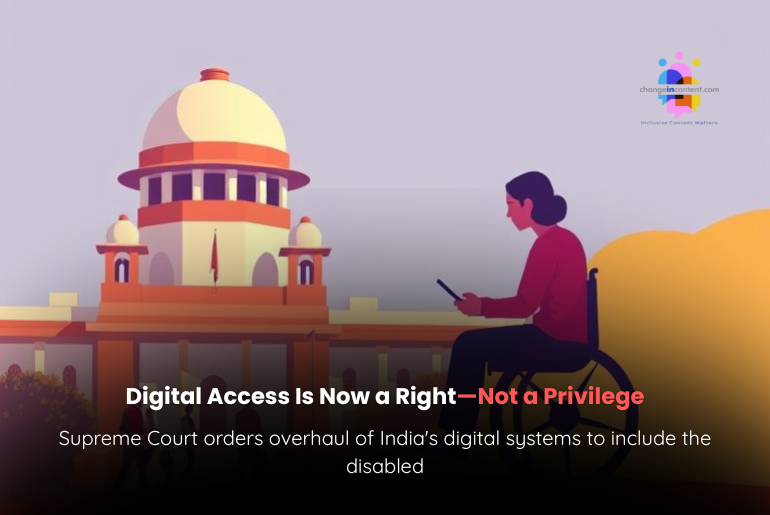
In a significant move for digital rights, the Supreme Court has officially linked digital inclusion for disabled citizens to the constitutional right to life. The ruling mandates changes that could radically shift how accessible our digital systems really are.
We live in a world where everything is a tap away. Bank accounts, ID verification, and even government services. We access it all through our smartphones. It is quick, portable, and efficient. But as we scroll, swipe, and click, there is one group that still struggles to keep up: people with disabilities. When we hear the word “disability,” most of us picture a wheelchair. But disability is not just physical. It includes sensory challenges like vision and hearing loss, as well as cognitive difficulties.
Many digital systems aren’t designed for everyone. Imagine a visually impaired person trying to complete a digital KYC form. Or an acid attack survivor with facial disfigurement trying to verify their identity through facial recognition. Until now, this exclusion has gone largely unaddressed. There were no clear legal standards in India for digital systems to be inclusive. However, that changed on April 30, 2025.
Digital inclusion for disabled citizens: A new chapter for digital India
On April 30, 2025, the Supreme Court of India ruled that digital access is a fundamental right under Article 21 of the Constitution, which guarantees the right to life and liberty. This ruling is a significant step forward in protecting the rights of persons with disabilities (PwDs), especially those with vision impairments and facial disfigurements.
The case that led to this judgment, Amar Jain v. Union of India & Others, focused on the challenges faced by persons with disabilities in completing the digital Know Your Customer (KYC) process. The petitioners highlighted how the current digital systems failed to accommodate their needs, making it difficult to access essential services.
Recognising this barrier, the Supreme Court directed authorities to revise digital KYC norms in line with the Rights of Persons with Disabilities Act, 2016. It includes making KYC processes more accessible to individuals with visual impairments and facial disfigurements, such as survivors of acid attacks.
What the court ordered on digital inclusion for disabled citizens
The court ordered that the government must ensure an inclusive digital environment for marginalised, underprivileged, vulnerable, disabled, and historically excluded communities. A two-judge bench led by Justice J.B. Pardiwala and Justice R. Mahadevan laid down 20 binding directives to prioritise inclusion and accessibility in how digital services reach the public.
The Supreme Court of India has accordingly issued the following directions:
Making digital KYC inclusive
The Reserve Bank of India (RBI) must now issue updated guidelines to make the digital Know Your Customer (KYC) process accessible to all. Instead of relying only on the current “blinking of eyes” method to confirm a person is present (liveness detection), the RBI must allow other ways to verify identity. It includes accepting thumb impressions as valid proof for people with visual impairments.
Ensuring reasonable accommodation
All reporting entities, whether public or private, must follow accessibility standards. They must appoint dedicated officers responsible for digital accessibility and conduct regular audits through certified experts.
Importantly, organisations must include persons with visual impairments when testing new apps, websites, or digital platforms. This step ensures that services work well for everyone before launch.
Accessibility must be mandatory
All government websites and digital services must comply with Section 46 of the Rights of Persons with Disabilities (RPwD) Act, 2016. This law clearly states that both digital and print information must be accessible.
Additionally, all government platforms must follow the Web Content Accessibility Guidelines (WCAG) 2.1 and the Guidelines for Indian Government Websites (GIGW). These rules are no longer optional and are now mandatory.
Clear communication and better services
Public services must offer information in multiple formats so everyone can understand it. It includes content in Braille, audio descriptions, and simplified formats that are easier to read.
To support people with disabilities during the KYC process, services must provide helplines and proper systems to address complaints. There must also be a human review process when KYC applications are rejected.
Awareness and training
Employees in all regulated entities must now receive training that includes disability awareness and inclusion. These modules will help them understand the challenges faced by persons with disabilities and how to support them better.
The RBI must monitor our compliance with these measures and run public awareness campaigns to spread information about the new, inclusive KYC process.
What comes next: Building an inclusive digital future
Now that the Supreme Court has recognised digital access as a fundamental right, the responsibility doesn’t rest on the government alone. Corporates, especially those in banking, technology, telecom, and digital services, must step up.
Screen readers, voice-enabled navigation, captioning, and alternative ID verification tools should become standard features, not special accommodations. Equally important is ensuring these tools are available in regional languages and in rural areas, where access gaps are wider.
As India moves towards greater digital governance, the society must view inclusion as non-negotiable. It is disheartening that the digital accessibility needs of disabled individuals have been overlooked for this long.
Digital inclusion for disabled citizens: The final thoughts
For too long, digital systems have excluded those who need them the most. By declaring digital access a fundamental right, the Supreme Court of India has reminded the nation that convenience must not come at the cost of exclusion. If digital services are the gateway to banking, governance, and welfare, then that gateway must be open for everyone.
Perhaps most importantly, this ruling opens a door to rethink how every Indian citizen accesses and participates in the digital world. When digital platforms are designed to be accessible with simple navigation, voice support, or alternatives to visual content, they don’t just help disabled users. They also make life easier for elderly people, those with low digital literacy, and anyone finding the digital services difficult to navigate.
Changeincontent has previously discussed the gaps in inclusive policy implementation. Our article on Disability Inclusion in Union Budget 2025 highlights similar blind spots that the system must address now that digital access is the law.
Disclaimer: The views expressed in this article are based on the writer’s insights, supported by data and resources available both online and offline, as applicable. Changeincontent.com is committed to promoting inclusivity across all forms of content. We broadly define inclusivity as media, policies, law, and history, encompassing all elements that influence the lives of women and marginalised individuals. Our goal is to promote understanding and advocate for comprehensive inclusivity.