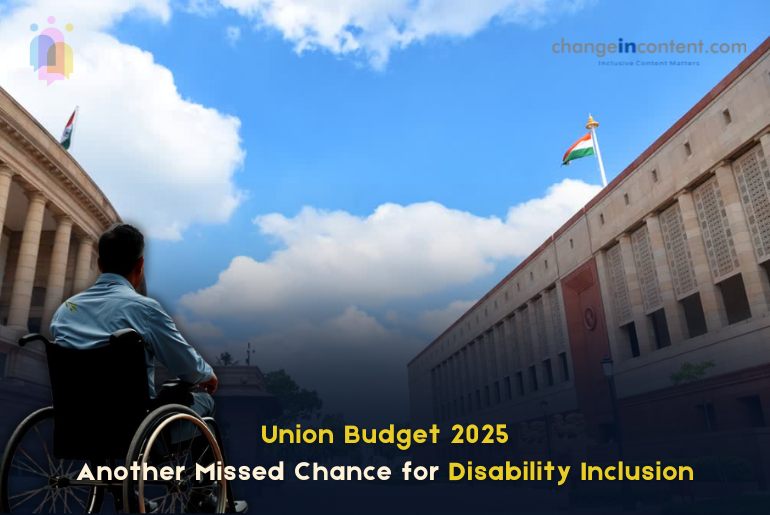
In the recently announced Union Budget 2025, Finance Minister Nirmala Sitharaman did not mention persons with disabilities even once, as highlighted by The Centre for Inclusive Policy. The lack of disability inclusion in the Union Budget 2025 raises concerns about the government’s commitment to the PwDs in India.
Despite making up nearly 8% of India’s population, persons with disabilities (PwDs) have once again been relegated to the margins of India’s financial priorities. The Union Budget 2025 has boasted record-high spending across various sectors. Still, the allocation for disability welfare remains shockingly low—a mere 0.025% of the total budget.
What is even more concerning? Even the little that is allocated is not fully utilised. India’s 80+ million disabled citizens are left asking the same question they ask every year: Where do we fit in the country’s development narrative?
The hard numbers: Budget allocation for disability in India
While the overall Union Budget 2025 has expanded significantly, the allocation for disability welfare has barely moved. The Department of Empowerment of Persons with Disabilities (DEPwD) was allocated ₹1,275 crore. That marks a 9.22% increase from the previous year’s revised estimate of ₹1,167.27 crore.
While any increase is welcome, let’s put this into perspective:
- India’s total budget has grown by 66% since 2020.
- Funding for disability welfare has decreased from ₹1,325 crore in 2020 to ₹1,275 crore in 2025.
- It accounts for just 0.025% of the total budget despite PwDs making up nearly 8% of the population.
The question remains: How can a fraction of a fraction be enough to address systemic inaccessibility, discrimination, and economic exclusion?
Slashing accessibility funds despite Supreme Court orders
One of the most shocking aspects of the Union Budget 2025 is the massive budget cut to the Scheme for Implementation of the PwD Act (SIPDA), which funds accessibility projects across India.
- In 2022-23, SIPDA received ₹240.39 crore.
- In 2023-24, this was slashed to ₹135.33 crore.
- In 2025-26, it has been further reduced to ₹115 crore.
This means that the scheme responsible for making India’s public spaces, government buildings, and transportation accessible has seen a 52% funding cut in just three years. Surprisingly, it happened even after a Supreme Court ruling in November 2024 (Rajive Raturi Judgment) mandated that public spaces and services must be made accessible.
The government is failing its own laws.
Underutilisation of funds: A silent crisis
Even the meagre budget allocated for disability welfare is not entirely spent. Year after year, a shocking portion of the funds allocated for PwDs remains unutilised:
- 64% of funds were left unused in 2020-21.
- 86% were unused in 2021-22.
- 79% were unused in 2022-23.
- 93% were unused in 2023-24.
It means billions of rupees meant for disability welfare are sitting unused while millions of disabled Indians struggle for basic accessibility, employment, and healthcare.
How can the government justify cutting accessibility budgets when it is failing to utilise what is already allocated?
Disability pensions: Stuck in 2012 while prices skyrocket
For millions of disabled Indians, the Indira Gandhi National Disability Pension Scheme (IGNDPS) is their only source of income. Yet, the pension remains stagnant at ₹300 per month—an amount unchanged since 2012.
With inflation skyrocketing, ₹300 today barely covers a week’s groceries, let alone medical care, assistive devices, rent, or transportation.
Despite the economic crisis, the Union Budget 2025 has made no effort to increase disability pensions. Meanwhile, elected officials continue to receive salary hikes.
Mental health crisis ignored
For two consecutive years, the Economic Survey has raised concerns about India’s growing mental health crisis. The National Crime Records Bureau (NCRB) reported over 1.6 lakh suicides in 2023, with mental health disorders playing a major role.
Yet, instead of increasing investment in mental healthcare, the budget for the Telemental Health Programme has been slashed from INR 90 crore to INR 79.60 crore.
At a time when mental health disorders are rising, when suicide rates are alarming, and when there is a dire need for accessible mental healthcare, this budget cut signals complete disregard for one of India’s most pressing public health emergencies.
No relief for disabled job seekers
Employment remains one of the biggest challenges for PwDs in India. However, the Union Budget 2025 offers no concrete solutions to address this.
The National Rural Employment Guarantee Act (MGNREGA), a crucial source of livelihood for disabled individuals, has not received an increase in funding.
While the Manufacturing & Skill Development Boost aims to create jobs, it does not mention inclusion for disabled workers.
The government envisions a “Viksit Bharat” (Developed India) by 2047, but how can a nation progress when 80 million of its citizens remain out of the workforce?
Opportunities – But only if done right
The Union Budget 2025 includes some key initiatives that could benefit disabled individuals if implemented inclusively:
- Credit Guarantee for MSMEs – Will disabled entrepreneurs finally get access to capital and business growth opportunities?
- Manufacturing & Skill Development Boost – Will disabled individuals be prioritised for training and employment?
- Jan Arogya Yojana for Gig Workers – Will disabled gig workers, who often struggle to get insurance, be included?
However, without specific inclusion mandates, these schemes risk becoming yet another missed opportunity.
Disability inclusion in the Union Budget 2025: Changeincontent’s perspective
At Changeincontent, we believe inclusion is not a privilege—it is a right. The Union Budget 2025 has once again failed to prioritise the basic rights of persons with disabilities.
- What good is a development plan if 80 million people are left out of it?
- What good is an “Accessible India” campaign when the budget for accessibility is cut every year?
- What good is a pension scheme when ₹300 a month won’t even cover food for a week?
The final thoughts on disability inclusion in the Union Budget 2025
The Union Budget 2025 presents yet another missed opportunity to make meaningful strides in disability inclusion. Without substantial investment and a commitment to implementing inclusive policies, India’s 80 million persons with disabilities will continue to face systemic barriers to full participation in society.
Disclaimer: The views expressed in this article are based on the writer’s insights, supported by data and resources available both online and offline, as applicable. Changeincontent.com is committed to promoting inclusivity across all forms of content. We broadly define inclusivity as media, policies, law, and history—encompassing all elements that influence the lives of women and gender-queer individuals. Our goal is to promote understanding and advocate for comprehensive inclusivity.