
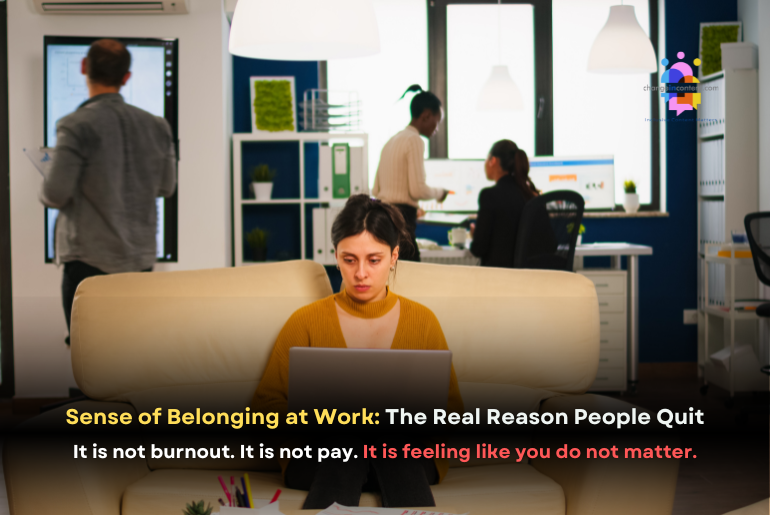
A few years ago, I met a talented marketing strategist—an IIT-IIM grad who had led million-dollar campaigns. She left her job not because of the workload, the pay, or even burnout. She left because no one said “hello” to her in the lunchroom for six months.
Sounds trivial? It is not. It is profoundly telling.
In the Indian workplace, especially in high-performance environments, we often reward hustle and skill. But we rarely reward humanity. A sense of belonging at work (the feeling that you are seen, respected, and safe to show up as yourself) is treated as a bonus. We treat it as something extra, something fluffy. But here is what we refuse to admit: it is the one thing that determines whether talent stays or leaves.
The cost of fitting in and the pain of standing out
Let me tell you about Akriti (name changed), a first-generation tech professional from rural Odisha who made it to a top IT company in Bangalore. She was technically brilliant. But she spoke English with a heavy accent and was not up to date with Netflix references and brunch culture. Colleagues joked about it in open meetings. They called her “desi hacker” and laughed.
She laughed too. Then one day, she just stopped showing up.
She did not quit because she was excluded from a project; she quit because she was excluded from conversations. That is the power of microaggressions. You cannot always name them, but you feel them every hour of every day.
Belonging is not the same as fitting in
Let us be clear: belonging is not about pizza parties or casual Fridays. It is not about attending team offsites or smiling in group photos.
Belonging is about knowing you will not be judged for who you are. It is about being able to ask “why?” without being seen as rebellious. It is about disagreeing with your boss without being labelled “too emotional” or “not a team player.” Moreover, It is about speaking up in a language you are comfortable with, and still being taken seriously.
In India, where hierarchies are deeply entrenched, many employees spend more energy trying to survive the culture than contributing to the company. That is not a talent issue. That is a systems issue.
Sense of belonging at work: The data we ignore
In a recent Randstad Workmonitor survey from Singapore, 62% of respondents said they would quit a job if they did not feel a sense of belonging. Among Gen Z, this jumped to 67%.
India is no different. In fact, our unspoken social codes, like language, caste, religion, gender expression, and skin tone, make exclusion more complex. However, we do not have enough Indian studies on workplace belonging because most of us are still afraid to name the problem.
We do not ask employees if they feel safe; we ask them if they feel “engaged.” We do not track attrition due to culture; we call it “lack of performance.” Moreover, we do not have exit interviews that ask the real questions because we are afraid of the real answers.
What organisations must understand
If you are in HR, leadership, or even running your own startup, here is what you must know:
- Psychological safety is not optional. Without it, diversity becomes decoration.
- Inclusive leadership is not a title. It is a daily behaviour of listening, unlearning, and apologising when needed.
- Real DEI means creating space for dissent, for dialects, for difference.
You do not build a sense of belonging through policies alone. You build it in conversations, in performance reviews, in who you promote, and who you ignore.
Conclusion: The ‘Sense of Belonging at Work’ must become non-negotiable
If your workplace still treats belonging as a “nice-to-have,” you are already losing your best people; you just do not know it yet.
Employees who do not feel like they belong do not fight. They withdraw. They do not challenge; they comply, silently. Until one day, they vanish. They do not just vanish from your organisation, but from the industry. That is the real cost of exclusion.
So, the next time someone says belonging is a soft issue, remember this: soft issues, when left ignored, harden into attrition, disengagement, and silent exits. And by then, it is too late.
For more on what inclusive workplaces should look like, read: Diversity and Inclusion Policy: The blueprint for an inclusive workplace.
Disclaimer: The views expressed in this article are based on the writer’s insights, supported by data and resources available both online and offline, as applicable. Changeincontent.com is committed to promoting inclusivity across all forms of content. We broadly define inclusivity as media, policies, law, and history, encompassing all elements that influence the lives of women and marginalised individuals. Our goal is to promote understanding and advocate for comprehensive inclusivity.
