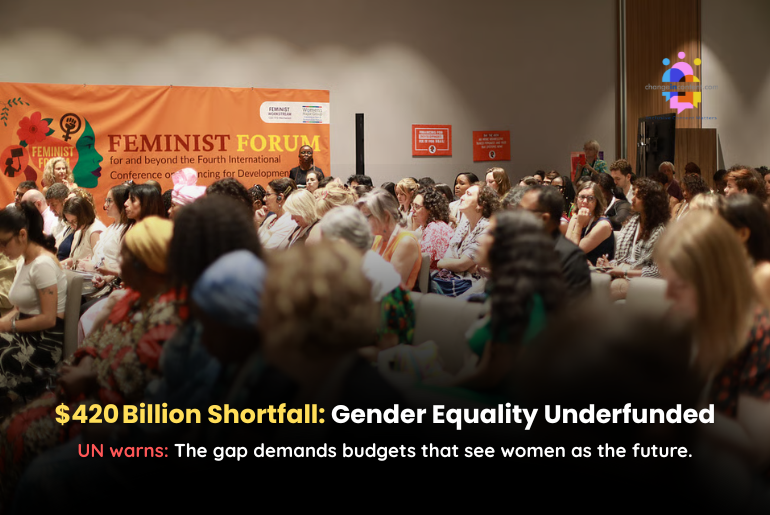
A recent UN Women report, highlighted at the Fourth International Conference on Financing for Development in Seville, reveals a startling shortfall: developing countries are underfunded by approximately $420 billion annually in their efforts toward achieving gender equality. While the Compromiso de Sevilla reaffirms global commitment, the pace and the annual funding gap in gender equality remain painfully concerning.
This is not just a headline because it signals systemic neglect. As Nyaradzayi Gumbonzvanda, UN Women’s Deputy Director, put it: “Gender equality must move from the margins of budget lines to the heart of public policy.”
Today, we examine how this significant funding gap translates into daily realities: policy delays, unfulfilled promises, and missed opportunities.
Defining the $420 billion annual funding gap in gender equality
Here is how the UN Women defines this annual shortfall.
- Without consistent investment, essential services, including childcare, eldercare, gender-based violence prevention, and girls’ education, remain precariously underfunded.
- Debt burdens and austerity measures in many developing countries leave little fiscal room to prioritise gender equality.
- As Gumbonzvanda emphasised, closing the gender gap needs not just resources but reform and leadership that sees women, “not as a cost, but as the future.”
Recommended strategies for closing the gap
UN Women has outlined clear, actionable measures:
- Expand Gender-Responsive Budgeting (GRB): Integrate gender lenses into every ministry budget, supported by transparent tracking mechanisms.
- Debt relief & gender-responsive taxes: Free up fiscal space for essential social services by lifting debt burdens and rethinking tax systems.
- Rebalance public spending: Shift from emergency spending to long-term investments in care, education, and resilience.
- Care infrastructure: Allocate at least 10% of GDP to childcare and eldercare, which would create jobs and raise income levels.
The ground reality: Why it is not working
As per the UN, any reform to close the annual funding gap in gender equality in developing nations is not working, because:
- Tracking failures: With 75% of countries lacking GRB systems, public spending remains “colorblind,” often excluding women’s needs
- Aid flows bypass low-income women: Most ODA fails to reach where it’s most needed; less than 0.5% addresses gender data and care economies.
- Care invisible in national accounts: Women continue to carry out 2.8 extra hours of unpaid care work daily, a cost not reflected in budgets, yet care infrastructure is chronically under-funded
Funding gap in gender equality: Time to fund futures
The $420 billion annual funding gap is not just arithmetic; it is a moral and economic failure that undercuts women’s rights and human development. Political commitment is not enough; resources must match the rhetoric.
Closing this gap requires bold investment, gender-responsive restructuring, debt reform, and overhauls of the care system. Only then can we deliver on SDG 5—not decades late, but in time to make a generational difference.
Also read: India ranks 4th in income equality – But are we really sharing the wealth?
Disclaimer: The views expressed in this article are based on the writer’s insights, supported by data and resources available both online and offline, as applicable. Changeincontent.com is committed to promoting inclusivity across all forms of content. We broadly define inclusivity as media, policies, law, and history. It encompasses all elements that influence the lives of women and marginalised individuals. Our goal is to promote understanding and advocate for comprehensive inclusivity.