
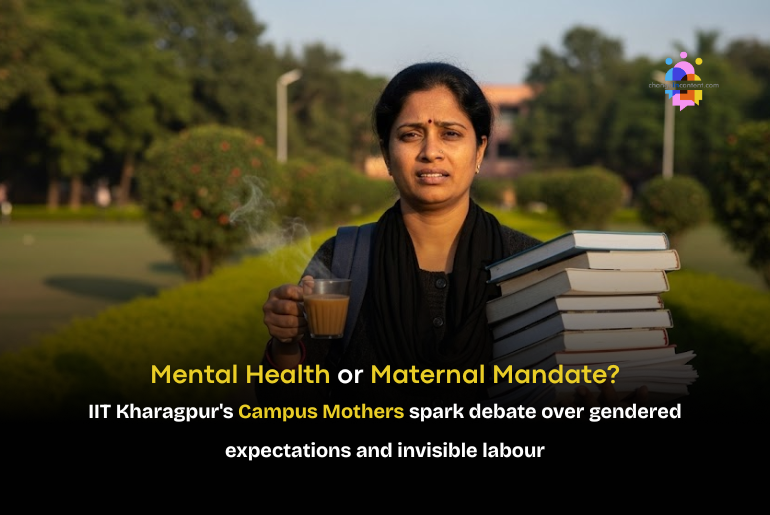
The introduction of the Campus Mothers at IIT Kharagpur may seem like a thoughtful mental health initiative. But dig a little deeper, and it becomes clear that it places yet another emotional responsibility on women, cloaked in institutional goodwill. Without addressing the gendered framing of care work, this initiative risks reinforcing biases rather than breaking them.
In response to growing concerns over student mental health and recent student suicides, the Indian Institute of Technology (IIT) Kharagpur has announced a new initiative titled ‘Campus Mothers.’ Women residing on campus, including both faculty and non-faculty staff, will be trained to provide mentorship and guidance to students who are struggling academically.
The announcement came after the institute reported three student suicides this year alone, with the most recent case occurring in May. The high-pressure environment, rigid academic expectations, and lack of accessible mental health care have repeatedly been flagged as contributing factors.
Campus Mothers at IIT Kharagpur: The good, the gendered, and the gaps
According to Professor Suman Chakraborty, the director, these “campus mothers” would sit down with students over tea or dinner and offer them a safe space to discuss their concerns. A detailed roadmap for the programme has yet to be released, but the idea is to establish a network of volunteers who can offer students informal emotional support. Chakraborty acknowledges that technology has its limitations when it comes to emotional care, which is why the human element is essential.
But! Why call them campus mothers? Why drag in gendered, outdated language into something as serious as student mental health?
Emotional labour is not a gender role
The title Campus Mothers has a very obvious gendered tone. Why are only women positioned as nurturers and caretakers? And where are the Campus Fathers? Or how about Campus Mentor, Peer Support Volunteer, or even Campus Parent?
Where are the Campus Fathers?
By giving the role this title, IIT Kharagpur falls back on the old, tired assumption that emotional labour is a woman’s responsibility. It reinforces the stereotype that women are natural nurturers, expected to step in and fix the mess when institutions fail to provide proper support systems. There is no mention of a gender-neutral title, such as campus mentors, or something that would actually make sense in a university setting.
The emotional needs of students shouldn’t be boxed into gender roles. Support, empathy, and mentorship are human skills. Not maternal instincts. Not feminine duties. The campus mothers programme also risks overburdening women employees, especially if the role comes with no additional pay or resources. It also fails to acknowledge that many of these women already juggle multiple responsibilities both at work and at home.
In naming the programme Campus Mothers, the institute has reduced emotional and mental health support to something gendered. It shows a mindset that still expects women to be the unpaid carers, the fixers, the listeners, even in a place like IIT.
Ignoring safety and encouraging a dangerous trend
Another serious concern is the safety of the volunteers themselves. The internet has already responded with sexist and inappropriate comments about the programme, with some even sexualising the role. For every comment in support of the idea, there are several that mock the volunteers or twist the intent behind the initiative.
The moment you call it Campus Mothers, you invite the usual sexist commentary that women in public spaces have always faced.
What protection do these women have? What guidelines ensure their safety and dignity? If the institute couldn’t see this reaction coming, that’s negligence.
Before rolling out such a programme, IIT Kharagpur must consider the consequences of turning women faculty or staff into emotional caregivers without proper support or protection. The environment in which these volunteers operate must be safe, respectful, and professionally managed.
You cannot coach maturity through surveillance
The director also remarked on how Indian students are often overparented until Class 12, and struggle when they suddenly expect them to manage their own lives in college. While this is a valid observation, the plan of recreating another parental figure on campus is not a valid solution.
College should provide students with a space to transition into adulthood. While support and mentorship matter, recreating a school-like setting doesn’t help students develop autonomy. Real learning occurs when individuals manage responsibilities, make decisions, and face consequences in a safe and non-punitive environment.
Instead of bringing a guardian figure back into the picture, IIT Kharagpur could focus on mentoring programmes that teach life skills, emotional regulation, and time management. These are skills that students actually need to become self-reliant.
Campus Mothers vs. Clinical Counsellors: A false choice
Perhaps the most critical question to ask is why rely on volunteers at all? If the institute truly values student mental health, it should hire trained therapists and professional counsellors. Mental health support requires clinical expertise, consistent availability, and adherence to ethical boundaries.
Informal care, no matter how genuine, cannot replace the role of a professional. What happens when a student needs more than a conversation over tea? What if the problems go beyond homesickness or academic pressure?
Gendered expectations and the cost of care
No matter how kind or well-meaning the volunteers may be, they are not therapists. They cannot handle crises. They cannot be expected to take on the emotional weight of students struggling with anxiety, depression, or worse. At best, this is a temporary patch. At worst, it’s a way to avoid paying for actual professionals by passing on more unpaid work to women on campus.
Creating peer groups, reducing academic pressure, offering flexibility in evaluation methods, and ensuring regular check-ins with trained counsellors would create a more sustainable solution than assigning emotional duties to women faculty.
The Campus Mothers at IIT Kharagpur: Support or stereotypes and systemic blind spots
No one is denying that students need emotional support. However, the way to build that is by respecting emotional labour, not by assigning it to women just because they’re women. This programme could have taken a completely different route. Let’s say, how about an inclusive support group, open to all genders, backed by trained professionals, and named in a way that doesn’t sound like a headline from the 1950s.
Instead, what we have is a plan with good intentions, but it operates within an old-world mindset. A mindset that still looks at women as the default caregivers. That still treats emotional work as unpaid and invisible. That still sees professional mental health care as optional.
At a place like IIT, holding onto such heavily gendered and patriarchal thinking is not just disappointing. It’s dangerous.
Changeincontent perspective
At Changeincontent, we believe support systems must be empowering, not exploitative. Emotional labour should be valued, recognised, and compensated—regardless of gender. Programmes like Campus Mothers at IIT Kharagpur show how even progressive ideas can carry the burden of old-world expectations. True inclusion means creating support without making women the default caregivers yet again.
Also Read: Household CEO, Office Employee: The double shift and invisible labour that no one acknowledges.
Disclaimer: The views expressed in this article are based on the writer’s insights, supported by data and resources available both online and offline, as applicable. Changeincontent.com is committed to promoting inclusivity across all forms of content. We broadly define inclusivity as media, policies, law, and history. It encompasses all elements that influence the lives of women and marginalised individuals. Our goal is to promote understanding and advocate for comprehensive inclusivity.
