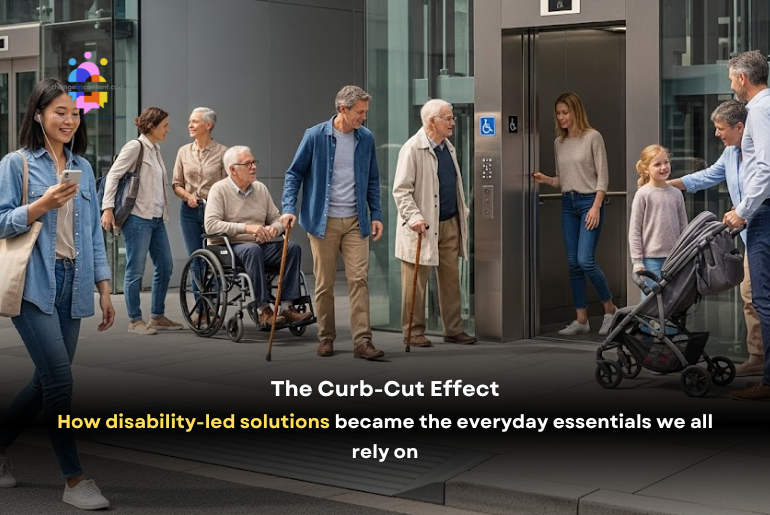
The Curb-Cut Effect is not just a theory, but an everyday reality we overlook. It shows us that when we design with inclusion in mind, the benefits ripple far beyond the intended audience. This effect has quietly reshaped how we live, move, learn, and work, all thanks to innovations first created for people with disabilities.
Many people assume that accessibility is only for those with disabilities. However, that’s not true. Accessibility benefits everyone, whether someone lives with a visible disability, an invisible one, or none at all. The reality is that when spaces, products, and services are designed to include people with disabilities, they often benefit a much larger population, often beyond what was initially imagined. That is called the Curb-Cut Effect.
What is the Curb-Cut Effect?
The Curb-Cut Effect refers to how laws, programs, and accommodations originally created for people with disabilities could enhance access and convenience for all of society. When you make changes with accessibility in mind, it will make life easier for everyone.
The name originates from the small ramps built into sidewalks to facilitate smooth movement between the pavement and the road for wheelchair users. These ramps weren’t always a standard part of urban planning. However, after their introduction, many others found them helpful, such as parents pushing strollers, elderly people using walkers, delivery workers with trolleys, or travellers wheeling suitcases. What began as an effort to support a specific group grew to help many others.
The Curb-Cut Effect in everyday life
The curb-cut effect appears in many places once you begin to notice it. Let’s take a look at ways accessibility benefits everyone:
Audiobooks started with accessibility; now everyone is listening.
Long before audiobooks became a modern reading habit for millions, they were created for a much more specific purpose. Back in 1932, the American Foundation for the Blind partnered with the Library of Congress to launch the “Talking Books Program.” The initiative aimed to make reading possible for people who are blind or visually impaired by converting books into audio recordings.
Interestingly, the first long-playing records, what we now call LPs, weren’t filled with music. They were full of spoken stories and texts meant for listeners who couldn’t read print. After World War II, demand for these talking books rose sharply, particularly as many soldiers returned home with vision loss resulting from their injuries.
Today, audiobooks are everywhere. Whether someone is stuck in traffic, cooking dinner, or squeezing in a chapter while jogging, audiobooks have become the go-to for multitaskers.
Subtitles and captions
Closed captions, subtitles, and audio or video transcriptions serve many users today, not just those with hearing loss. They help viewers catch quiet or unclear dialogue, understand different accents, or enjoy content in noisy places like buses and train stations. Whether someone has a hearing impairment or simply prefers to read along, subtitles enhance the experience for all types of viewers.
In September 2022, The Wall Street Journal asked a simple question: “Why Do All These 20-Somethings Have Closed Captions Turned On?” The article referred to a survey by Preply, which revealed that nearly 90% of viewers have used subtitles while watching videos. Among Millennials, 53% said they use them most of the time. For Gen Z, the number was 70%.
Many said they use captions because the audio isn’t clear, the accents are hard to follow, or they’re watching without sound to avoid bothering others. Around 30% said subtitles help them focus, and nearly 20% use them to learn a new language.
Accessible entry is now everyday design.
Touchless and automatic doors also began as a way to create more accessible spaces. But over time, these doors proved helpful to many more people. Think of someone carrying groceries, pushing a stroller, pulling a heavy suitcase, or simply in a rush. Today, they’re everywhere, in airports, hospitals, malls, and large offices. What began as an accessibility solution to allow barrier-free access for people with disabilities has become part of everyday public design.
For wheelchair users and individuals with limited mobility, elevators are essential. Without them, multi-floor buildings would remain entirely out of reach. Their usefulness doesn’t stop there. Parents pushing strollers, elderly individuals, travellers with suitcases, and workers carrying heavy loads all rely on elevators. Even someone simply too tired to take the stairs benefits. In fact, most of us don’t think twice about stepping into one.
Electric toothbrushes
People with conditions such as arthritis, cerebral palsy, or tremors often find that holding and moving a manual toothbrush can be difficult. Tasks that require steady hand control or repetitive movement, such as brushing teeth, usually become frustrating and tiring. We now have electric toothbrushes, and everyone uses them. They were originally designed to help people with limited dexterity, including individuals with physical disabilities and orthodontic patients, brush more effectively. It’s another example of how something designed with accessibility in mind has become helpful for everyone.
Velcro: From adaptive clothing to an everyday staple
Velcro was primarily used in adaptive clothing designed for individuals with difficulty managing buttons and zippers. It included those with joint pain, severe autism, limited hand movement, or those recovering from a stroke. It helped them dress independently and with ease. Now, Velcro is used in shoes, school supplies, jackets, and bags. It’s quick, simple, and effective, regardless of who’s using it.
Better signage helps everyone navigate with ease.
Informational and directional signs play a key role in helping people move through public spaces. To be effective, we must place these signs where they are easily visible and designed in a way that makes them quick to read. Accessibility guidelines have led to the use of high-contrast colours, non-glare surfaces, and simple, readable fonts. These features benefit not only people with visual impairments but also others.
Clear signage is helpful in many everyday situations. Someone navigating a new building, trying to read a sign from a distance, or glancing up while in a hurry, will find it easier to follow directions when signs are designed with clarity in mind. What started as a measure to improve access for people with low vision has evolved into a design standard that enhances the experience for everyone.
The Curb-Cut Effect in learning and development
When we apply the curb-cut effect to learning and development, we design tools and methods that help everyone. This approach leads to more inclusive and effective learning experiences. Take mind mapping as an example.
Mind mapping is a visual strategy that lays out ideas in a diagram, helping people see connections between concepts. It is beneficial for learners with disabilities like dyslexia or ADHD, as it breaks down complex information into manageable parts. However, it can help any learner improve their ability to organise thoughts, develop critical thinking, and solve problems.
Accessibility is not a barrier.
Many of us often view accessibility as an extra step. But it’s not something that slows things down or gets in the way. When we design with access in mind, we make life easier for more people without making it harder for anyone. This approach is known as universal design. Instead of focusing solely on what’s required, it pushes us to create spaces and tools that work for different people in various situations.
When we design for all, we create a better, more equal world.
Conclusion: The Curb-Cut Effect is not a fluke
We’ve just covered a handful of examples of the curb-cut effect, but they’re only the beginning. There are countless other ways accessibility-driven design has quietly improved everyday life for everyone. From speech-to-text features to flexible work setups, from curb ramps to voice assistants, what starts as an inclusive solution often becomes something we all rely on.
Designing with access in mind leads to smarter, more inclusive innovations. When the needs of different users are considered from the outset, the results are often more practical, efficient, and widely applicable.
Changeincontent’s Perspective
At Changeincontent.com, we believe inclusion is not just a checkbox—it is a catalyst for universal progress. The Curb-Cut Effect proves that accessibility is not a limitation, but an invitation to build a world that functions better for everyone. From design to policy, let us centre the margins to uplift the whole.
Also Read: Intersectionality and why Changeincontent is an ally in workplace inclusion.
Disclaimer: The views expressed in this article are based on the writer’s insights, supported by data and resources available both online and offline, as applicable. Changeincontent.com is committed to promoting inclusivity across all forms of content. We broadly define inclusivity as media, policies, law, and history. It encompasses all elements that influence the lives of women and marginalised individuals. Our goal is to promote understanding and advocate for comprehensive inclusivity.