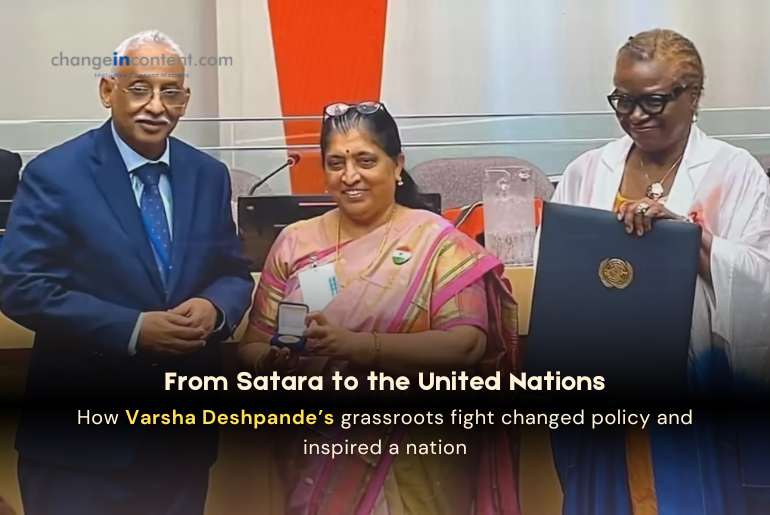
For over 35 years, Women’s Rights Activist Varsha Deshpande has been an unwavering advocate for women’s rights in rural Maharashtra. On July 11, 2025, the United Nations Population Fund bestowed upon her the highly prestigious United Nations Population Award, recognising her pioneering efforts in combating gender‑biased sex selection and empowering socially marginalised women through grassroots activism.
Her journey, sparked by the founding of the Dalit Mahila Vikas Mandal in 1990, transformed local action into a national impact. Deshpande’s leadership in enforcing India’s PCPNDT Act and campaign strategies against child marriage, while championing joint property rights for women, exemplify community-driven reform with enduring policy influence.
The award & its significance
Announced in New York on World Population Day, the 2025 U.N. Population Award marks its 40th edition and includes a gold medal, diploma, and cash prize. Deshpande joins the rarefied list of Indian recipients in the individual category, following Indira Gandhi (1983) and JRD Tata (1992).
This accolade is not just personal. Instead, it’s a tribute to a decades‑long grassroots movement grounded in solidarity, legal literacy, and empowerment for women from Dalit and marginalised communities.
Women’s Rights Activist Varsha Deshpande and a lifetime of grassroots activism
From the Mandal’s inception in Satara, Deshpande’s strategy weaves together vocational skill‑building, community education, and legal awareness. She has tackled child marriage by mobilising adolescent girls and engaging young men in transforming norms. She has championed the rights of informal sector women by promoting collective action for financial independence and access to state entitlements.
Deshpande’s method is deeply participatory: women are trained to demand their legal rights, seek joint property registration, and assert reproductive autonomy.
Enforcing the PCPNDT Act
Under her leadership, the Mandal has played a critical role in the enforcement of the Pre‑Conception and Pre‑Natal Diagnostic Techniques (PCPNDT) Act, 1994, which curbs sex‑selective abortions. Deshpande pioneered sting operations to expose medical practitioners facilitating illegal sex selection. It was a bold tactic that brought widespread attention and pressure for legal accountability.
Her activism added moral urgency to the law and complemented government efforts with local legitimacy and vigilance.
Policy influence and institutional roles
Deshpande has served on multiple statutory bodies under the central and state governments. Moreover, her lived-experience perspective offers valuable insights to policymaking processes. Her advocacy focuses on legal reform, gender justice, and intersectionality, recognising how caste, class, and gender intersect.
She has helped mainstream proposals that uplift marginalised women, particularly in accessing asset ownership and reproductive health justice.
Women’s Rights Activist Varsha Deshpande: A beacon of inclusive leadership
As a Women’s Rights Activist, Varsha Deshpande exemplifies how unwavering grassroots commitment can reshape national conversations and policies. Her legacy serves as a model for changemakers: systemic change must be rooted in community, accountability, and persistent advocacy.
Her U.N. award is a signal to all that women-led social movements are integral to sustainable development, and that investing in women’s agency is not charity, but justice.
Also Read: The women’s safety tax: An unspoken economic inequality.
Disclaimer: The views expressed in this article are based on the writer’s insights, supported by data and resources available both online and offline, as applicable. Changeincontent.com is committed to promoting inclusivity across all forms of content. We broadly define inclusivity as media, policies, law, and history. It encompasses all elements that influence the lives of women and marginalised individuals. Our goal is to promote understanding and advocate for comprehensive inclusivity.