
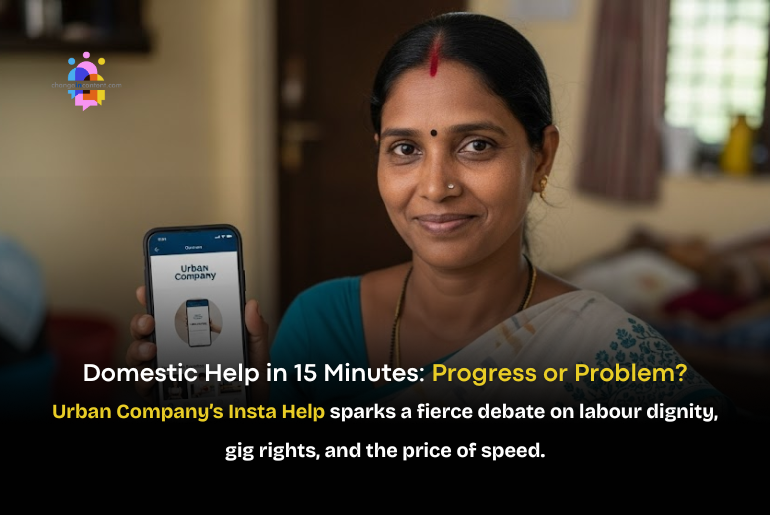
In a bold move that merges convenience with an attempt at reform, Urban Company Insta Help enters a space that has long remained unregulated and undervalued: Domestic Labour. This service promises formal recognition and a structured economic framework for a workforce that has been historically overlooked. But can a gig economy app truly change the narrative around domestic help in India?
Quick commerce has become a part of everyday life. Today, people expect services to reach them in minutes, not hours. Consumers want everything faster. What began as the instant delivery of essentials, such as groceries and snacks, has now expanded into new and unexpected areas. The latest is house help services. In March 2025, Urban Company, a home services firm specialising in plumbing, cleaning, and salon services, introduced ‘Insta Maids’, which provided users with access to house help in under 15 minutes.
From ‘Insta Maids’ to ‘Insta Help’
The launch of ‘Insta Maids’ received a lot of attention. However, not all of it was positive. The name drew criticism for reducing domestic workers to a mere commodity, with many questioning whether it respected the dignity of those who perform this work. The word “maid” itself, while commonly used, has long been debated for its classist and dehumanising undertones in India.
Following public outrage, Urban Company renamed the service to ‘Insta Help’. The rebranding was a response to these concerns, demonstrating the company’s willingness to listen and address its customers’ needs. However, the issue has renewed attention to the boundaries between convenience-driven services and ethical labour practices.
How does the Urban Company Insta Help model work?
At the time of the launch, Urban Company offered an introductory price of ₹49 per hour to customers, a strategy likely designed to attract users and generate buzz. However, the low pricing raised concerns about the workers’ share of the earnings.
Urban Company later clarified that service partners under ‘Insta Maids’ would earn between ₹150 and ₹180 per hour. In addition, they would receive free health insurance, as well as on-the-job life and accidental insurance. The company assured that anyone working six hours a day, 22 days a month, would earn at least ₹20,000 monthly.
Workers get a steady income, insurance, and a formalised structure. However, the concern remains about how much of the hourly charge goes directly to the worker and how much the company retains. Given how poorly regulated domestic work is in India, many remain sceptical.
Is this a step towards the formalisation of domestic work?
Still, it is essential to recognise the potential impact of this service on the sector. Domestic workers, often operating in informal settings with no contracts or safety nets, now have a company representing them. That brings visibility, formalisation, and in some cases, security. Workers are verified, their movements are tracked through the app, and both clients and service providers are accountable to the platform. This setup might reduce some risks of exploitation or abuse, and it could help change how society views domestic labour.
For customers, too, this brings a sense of safety. Knowing that someone from a verified company is arriving at your home, with their identity confirmed and visits monitored, builds a level of trust and reliability that is often missing in informal arrangements.
In this light, Urban Company’s entry into quick commerce with domestic help services could be seen as a small push toward recognising domestic work as real, valuable labour deserving of professional standards.
But labour ethics remain in question
India’s relationship with domestic work remains deeply flawed. Domestic workers often belong to marginalised communities, receive little to no job security, and face stigma both inside and outside their workplace. Bringing them into a gig-like platform does not erase those issues.
The larger concern is whether quick commerce will treat these workers as assets or as disposable resources. Speed often demands availability at all times, and in a country with weak enforcement of labour laws, that creates a risk of exploitation. Workers might feel pressured to accept more jobs than they can handle, and companies may quietly prioritise customer convenience over worker wellbeing.
Globally, booking a House Help online is not a new concept. Students and part-time workers abroad regularly use platforms to find such gigs, with standardised wages, contracts, and protections. However, those same students, when in India, hesitate to work in the same field due to the stigma associated with domestic work and the lack of proper labour protections. This double standard highlights how domestic work in India is not recognised as employment, but rather as a service class issue.
From maids to professionals: Changing the language, changing the lens
For a long time, domestic work has remained informal, invisible, and undervalued. A platform that allows people to sign up, get verified formally, and access steady work brings some long-overdue structure to the sector. It shows that house help can be part of a recognised service, not just something arranged through word of mouth or out of no choice.
Being listed through a formal channel means workers can now show proof of their work, receive fixed payments, and access insurance benefits, things that were once out of reach for most in this line of work. For many, this could bring a sense of stability and pride in their work.
That said, a gig platform alone is not enough. The service must also put some limits in place. Workers should not feel obligated to be on call all day just to earn a sufficient income. There needs to be fixed hours, breaks, and the option to decline work without losing future bookings.
Workers also need a space to speak up if something goes wrong. Whether it is late payments, poor treatment, or unsafe work conditions, there should be an easy way to raise a complaint and get support. This system should be simple and actually work, not just exist on paper.
Laws must catch up, too. Domestic work and app-based jobs often fall outside the basic protections afforded to other workers. That needs to change. There should be laws that guarantee fair pay, health cover, paid time off, and other rights. The government cannot leave this entirely to platforms to figure out on their own.
Urban Company Insta Help: A glimpse of progress or a gig gone too far?
Quick services are not going away. People will always want things faster and easier. Bringing domestic help into gig work opens the door to some level of protection and formal recognition for workers who have long been overlooked.
It is only the beginning. For it to lead to real progress, domestic workers need to be seen as professionals with rights, not just service providers on a list. What matters is formal access, fair pay, reasonable working hours, and proper legal support. If platforms want to lead this change, they must build systems that respect the workers’ time, health, and dignity, alongside the customer’s need for convenience.
Changeincontent perspective
At ChangeInContent, we see Urban Company Insta Help as a bold but complicated experiment. Formalisation is not just about identity cards and apps; it is about changing mindsets, ensuring worker safety, and elevating domestic work from a means of survival to a dignified profession. Gig platforms are writing the first draft of this future, but the final version must be co-authored by law, policy, and worker voices.
Read More: Invisible on their own day: The stark truth behind Domestic Workers Day.
Disclaimer: The views expressed in this article are based on the writer’s insights, supported by data and resources available both online and offline, as applicable. Changeincontent.com is committed to promoting inclusivity across all forms of content. We broadly define inclusivity as media, policies, law, and history. It encompasses all elements that influence the lives of women and marginalised individuals. Our goal is to promote understanding and advocate for comprehensive inclusivity.
