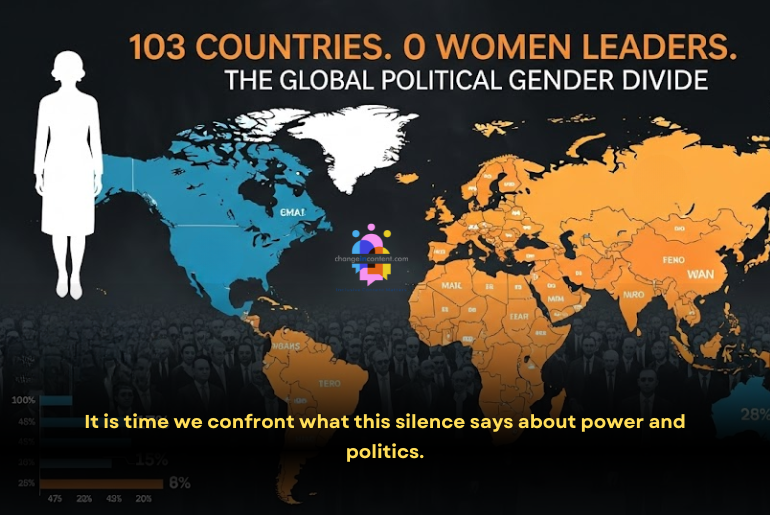
Despite decades of activism, women in politics remain a rare occurrence globally. This article examines the latest UN Women report, highlighting the significant disparity between global rhetoric and political realities. From glass ceilings to glass cliffs, it explores the entrenched barriers that keep women out of power.
The political gender gap: A global snapshot
The level of political equality that women have reached remains disappointingly low. The UN Women’s latest publication, Women Political Leaders 2025, states that equality for women in politics, particularly in leadership and executive positions, is regressing. Women remain significantly underrepresented as Heads of State or Government and in key ministerial positions. This persistent gap highlights widespread barriers and an uneven, often weak, commitment to gender equality in political leadership.
At the same time, this decline is occurring during a global rise in backlash against women’s rights. Alongside policy setbacks, many women in politics face growing violence, both in physical spaces and on digital platforms. These attacks discourage women from entering politics or holding on to leadership roles, making it even harder to close the gender gap in representation.
Women remain outnumbered by men more than 9 to 1 in chief executive roles. To reach equal political representation, the world would need over five times more women in leadership positions.
UN women flags drop in women’s political equality worldwide
As of 2025, only 27 countries have a woman as Head of State or Government. That’s an increase from 21 five years ago. However, 103 countries have never had a woman in their highest executive office. Representation in ministerial positions also shows that women’s political equality has a long way to go.
Women today hold only 22.9% of Cabinet-level posts globally, down from 23.3% in 2024. This marked the first recorded decline in the number of women serving as Cabinet ministers. Parity cabinets, where women make up at least half the ministers, have fallen from 15 to just 9 in a year. Meanwhile, the number of countries without a single woman in ministerial roles has increased from seven to nine.
Countries performing the best in equality for women in politics
Geographically, women hold the highest share of Cabinet positions in Europe and Northern America (31.4%), followed by Latin America and the Caribbean (30.4%). However, in Central and Southern Asia, the number is just 9%.
Even when women do enter Cabinets, they are often appointed to roles tied to social or family welfare. Women lead 87% of ministries focused on gender equality, and 71% of those ministries are specifically focused on children and families. In contrast, men continue to dominate powerful ministries such as defence (87%), finance (84%), and foreign affairs (82%).
Sima Bahous, Executive Director of UN Women, summed up the situation by stating, “The world is witnessing the erosion of women’s political leadership at the very moment we need inclusive decision-making the most.“
Participation of women in politics in India
In India, an increasing number of women are showing interest in politics, particularly in recent years. In 1957, only 45 women contested the Lok Sabha elections. By 2024, that number had grown to 797. Still, only 74 women won seats in the 18th Lok Sabha, representing just 13.6% of the total 543 members.
However, the data look better at the local level. In 2022, women held 44% of the seats in local self-governance bodies. Over 1.3 million women were elected to these positions. Local elections have provided more opportunities for women to enter politics, although this has not yet translated into stronger national representation.
Why are women underrepresented in politics?
There are many reasons why women continue to be underrepresented in politics. Experts often group them into two types: supply-side and demand-side factors.
On the supply side, women may be less likely to enter politics due to family responsibilities, a lack of support networks, or social norms that still expect men to lead.
To make matters worse, institutional support is also shrinking. The number of ministries dedicated to gender equality has dropped. In 2020, about 80 such ministries existed. That number fell to 76 in 2024 and further down to 74 in 2025. This decline limits governments’ ability to build long-term, gender-inclusive political systems.
On the demand side, political parties and voters often hesitate to support women candidates. It can limit women’s chances of getting elected or promoted within political systems.
Sexism remains a persistent obstacle. Kamala Harris, when running for president, faced scrutiny not only over her gender but also over her emotions and personal choices, such as not having biological children. These same attacks mirrored the sexism Hillary Clinton encountered during her 2016 campaign. In both cases, gendered double standards highly influenced public perception and media narratives.
Study finds sexist attacks push women out of politics
A study by Hilde Coffé and colleagues examined sexism during the June 2024 regional, federal, and European elections in Belgium. It analysed nearly 44,000 reactions to 2,922 posts on X, Facebook, and Instagram by 40 candidates throughout the campaign period. They also interviewed 23 political candidates, both men and women.
One key finding from the study is that sexism affects women’s confidence. Many women said they believe in public service and its power to create change. Still, they spoke about how hard it is to stay motivated while dealing with constant sexist remarks. Some even said this kind of treatment might force them to leave politics altogether.
As one woman put it, “I feel like I belong here, that this is a sector I want to work in. But sometimes you start asking yourself: Why do I have to deal with all of this too?”
Another candidate said, “If I ever quit, it won’t be because of the hard work or the long hours. I actually enjoy that part. But this toxic environment, that’s what might push me out.”
Why women in politics matter
Equal representation is essential for inclusive governance and long-term development. It’s also linked to economic growth. A report by McKinsey Global Institute showed that closing gender gaps in employment, including political leadership, could add $28 trillion or 26% to annual global GDP in 2025.
Women’s active participation in politics is essential to achieving Sustainable Development Goal 5, which aims to promote gender equality and empower all women and girls. According to the United Nations, this is not only a matter of human rights but also a key step toward building a more peaceful, inclusive, and sustainable world. Without equal representation in political decision-making, we cannot achieve gender equality, and societies risk missing out on the diverse perspectives and leadership that women bring to the table.
The final thoughts on political inequality for women
UN Women is urging governments to take real steps to improve women’s representation. It includes appointing more women to executive roles, using quota systems where needed, and ensuring protection from political violence.
Sima Bahous, Executive Director of UN Women, says the world must move beyond promises. “Women’s full, equal, and meaningful participation in decision-making is not only a matter of justice. It is essential to fulfil the promises of the Beijing Platform for Action and the Sustainable Development Goals. It is time to turn commitments into concrete action.“
Changeincontent Perspective
At Changeincontent, we believe representation is not a footnote in political discourse; it is the foundation of an inclusive democracy. The fight for women in politics must go beyond symbolic gestures. We must ask: who holds the mic, who makes the laws, and who gets heard in the corridors of power?
Disclaimer: The views expressed in this article are based on the writer’s insights, supported by data and resources available both online and offline, as applicable. Changeincontent.com is committed to promoting inclusivity across all forms of content. We broadly define inclusivity as media, policies, law, and history. It encompasses all elements that influence the lives of women and marginalised individuals. Our goal is to promote understanding and advocate for comprehensive inclusivity.