
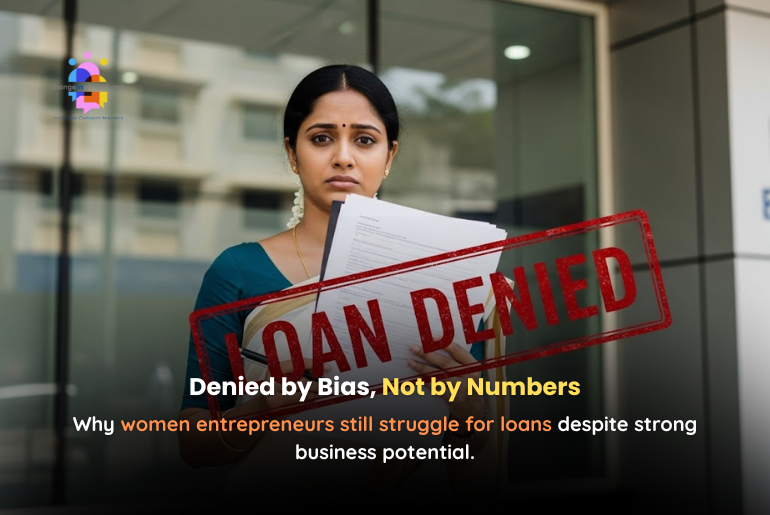
The latest research highlights that securing a loan for women entrepreneurs is often more about battling bias than balancing books. From traditional banks to venture capital, women founders continue to face roadblocks that limit their growth. It is happening even when they match or outperform their male counterparts.
A recent study by the Goa Institute of Management (GIM) revealed that women entrepreneurs face greater challenges in securing formal loans compared to their male counterparts. The research, published in Applied Economics, highlights a significant gender gap in access to credit, especially in India’s unorganised sector.
The researchers examined borrowing patterns of women-owned enterprises from formal institutions such as banks and government financial bodies. Their dataset drew from more than 400,000 unorganised sector firms surveyed in the 2022–23 round of the National Sample Survey Office’s Annual Survey of Unincorporated Sector Enterprises (ASUSE). The study results show women entrepreneurs face a visible disadvantage when applying for loans. This gap holds back their ability to grow businesses, expand operations, and contribute fully to economic activity.
GIM Study warns: Without awareness, women cannot benefit fully from digital finance
The study also found that digital technology can play a transformative role. Women-owned enterprises that used internet banking, digital payment platforms, and other financial services reported improved access to loans. These tools reduce the need for multiple visits to banks and help limit information gaps between borrowers and lenders.
Professor Ashay Kadam of GIM explained that financial institutions carry immense responsibility in supporting women’s entrepreneurship and job creation. Disparities in loan approvals based on gender or caste weaken the positive impact of credit. He further noted that while new financial technologies continue to evolve quickly, their benefits do not always reach women entrepreneurs at the grassroots level.
For this reason, Kadam stressed the need to invest in financial literacy with as much urgency as product innovation. “At the bottom of the pyramid, we need to invest just as much time, effort and money in driving financial literacy, as we do in creating new financial technology,” said Ashay Kadam, Professor, Banking, Insurance and Financial Services, GIM.
Without adequate awareness and education, many women entrepreneurs cannot fully harness the benefits of digital finance.
Loan for women entrepreneurs: Recommendations from the study
Dr. Swarna Parameswaran, Assistant Professor at GIM, pointed out that the gender gap in loans weakens the progress of women entrepreneurship in India. However, she also noted that digital banking offers a practical way to reduce this disparity.
Digital financial services improve access because they cut down the need for repeated in-person interactions with banks and reduce information imbalances. By making financial systems easier to navigate, digital platforms lower the barriers women face in securing loans.
The researchers of the GIM study concluded that greater awareness about digital financial tools could remove long-standing obstacles to access to credit. They also recommended that banks and regulators revisit lending policies to address gender disparity directly.
The GIM research proposed that banking supervision practices must change with a specific goal of reducing gender bias in credit. Second, government-backed schemes and funds should actively promote the adoption of digital technology among women entrepreneurs in the unorganised sector.
These interventions could ensure that credit reaches women who are otherwise excluded and provide them with tools to build more sustainable businesses.
A global challenge in funding women entrepreneurs
The GIM research is now one among the long list of studies that reveal financial bias against women entrepreneurs. The World Economic Forum estimates that women face a $1.7 trillion finance gap in the global micro, small, and medium enterprise (MSME) sector. This gap highlights the extent to which women entrepreneurs remain underfunded compared to men.
Heather E. Tookes, Deputy Dean of Faculty and Professor of Finance, Yale SOM, has tracked how investors allocate resources to women-founded businesses. Her findings show that women typically receive 14% less funding than men. More troubling, if an investor has previously seen a woman-led startup fail, they cut funding for new women-led ventures by another 8%. As a result, gendered perceptions of risk influence investment decisions, creating a cycle where women entrepreneurs struggle to recover from systemic bias.
Research by EY further confirms that nearly 87% of venture capital in 2023 went to male-founded startups. While women comprised 12.2% of all startups that secured funding in 2023, only 1.8% of those receiving at least €50 million in capital were women-led. It means that even when women do break into the funding space, they remain largely absent from the biggest investment deals.
Giving women entrepreneurs a fair chance
Addressing the credit gap requires policy change; inclusive lending practices and targeted government intervention are necessary to give women-owned enterprises the same opportunities as their male counterparts. Digital technology has proven effective in improving access, but it will succeed only if accompanied by education and awareness campaigns that reach women at all levels of the economy.
Globally, investors and financial institutions must confront their biases and adopt transparent practices that judge entrepreneurs by business potential rather than gender. Without such steps, the gap in funding will continue to lower women’s economic participation.
Loan for women entrepreneurs: The final thoughts
The GIM study concludes by revealing the financial hurdles women entrepreneurs face in India’s unorganised sector. Whether it is small loans for informal businesses or large-scale startup investments, women receive less support than men. Taken together, the data from India and across the world show that deep-rooted barriers stop women from getting equal access to finance. However, the research also points to digital technology as a way to reduce this gap, and stresses that real change depends on systemic reforms. Women cannot reach their full potential as entrepreneurs if they continue to be excluded from formal sources of credit.
Changeincontent perspective
At Changeincontent, we believe that bridging the credit gap is not just about a loan for women entrepreneurs. Instead, it is about dismantling systems that undervalue women’s ideas, leadership, and resilience. Financial institutions must stop treating women as higher-risk borrowers and start recognising them as growth engines. True inclusion means rewriting lending policies to work for women at every level of enterprise.
Also Read: Financial schemes for women entrepreneurs: 6 schemes every woman entrepreneur should know.
Disclaimer: The views expressed in this article are based on the writer’s insights, supported by data and resources available both online and offline, as applicable. Changeincontent.com is committed to promoting inclusivity across all forms of content. We broadly define inclusivity as media, policies, law, and history. It encompasses all elements that influence the lives of women and marginalised individuals. Our goal is to promote understanding and advocate for comprehensive inclusivity.

1 comment
Impressive article! Informative and straight to the point.
This site is a lifesaver.