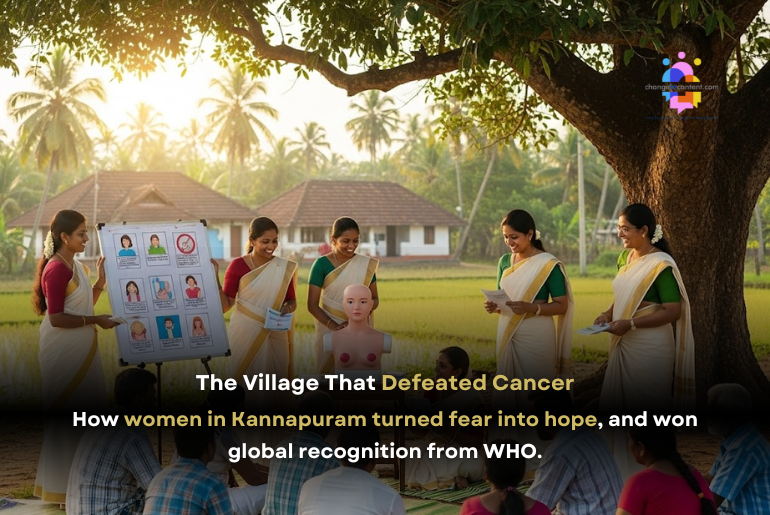
WHO recognises Cancer-free Kannapuram not just as a medical achievement but as a story of resilience, trust, and women-led leadership. What began as a local fight against stigma has grown into a global example of how grassroots communities can change the course of public health.
In 2016, Kerala’s Kannapuram gram panchayat launched a project to detect and control cancer at the earliest stage possible. Women were involved at every stage of this project, from planning and leadership to volunteer work and screening. Over the years, this initiative, now known as the Cancer-Free Kannapuram initiative, has become a model for how local communities can take charge of public health.
Now, the Cancer-Free Kannapuram initiative has been officially recognised by the World Health Organisation (WHO) for its remarkable impact on early detection and control of cancer.
WHO recognises Cancer-free Kannapuram: A community’s fight against cancer
The groundwork began long before the project officially launched. For over a decade, the gram panchayat had worked to mobilise residents, self-help groups, and local institutions. This network became the backbone of the cancer-control effort. The Malabar Cancer Centre provided medical expertise, while the Kannapuram panchayat coordinated activities and ensured every woman in the household was involved.
Phase 1: Laying the foundation
The first step was to remove fear and misinformation about cancer. Local leaders organised sensitisation workshops that brought together elected representatives, primary health centre staff, doctors, and members of self-help groups. These sessions explained how cancer could be detected early and treated effectively.
From there, volunteers conducted a door-to-door survey to identify people at higher risk. While gathering this data, they encountered widespread reluctance even to discuss cancer. Many residents feared a diagnosis would lead to social stigma or a sense of hopelessness. This discovery made it clear that awareness and trust-building would be as important as the medical work itself.
Phase 2: Spreading awareness and building trust
Once the authorities understood the initial resistance, the panchayat launched an extensive education drive. Information, education, and communication (IEC) materials reached homes and community spaces. Health exhibitions at public events allowed residents to learn in an open, informal setting.
The project also created “winners meet,” where cancer survivors shared their journeys, proving that early detection could lead to recovery.
Literary competitions and panel discussions talked about diet, prevention, and lifestyle changes. Kitchen garden projects encouraged residents to grow fresh produce, promoting healthy eating habits.
Schools joined the effort through campaigns on cancer and tobacco awareness. The Parent-Teacher Association played a vital role in ensuring these lessons reached both students and their families. Slowly, the stigma and fear surrounding cancer began to fade.
Phase 3: Turning awareness into action
With trust established, Kannapuram moved to direct screening. The gram panchayat launched a breast cancer screening project with a single-day registration drive covering 3,800 households.
A ten-day mega camp followed, offering free examinations for healthy women over 30 with no prior history of breast cancer. Women technicians, specially trained for the task, examined 200 to 500 women daily. Every participant received pamphlets and practical training on self-examination techniques.
Women who tested positive in the initial screening received counselling and referrals for further tests. A dedicated team ensured these women could attend appointments, arranging travel and follow-up visits when needed.
Why women’s involvement made the difference
The success of the Kannapuram model rests heavily on the role women played at every stage. From the earliest awareness sessions to the final stages of screening and follow-up, women were the organisers, communicators, and motivators. Their involvement gave the programme credibility in a way that outside interventions often cannot achieve.
Women-led awareness campaigns created an environment where it was easy to discuss sensitive topics without embarrassment or hesitation. In many communities, health concerns, especially those related to breast cancer, are surrounded by stigma, and women may avoid speaking about them in mixed gatherings. By having women health workers, volunteers, and organisers lead the sessions, residents felt they were in a safe space. It was easier for them to ask their questions and express their concerns without the fear of being misunderstood or judged.
The role of women in leading the fight
As noted in the WHO South-East Asia Journal of Public Health paper on the initiative, “In our study, the continuous awareness campaigns led by female members, acceptable and cost-free screening methods, well-organised screening camps with female providers, and the geographically accessible campsite led to increased screening participation. The involvement of the community helped to overcome most of the barriers at large, address the possible mistrust between the health system and the public, and sustain the interventions to achieve the goal.“
96% of eligible women participated in the cancer screening camp
The women leading the cancer drive were not outsiders. They were neighbours, friends, and self-help group members who had worked alongside residents for years. This existing trust meant that when they encouraged women to get screened, people listened. As a result, the screening drive achieved results few public health campaigns can match. 96% of eligible women took part, which was an extraordinary participation rate for any health programme.
From the women screened, 0.96 per 1,000 were diagnosed with breast cancer. While that figure may seem small, the significance lies in detecting these cases early, often before symptoms appear.
About 6.2% of women needed further testing based on initial results. Of these, 84% reported no symptoms, yet the follow-up still revealed conditions that required medical attention.
With the encouragement from volunteers, 66.5% of women needing further tests followed through, even if they felt healthy. This persistence made it possible to catch illnesses before they progressed to later stages.
The panchayat team recalled that many women had lived with symptoms for months or even years but avoided seeking medical help. Fear of a cancer diagnosis, combined with the social stigma attached to the disease, kept them silent. The direct, personal engagement by local women volunteers challenged this fear and produced a screening participation rate of 96%!
WHO recognises Cancer-Free Kannapuram: Final thoughts
The Cancer-Free Kannapuram initiative is a notable example of how women-led public health campaigns can yield remarkable results. The project combined local governance, community participation, and expert medical support from the Malabar Cancer Care Centre to create a method that other regions can adapt. Because the community leads the programme, it is not a temporary campaign but a long-term system.
The same approach that delivered the initial success can continue to offer screening, awareness, and support for years. Cancer-Free Kannapuram shows that women-led leadership can inspire similar progress worldwide.
Changeincontent perspective
At Changeincontent, we see Kannapuram’s story as a lesson: health outcomes are not only about hospitals or policies. Instead, they are about communities, trust, and the power of women to lead change. When women drive awareness and action, barriers like stigma and silence fall away. WHO recognises Cancer-Free Kannapuram today, but its true legacy lies in proving that grassroots women’s leadership can succeed where top-down systems often fail.
Also Read: Punjab’s Cancer Train: The tragic legacy of Punjab’s Green Revolution.
Disclaimer: The views expressed in this article are based on the writer’s insights, supported by data and resources available both online and offline, as applicable. Changeincontent.com is committed to promoting inclusivity across all forms of content. We broadly define inclusivity as media, policies, law, and history. It encompasses all elements that influence the lives of women and marginalised individuals. Our goal is to promote understanding and advocate for comprehensive inclusivity.