
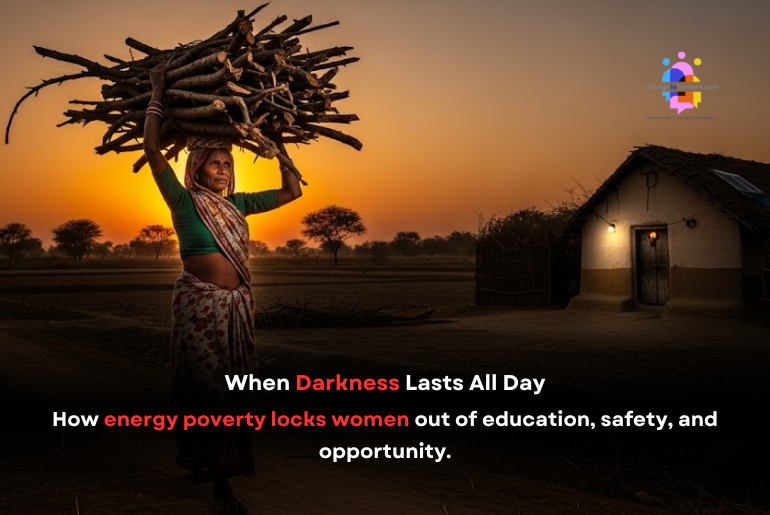
Energy Poverty in India is not just about darkness after sunset. Instead, it is about the hours women lose to collecting fuel, the air they breathe while cooking over smoky stoves, and the opportunities they never get to take. This crisis hides in plain sight. However, its impact is loudest in the lives of women and girls who bear the heaviest, most invisible burden.
Many assume that in the 21st century, everyone has access to electricity and clean cooking fuel. That is far from the truth. Energy poverty, the lack of clean, safe, reliable, and affordable energy, still affects millions, especially women.
The United Nations Development Programme (UNDP) defines energy poverty as the lack of access to modern cooking fuels and electric lighting, preventing the ability to carry out basic activities after sunset. In India, even in 2030, an estimated 580 million people will still rely on traditional biomass for cooking.
Globally, the problem is just as severe. One-third of the world’s population has no access to clean energy. About 759 million people live without electricity, most of them in Africa and South Asia. Over 2.6 billion people still cook with polluting fuels, and nearly four million die each year from illnesses caused by household air pollution.
Energy poverty in India
In India, about 780 million people lack access to modern energy and rely on firewood, dung cakes, and kerosene. Electrification schemes such as the Pradhan Mantri Ujjwala Yojana have helped, but around 239 million people still live without electricity.
Rural areas face the highest challenges. According to the 2011 Census, 87% of rural households use solid fuels for cooking. Without change, more than half a billion Indians will still lack access to clean cooking fuels by 2030.
Women: Bearing the heaviest burden of energy poverty in India
Energy poverty does not affect everyone equally. Women and girls face the most severe impacts because they shoulder much of the unpaid domestic and caregiving work. Their lack of access to energy limits healthcare, education, public safety, and economic opportunities.
On average, women in energy-poor areas spend 40 hours each week collecting fuel and preparing meals. Social norms often assign these tasks to women, leaving them with 2.5 times more unpaid domestic work than men each day. Hours spent gathering firewood or kerosene mean less time for education, paid work, or rest. Access to clean energy can free these hours, opening the door to greater equality and participation in society.
Time lost to collecting fuel often robs girls of education. Without electricity, studying after dark becomes difficult, and household duties take priority over schooling. The result is a cycle where women remain overrepresented among the world’s 754 million adults who cannot read or write, as reported by UNESCO.
The health and safety costs
The daily grind of fuel collection comes with serious health and safety risks. Carrying heavy loads of firewood or gas cylinders can cause musculoskeletal injuries. Long walks through isolated areas, often after dark, can expose women to violence and harassment.
The health effects do not end there. The World Health Organisation estimates that 3.2 million people die prematurely each year due to household air pollution from solid fuels and kerosene. Women who spend more time near open fires or smoky stoves face higher risks of chronic respiratory diseases, including COPD and lung cancer.
Energy poverty also worsens vulnerability to extreme weather. Older women, who tend to live longer and alone, face higher risks from heat and cold stress. Poorly insulated homes intensify these effects, making gender-sensitive energy solutions essential.
Women, domestic work, and energy inequality
In most households, women are responsible for most domestic work, which requires a significant amount of energy. Tasks such as cooking, cleaning, washing clothes, and heating water often rely on electricity or fuel. In Europe, for example, 80% of women handle daily household chores, compared to only 45% of men.
The type of household also makes a difference. Single women tend to use less energy than single men because they usually own fewer appliances and vehicles. However, many women-headed households live in older homes that are poorly insulated and less energy-efficient. This means they can end up paying more for heating or cooling, even if they consume less energy overall.
Other personal and social factors also influence energy needs. A person’s age, health condition, ethnicity, and income level can combine with gender to create unique challenges. For instance, an older woman with limited income living in a rural area may face much higher risks of energy poverty than a younger man with stable employment in a city.
Recognising these differences is important for making policies that work for everyone. Solutions that ignore the social and cultural side of energy use may leave the most vulnerable groups behind.
The final thoughts
Energy poverty is not gender-neutral. Men and women have different patterns of energy use, access, and vulnerability. Energy poverty is both a development challenge and a gender equality issue. Tackling it requires ensuring access to clean, affordable, and safe energy for everyone, especially those who bear the greatest burden.
When women have access to modern energy, they can reclaim time for education, work, and community participation. They can protect their health, secure their safety, and contribute fully to economic growth.
Burden of energy poverty in India on women: Changeincontent perspective
At Changeincontent, we see energy access as a human right and energy poverty as a form of gender-based injustice. When women are denied clean, affordable energy, they are denied time, health, and freedom. Tackling Energy Poverty in India is about dismantling the systemic barriers that keep women tethered to the most exhausting and unsafe parts of daily life. Let us move beyond just focusing on building grids and distributing cylinders.
Disclaimer: The views expressed in this article are based on the writer’s insights, supported by data and resources available both online and offline, as applicable. Changeincontent.com is committed to promoting inclusivity across all forms of content. We broadly define inclusivity as media, policies, law, and history. It encompasses all elements that influence the lives of women and marginalised individuals. Our goal is to promote understanding and advocate for comprehensive inclusivity.
