
“Have you been hit?” is the wrong question in too many Indian homes. A better one is: “Was it today?” Patriarchy is not only written in law or policy. It lives in the small permissions that gate a woman’s day. These can be instances when she may step out, what she may wear, who she may speak to, and how loud her voice may be.
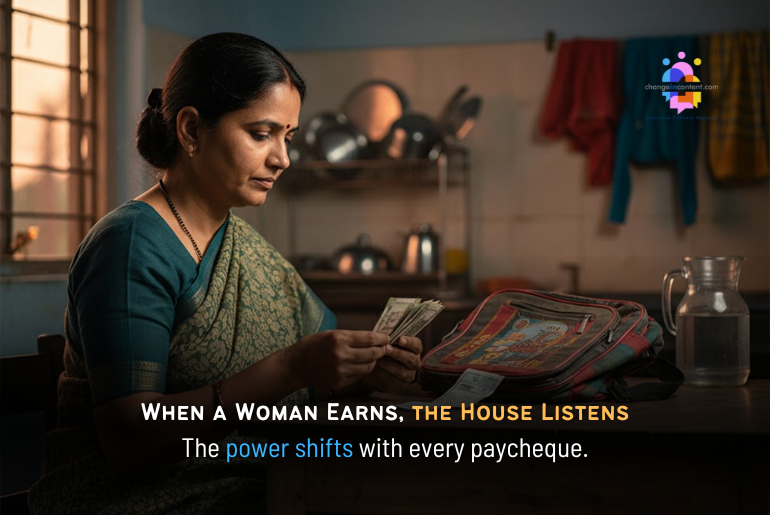
And then, sometimes quietly, money enters the frame. Not as charity. As income. An amount that pays the school fee on time, covers the rent gap, and replaces the mixer that stopped working last month. The house takes notice. The tone shifts. The “no” at the door loosens. This is not theory; it is the everyday economics of power.
The first rupee, the first refusal
In a lane off Kadapa’s old bazaar, we met Ameena. Her days were stitched to everyone else’s needs: packing tiffins, fetching water, swallowing words. A tailoring class at her son’s school became a balcony for breath. The early months were small money and large taunts. She still came home to scrub the floor.
Then the orders grew. One evening, as Ameena reached for the sink, her mother-in-law said, “Leave it. Have tea.” It was a sentence (perhaps ordinary and domestic) that carried the weight of an amendment. Respect moved an inch. Money had made room for it.
Call it the honour–income trade-off: families trade a portion of reputational “honour” for the reliability of women’s earnings. Once those earnings cross a threshold that visibly sustains the home. The threshold varies by city, caste, class, and kinship rules, but it exists. Cross it, and resistance softens.
The tipping point (and why it is hard to reach)
The economic cost for a woman to work is higher than for a man. The commute is not just distance; it is surveillance. The interview is not just a skill test; it is a negotiation with gatekeepers at home. Add the undertow of unpaid care (such as cooking, cleaning, elder care, childcare) that never clocks out.
Data mirrors the drag. A leading inequality report estimated that men capture roughly four-fifths of labour income in India. Official surveys show that the average salaried woman still earns markedly less than men, with certain manufacturing roles paying women about two-fifths of the male earnings. In real homes, that translates to a blunt rule: “If she must step out, it better be worth it.”
Where the money is coming from (Quietly, Steadily)
Two work models are nudging women past the threshold:
1. Platformed services and gig work
Flexible hours. Closer-to-home demand. On-the-job upskilling. A major services index (2023) showed that women service partners averaged around ₹33,000 per month, earning ~23% more per hour than men on the same platform. Uniforms, ID badges, and verified bookings are not just optics; they lower friction with families and neighbours.
2. Formal flexi-staffing and community-linked hiring
India’s largest staffing ecosystems employ hundreds of thousands of associates, with roughly one in five being women. Internal analyses with a development foundation revealed a 90-day retention threshold: if families see three pay cycles, objections tend to subside. Access to small salary advances and interest-free loans via internal finance rails was correlated with lower dropout rates, as women could smooth out shocks (such as school fees, clinic bills, or scooter repairs) without having to ask for help at home.
The pattern repeats across districts: steady, visible money converts sceptics faster than speeches do.
Lata’s paycheque and the electronics line
Lata, from the Krishnagiri belt, joined an electronics assembly line a decade ago when local plants began to scale. Precision work, consistent shifts, predictable pay. She started with near ₹9,000. Today she takes home above ₹13,000, sometimes more with overtime.
The family that once argued about a woman taking buses now argues about which diploma her younger sister should pursue. Neighbours notice outcomes: a tiled floor, a water filter, fees paid in April, not August. The material cues of dignity are not trivial; they are persuasive.
Respect has an elasticity
Economists talk about price elasticity. Respect has one too. In low-income homes under pressure, the elasticity is steep: a modest jump in a woman’s earnings buys a sizeable increase in her say. In middle-income homes, the curve is flatter and the threshold higher; status anxieties and the concern of “what will people say” travel under different names. You will often hear names like “culture fit,” “safety,” and “kids need you more.” But the curve exists. With reliable, repeated income, it bends.
What holds women back (even when jobs exist)
It is no secret that despite the availability of jobs for women, a lot of things hold them back from getting what they deserve.
- Time taxes: Unpaid care consumes hours that cannot be sold in the labour market.
- Safety taxes: Street harassment, poor lighting, unreliable transport—all subtract from feasibility.
- Information gaps: Jobs rarely reach women who are not already part of existing networks.
- Credential traps: Prior career breaks penalised; hiring proxies mistake bias for “merit.”
- Wage opacity: Families undervalue women’s work when pay is unpredictable or hidden.
What works (Because we have seen it work)
At changeincontent, we have seen things work for women from all sectors. Here are simple things that work. Implement them, and you will experience the change.
- Make pay visible, predictable, progressive: Offer clear floor wages, transparent increments, and punctual disbursals. Publish ranges. Visibility convinces homes.
- Compress the first 90 days: Guaranteed shifts, onboarding stipends, and micro-loans for initial costs (such as ID proofs, travel, and shoes) help women navigate the break-in period when families are most sceptical.
- Reduce the friction footprint: Creche tie-ups, safe commute options, buddy routes, seasonal shift swaps around school exams and festivals. Small logistics, huge signal.
- Hire with the community, not against it: Pre-hire meetings with local elders, women’s groups, and panchayats reduce rumours and resistance—and protect the worker later.
- Count and credit unpaid care: Where feasible, stipend the caregiver hours (training days, overtime meals, elder-care vouchers). Name the work; do not hide it.
- Skill for mobility, not just entry: Stackable credentials that move a woman from entry-level to supervisor to trainer are what lock in the dignity dividend.
The window we cannot waste
Government data suggests that more women than men now graduate from university in India. Fertility trends are sliding toward replacement levels, which means our demographic window for a big labour-force leap is one generation wide. If we do not move now, we entrench a two-speed economy: educated women at home, GDP short of its potential, and a culture that keeps rehearsing the same excuses.
The kitchen table economics of power
Patriarchy is not an unbreakable wall. It is a scaffolding held up by habit, and habit is sensitive to cash flow. When a woman’s income pays a bill that matters, the house hears it. When she pays it again next month, the house remembers. Power does not walk in with a slogan; it slips in with a receipt.
What we can each do this week
Each achievement and change in the society is a result of the small, yet consistent contributions of each section. Here is what you can do to contribute:
- If you are an employer: Post roles where women actually look; reveal pay bands; design for the first 90 days.
- For colleges & ITIs: Run placement drives that reach families, not just students.
- Dear city leaders: Light the last mile, extend bus timings, and fix harassment reporting.
- For the families: Translate pride into permission, and then into partnership.
- All of us: Stop asking “Should she work?” Ask, “What will help her keep working?”
Patriarchy and women’s income: The more she earns, the quieter it gets
Women’s income is not merely a personal achievement; it is a public infrastructure for equality. When women cross the threshold where their earnings are indisputable, the household power balance adjusts, and so does the neighbourhood’s idea of normal.
At ChangeInContent, we argue for a new common sense: help women earn, help women stay, help women rise. Do that, and watch an old order lose its voice with every paycheque.
Disclaimer: The views expressed in this article are based on the writer’s insights, supported by data and resources available both online and offline, as applicable. Changeincontent.com is committed to promoting inclusivity across all forms of content. We broadly define inclusivity as media, policies, law, and history. It encompasses all elements that influence the lives of women and marginalised individuals. Our goal is to promote understanding and advocate for comprehensive inclusivity.
